
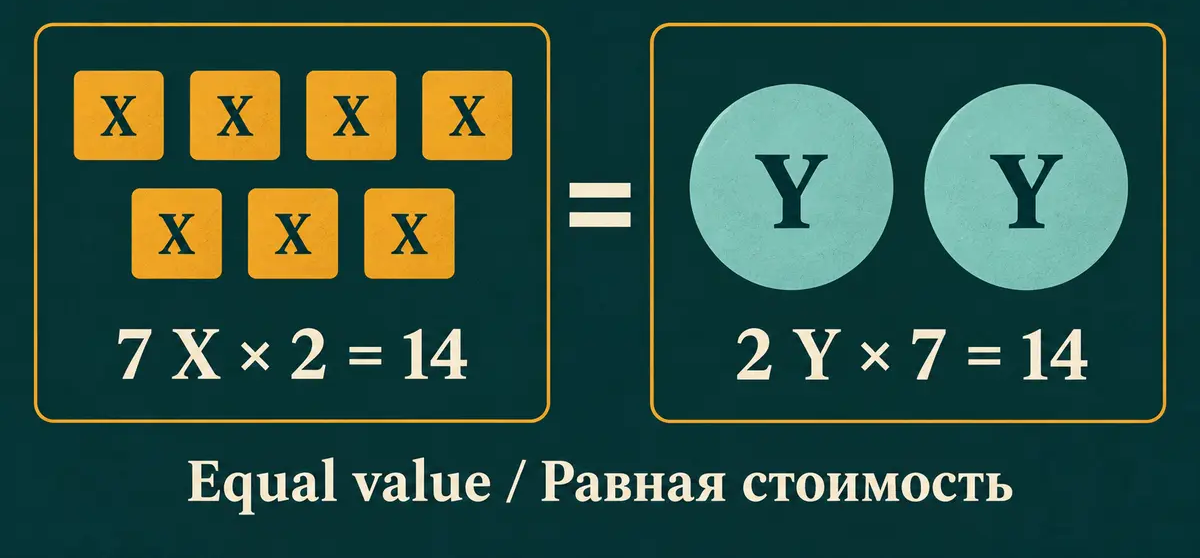
A business can agree with another business about what two products are worth and still find that there is nothing useful to exchange. The obstacle need not be an argument over prices. It can be a mismatch between whole units available, whole units wanted and the particular combinations that balance. This distinction matters whenever a reported exchange is described mainly through the goods on either side. Naming those goods does not reveal whether the arrangement was easy to assemble, attractive to both parties or repeatable.
Reuters reported on September 15, 2025 on barter involving Russia. It could not establish overall volume or value, or the quantities and valuation mechanism of a reported wheat-for-cars exchange. Customs described the number of barter transactions as insignificant relative to overall foreign-trade contract volumes. That comparison does not establish a share by monetary value.
Those limits leave a useful analytical question, rather than an invitation to reconstruct an undisclosed transaction. What conditions must hold before equal stated values become a feasible bilateral exchange? The fictional example below isolates reciprocal demand and indivisible quantities. It does not describe any reported contract, offer a way around restrictions or evaluate the legality of a transaction.
One agreed valuation, several separate tests
Suppose two managers write the same values against the same products. That agreement answers a measurement question: how will the quantities be compared? It does not answer a production question: can the goods be divided into the quantities implied? It also leaves a demand question: does each manager actually want the resulting package? A balanced calculation can pass the first test and fail either of the others.
The distinction is easiest to see when the products come in whole units. An accounting calculation may generate a fraction of a unit, while the assumed exchange permits no fractions. Rounding is not an innocent presentational choice in that setting. Rounding changes what someone gives or receives. A calculation that was balanced before rounding may no longer be balanced afterwards, even though the printed totals look close.
Usable demand imposes another boundary. A party may have room in its budget for a package but no use for all of it. The extra items do not become useful simply because their stated value matches the goods surrendered. Whether they could be sold elsewhere is a separate question with separate evidence requirements. The model deliberately does not assume that an unwanted item can be effortlessly converted into something wanted.
A small exchange with only one positive solution
Consider two fictional businesses, A and B, and two neutral products, X and Y. A can offer at most ten whole units of X. B can offer at most three whole units of Y. Both agree, solely for this exercise, to an accounting value of two units per X and seven units per Y. These numbers are not observed prices, monetary forecasts or estimates of production costs.
Assume that only whole products may be exchanged. No balancing payment, fractional product or additional item is permitted inside this deliberately narrow example. If x represents the number of X units transferred and y the number of Y units transferred, equal stated value requires 2x = 7y. The supply boundaries are x no greater than ten and y no greater than three; both quantities must be nonnegative integers.
Why seven for two is not an arbitrary choice
One Y has a stipulated value of seven, requiring three and a half X to balance. That is not allowed. Two Y have a value of fourteen, matched by seven X. Three Y have a value of twenty-one, requiring ten and a half X. That fails both the whole-unit rule and A's supply boundary. Consequently, seven X for two Y is the only positive balanced package under the stated assumptions.
After that package, three X and one Y are outside the exchange. Calling those quantities a loss would add information the example does not contain. They may have other uses, or none; no outside market has been specified. The calculation establishes only that the entire available supply cannot be included in this particular balanced bilateral package. It says nothing about either business's total stock, sales performance or eventual earnings.
Demand can eliminate the mathematical solution
Now add a simple condition: B can use no more than six X. The seven-for-two package still balances in the common accounting units. The products still exist, and nobody has changed the agreed values. Yet the only positive mathematical solution requires B to accept more X than its stipulated usable demand. If that demand boundary is binding, there is no acceptable positive exchange in the model.
This failure is different from a shortage. A has enough X to supply the package, and B has enough Y. It is also different from disagreement over the exchange ratio. Both parties continue to accept the same values. The limiting factor is the intersection of conditions: whole-unit equality, supply and reciprocal usefulness. Satisfying each condition somewhere in isolation does not mean one package satisfies all of them together.
If B can instead use at least seven X, and A is willing to use two Y, the package passes those particular tests. That change does not prove that the parties would sign an agreement. Their opportunity costs, preferences and other requirements remain unspecified. It establishes a narrower result: reciprocal usable demand no longer rules out the one balanced package. Feasibility is a necessary checkpoint, not a synonym for commercial success.
The demand boundary also shows why counting potential counterparties is not enough. A list of businesses holding Y would not establish how many of them wanted seven X. A list of businesses interested in X would not establish that they could provide two Y. The relevant observation concerns both conditions in the same participant. Separate totals can therefore exaggerate the apparent number of useful matches without any error in either total considered alone.
That is a question of compatibility, not a forecast of trading activity. In this example there are only two participants, and the model makes no statement about a wider network. Adding hypothetical participants without specifying their supplies and requirements would create an impression of extra possibilities rather than demonstrate them. A careful analysis would need to define those new conditions explicitly before counting another feasible exchange. More names on a list do not, by themselves, solve the original matching problem.
Missing evidence of demand is also different from evidence that demand is absent. In the first case, the analyst does not yet know whether the package is useful. In the second, a known condition rules it out. Replacing an unknown with zero is no more justified than assuming that every offered product will be welcome.

Almost equal totals are not almost the same problem
The full supplies have stated values of twenty for A and twenty-one for B. A quick comparison might suggest that the mismatch is minor. But closeness in aggregate value does not tell us whether a permitted package exists at the desired scale. The difference between twenty and twenty-one is small numerically; the difference between a usable whole product and an unavailable fraction can be decisive operationally.
Imagine, as a separate variation, that A's intended use requires exactly three Y together. Receiving two would not meet that particular requirement. The balanced seven-for-two package therefore cannot satisfy A, even if B welcomes seven X. Three Y would require ten and a half X at the stipulated ratio. No permissible quantity supplies that result. This is a change in the demand condition, not evidence that the accounting calculation was wrong.
It would be misleading to smooth the example into a percentage discount and announce that the problem had disappeared. A new ratio would define a different model and require a new agreement. Likewise, allowing fractions or another balancing item would change the rules being tested. The point of keeping the boundaries fixed is not to claim that all exchanges have these restrictions. It is to identify exactly why this particular set has no solution.
A common number does not measure every kind of value
Accounting value provides a common language for comparing the two sides. Use value concerns what the recipient can actually do with a product. Opportunity cost concerns what is given up by choosing this exchange rather than another available action. These concepts can point in different directions without contradiction. An item can carry a positive stated value and still be an unattractive receipt for a particular business.
Our model does not specify reservation values: the least attractive terms each party would still accept. It cannot therefore measure gains from trade. Seven X and two Y both being assigned fourteen proves numerical equality under the chosen convention. It does not prove that either party gains fourteen, that their gains are equal or that an exchange creates fourteen of profit. Such claims would confuse a valuation label with an economic outcome.
Nor does willingness to use a product establish its contribution to earnings. A usable item might replace an alternative purchase, support an existing activity or remain unused for reasons not included here. Measuring the benefit would require another model and further evidence. Keeping that question open makes the small calculation more reliable: it can illuminate one constraint without pretending to provide a complete business valuation.
Why a widely accepted medium changes the matching problem
The Bank of England explains that money's broad acceptance makes buying and selling easier than relying on a particular reciprocal exchange of goods. That general explanation is background, not evidence about the contracts in the news.
Conceptually, a broadly accepted medium separates two questions that the fictional bilateral model joins together. A seller need not obtain the desired product from the same counterparty that wants the seller's output. The recipient accepts something useful for other purchases instead. This does not mean every sale becomes possible, every product divisible or every payment accessible. It means the requirement for that specific reciprocal product match is no longer the same.
The distinction should not become a claim that one settlement form is universally superior in every circumstance. The present exercise compares a restricted matching problem with the conceptual role of a common medium. It does not include fees, credit, regulation, delivery or contractual enforcement. These omissions prevent a ranking of actual arrangements. They also prevent a reader from treating an abstract explanation as a recommendation for conducting a particular transaction.
What a reader would need to know about a real agreement
A short report naming two exchanged products cannot supply the entire feasible set. Understanding a specific agreement would require its own evidence about quantities, permitted divisions, valuation conventions and demand. Even a complete list of those items would not automatically establish profitability. The responsible sequence is to identify what the disclosed information supports before asking it to carry a broader conclusion.
- Were the stated quantities the whole contract or one part of a larger arrangement?
- Did the parties use a fixed comparison ratio, and what exactly did that ratio measure?
- Were products indivisible under the relevant terms, or is indivisibility only an analyst's assumption?
- Did each recipient want the entire package for its specified purpose?
- What evidence, beyond balanced values, supports any claim about economic benefit?
These are questions for evaluating evidence, not steps for arranging a trade. An unanswered question should remain unanswered in the analysis. Replacing missing quantities with plausible-looking numbers can make an article sound precise while making its conclusion less defensible. A transparent fictional example is useful precisely because its assumptions are visible and its arithmetic can be checked without pretending that confidential terms have been discovered.
Keep the result as narrow as the model
The central result has two layers. Under the stipulated whole-unit values and supply limits, only seven X for two Y balances positively. Under the additional limit that B can use at most six X, even that solution disappears. Neither layer requires a forecast about aggregate trade or a judgement about the motives of businesses whose contracts are unavailable. Both depend on stated assumptions that a reader can inspect.
Changing an assumption can change the result, but it should be identified as a change rather than smuggled into the conclusion. A different supply boundary, a different permitted unit or a different demand requirement creates a different feasible set. This sensitivity is not a weakness of the example. It is the reason a headline comparison of two products cannot establish the economics of their exchange on its own.
Equal stated values are therefore a starting point for a question, not the final answer. The missing step is a package that both sides can actually supply and want, under the same rules. Recognising that step helps distinguish a balanced expression on paper from a feasible bargain, while leaving the undisclosed facts of real transactions where they belong: outside the calculation.