Mercedes-Benz reported on 7 October 2026 that third-quarter car sales fell 8 percent to 407,200. Deliveries in China declined 31 percent to 86,800, while Europe grew 5 percent and the United States 6 percent. Top-End sales dropped 21 percent to 53,900 amid market weakness and model changes. Battery-electric sales across cars and vans rose 52 percent to 78,100, according to Reuters.
Regional demand and the preceding sales cycle
The American retail report issued the same day used a different reporting basis. Mercedes-Benz USA recorded 76,200 passenger cars sold to customers, an increase of 4 percent, together with 9,600 vans. Combined retail sales reached 85,800, up 3 percent. Its Core segment grew 12 percent during the quarter, while E-Class and S-Class retail sales increased 39 and 47 percent respectively. The company associated those gains with demand for its sport utility vehicles and higher-priced models in the local dealer network.
The longer sales background begins with the 2024 annual report published on 10 January 2025. Mercedes-Benz then recorded 2,389,000 cars and vans, including 1,983,400 passenger cars. The Core range reached 1,167,100 vehicles, an increase of 6 percent, supported by the E-Class and GLC. Battery-electric passenger-car sales fell 23 percent to 185,100, whereas plug-in hybrids grew 13 percent. The company attributed the electric decline to slower adoption in its principal markets, while its fourth quarter showed stronger demand for higher-priced vehicles.
The next annual sales announcement, dated 12 January 2026, reported 2,160,000 cars and vans for 2025. The final quarter contributed 558,400 vehicles, including 459,400 passenger cars. Mercedes-AMG deliveries reached 145,000 for the year, up 7 percent, and the G-Class reached a record 49,700, up 23 percent. The company said tariffs and competition affected the overall business. It separately reported 303,200 American customer deliveries, up 1 percent, while group sales there reflected its decisions on inventory management.
Financial results describe another part of the transition
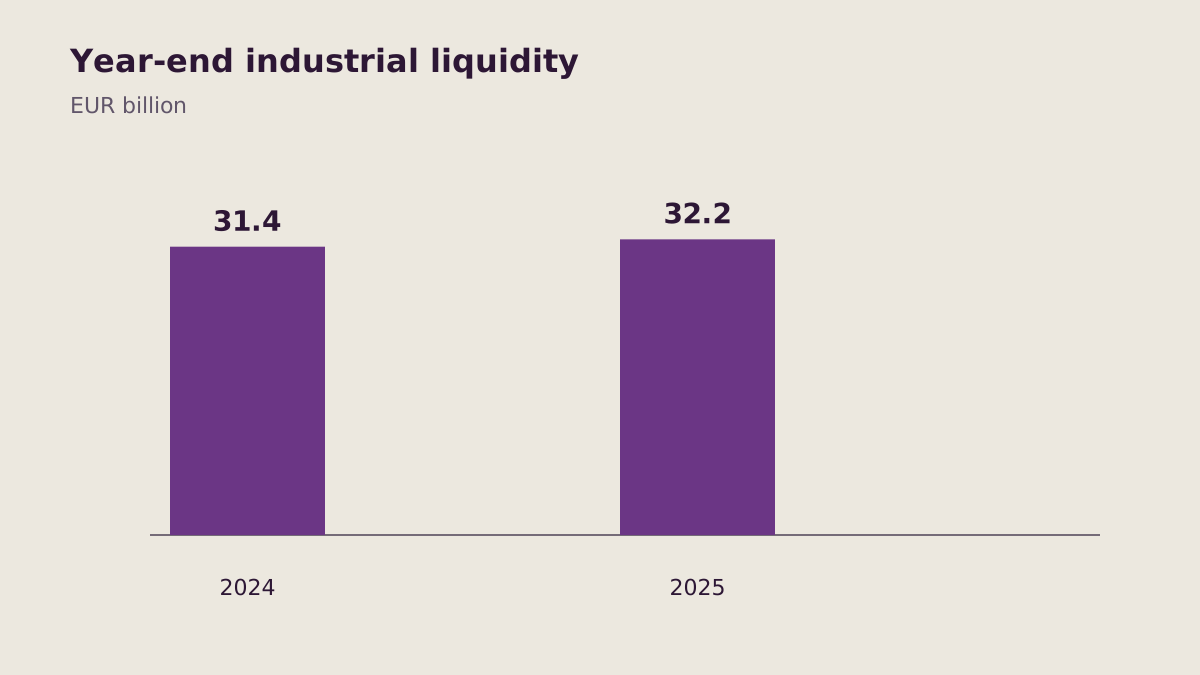
Financial results published on 12 February 2026 placed 2025 revenue at €132.2 billion, against €145.6 billion a year earlier. Adjusted group earnings before interest and taxes were €8.2 billion, down from €13.7 billion. Industrial free cash flow reached €5.4 billion, compared with €9.2 billion. Year-end industrial net liquidity increased from €31.4 billion to €32.2 billion. These annual financial measures accompanied the company's continuing product launch programme.
A more detailed view of the earlier transition appeared in the second-quarter results released on 30 July 2025. Industrial free cash flow reached €1.9 billion for the quarter and €4.2 billion for the first half. Adjusted group earnings before interest and taxes were €2 billion. Passenger-car sales totalled 453,700, down 9 percent, with an adjusted operating margin of 5.1 percent. The company reported growth of 34 percent in plug-in hybrids and 32 percent in electric vans during the same quarter.
The comparable financial announcement from 29 October 2025 recorded 441,453 passenger cars sold during that year's third quarter. The car division's adjusted operating margin was 4.8 percent, while Top-End vehicles represented 15.4 percent of its sales. Group adjusted earnings before interest and taxes reached €2.099 billion and industrial free cash flow €1.4 billion. The company associated the results with lower volumes, tariffs and exchange rates. Battery-electric car sales increased 22 percent against the preceding quarter as the electric CLA entered European delivery.
The second-quarter 2026 financial release, published on 28 July, reported revenue of €32.1 billion, compared with €33.2 billion a year earlier. Reported group earnings before interest and taxes rose from €1.3 billion to €1.5 billion, while the adjusted measure reached €2.3 billion. First-half industrial free cash flow was €3 billion, including an outflow of approximately €1.1 billion for severance payments. Industrial net liquidity stood at €30.4 billion after dividends and share repurchases. Management described efficiency measures and new-model deliveries as its continuing priorities.
The production programme behind the electric range
A production strategy announced on 8 September 2025 set out the manufacturing framework for more than 40 vehicles over three years. Mercedes-Benz reported investment exceeding €2 billion in European assembly sites. Its programme combined digital simulations, connected production data and lines accommodating combustion, hybrid and battery-electric powertrains. The company targeted a 10 percent reduction in production costs between 2024 and 2027, alongside an increase in the share of production in lower-cost countries from 15 to 30 percent. Both figures were programme objectives.
The new CLA's production at Rastatt was described on 4 June 2025. Mercedes-Benz had remodelled an existing assembly hall after simulating its conversion digitally. The site could manufacture combustion, hybrid and fully electric vehicles on the same line. Its new software architecture transferred vehicle software through a central cloud server, replacing configuration through separate hardware modules. The company also reported that artificial intelligence used to monitor processes in the top-coat booths had reduced their energy consumption by 20 percent and shortened the process ramp-up.
The electric GLC's manufacturing ramp-up was described on 6 May 2026 at Bremen in Germany. Hall 9 produced it alongside combustion and hybrid GLC versions and the EQE. That hall had operated on three shifts for more than a decade. The plant had integrated the EQC into series production in 2019 and was now building its third fully electric series model. Batteries came from Kamenz, while Hamburg supplied electric axles and other powertrain components within the manufacturer's connected production network.
Another expansion was announced at Kecskemét in Hungary on 13 July 2026. The site's footprint had increased from 200 to 440 hectares, with investment of around €1 billion under the 2022–2026 business plan. New body and assembly halls accompanied a paint shop, press facilities and battery assembly. The announcement marked the start of electric C-Class production. An existing hall retained mixed-powertrain manufacturing, while the new hall focused on battery-electric models. The company linked this arrangement to adjusting production volumes to market demand.
In Romania, the component stage had begun earlier. On 13 October 2025, the wholly owned Star Assembly subsidiary in Sebeș started assembling electric drive units for the new GLC. A facility of more than 30,000 square metres combined assembly and logistics. It became the second drive-unit supply location after Untertürkheim. The announced programme would supply Bremen for the GLC and, during the following year, Kecskemét for the electric C-Class. The project received approval for government support and expanded the local site's component portfolio.
At Berlin-Marienfelde, Mercedes-Benz announced large-scale axial-flux motor production on 9 June 2026 for its new high-performance four-door model. The company described 98 production steps, including 65 new to its own operations and 35 it characterized as new worldwide. Three halls and seven lines occupied approximately 30,000 square metres. More than 30 patent applications accompanied the manufacturing development. During final assembly, the stator's position between two rotor discs had to remain within a tolerance of less than one tenth of a millimetre.
Local production serves different regional portfolios
At Auto China on 24 April 2026, Mercedes-Benz described China as both a sales market and a development centre. Its research network included Shanghai and Beijing, with work on vehicle architectures, operating software, connected services and automated driving. The Beijing manufacturing joint venture had produced its six-millionth vehicle. Its local portfolio included 14 passenger-car models, with expansion to 20 planned by 2027. The company said product development reflected the expectations of more than seven million Mercedes-Benz customers in the country.
The American manufacturing programme was presented on 31 March 2026 through the GLE and GLS premieres at Tuscaloosa. The event coincided with the site's five-millionth assembled vehicle. Its range already included combustion and electric sport utility vehicles, and management described future localization of the GLC as an additional part of the American footprint. The company identified operations across 13 states. It placed the new SUV programme within a history of American activity that included local assembly of an earlier Mercedes vehicle in 1905.
The van division's production change appeared at Vitoria in Spain on 12 June 2026, with the start of VLE series manufacturing. Conversion had proceeded while the V-Class, Vito and eVito continued to be produced. New body, paint and assembly facilities were supported by updated logistics and information systems. Approximately 5,000 direct employees had prepared through more than 160 training programmes. The company expected a second production stage in Fuzhou, serving the Chinese market, at the end of the year.
Products combine charging, software and new materials
Recognition of the electric CLA preceded those production announcements. Mercedes-Benz reported its European Car of the Year award on 9 January 2026, following voting by 59 automotive journalists from 23 countries. Its 320 points placed it 100 ahead of the runner-up. European sales had begun in mid-2025. The CLA 250+ specification included a range of up to 792 kilometres under the WLTP procedure and an 800-volt system with up to 325 kilometres of additional range from a ten-minute charging session under specified conditions.
The electric GLC's American technical presentation on 1 April 2026 described a different combination of comfort and software features. Its optional continuous display measured 39.1 inches, with the vehicle operating system coordinating infotainment, navigation and assistance functions. A multi-source heat pump could use heat from the drive unit, battery and surrounding air. Optional air suspension came with rear-wheel steering through up to 4.5 degrees. The announced assistance configuration used up to ten external cameras, five radar units and twelve ultrasonic sensors.
A separate environmental assessment, announced on 23 March 2026, compared the electric GLC with the combustion-engine model. Mercedes-Benz said independent auditors had verified the lifecycle assessment, which showed a reduction of approximately two thirds in carbon emissions across the vehicle's life. Manufacturing emissions were reduced by 23 percent through measures agreed with suppliers. These included changes to battery cells, aluminium, steel and thermoplastics. The vehicle used 134 pounds of secondary-material thermoplastics, of which approximately 35 percent originated from post-consumer recycled material.
Factory changes extend beyond vehicle assembly
At Sindelfingen, a paint-shop investment announced on 3 April 2025 addressed production infrastructure. The planned building covered approximately 170,000 square metres on a footprint of 60,000 square metres, using the location of a former assembly hall. Mercedes-Benz described investment in the high hundreds of millions of euros. Its targets included halving energy consumption, reducing water use by more than half and cutting emissions by around 60 percent. Heat pumps, energy-management software and 20,000 square metres of rooftop solar equipment formed part of the design.
The Berlin Digital Factory Campus programme announced on 18 March 2025 concerned production methods rather than a new sales model. Mercedes-Benz was testing Apptronik's Apollo humanoid robots for repetitive internal logistics, component transport and initial quality checks. Employees trained the robots using remote operation and augmented reality. The company planned an investment in Apptronik in the low tens of millions of euros. Its campus also tested software and production processes before transfer to other factories, including tools supporting the CLA's new operating architecture.
Battery materials had received a separate industrial investment in October 2024. Mercedes-Benz opened its Kuppenheim recycling plant on 21 October, combining mechanical processing with chemical recovery. Its stated annual capacity was 2,500 tonnes, with recovered material intended to support more than 50,000 new battery modules. Technology partner Primobius joined industrial equipment expertise with process technology. The plant separated metals, plastics and other materials before extracting cobalt, nickel and lithium. The low-temperature chemical stage operated at up to 80 degrees Celsius.
The earlier battery research stage was described when the eCampus opened at Stuttgart-Untertürkheim on 8 July 2024. Its approximately 10,000-square-metre Industrial Cell Lab produced and tested cells with different chemistries. Research covered silicon-based anodes, cobalt-free cathodes and solid-state systems. The company identified energy density of up to 900 watt-hours per litre as a development objective. Knowledge from cell design and industrial-scale testing would support partner production, while management associated the programme with a future reduction in battery costs exceeding 30 percent.
Charging networks accompany the vehicle programme
The manufacturer's charging overview put its integrated public network above three million points as of June 2026. That total combined alternating-current and direct-current chargers operated by participating charging companies. Customers could access them through the company's public charging service. The number described the size of the integrated service network, whose sites included equipment from other operators. The overview also presented an experimental charging vehicle used to study interactions between electric cars, charging infrastructure and the energy system under real-world conditions.
A separate North American infrastructure programme was announced on 9 February 2024 when the seven-manufacturer IONNA venture began operations. Its network would accept vehicles using either of the two principal North American fast-charging connector systems. The venture planned at least 30,000 high-power points, initially in the United States and subsequently in Canada. Planned sites combined charging with nearby facilities such as food, shops and restrooms. Vehicle and application integration would support route planning, reservations and payment, with renewable electricity among the announced objectives.
The Chinese charging venture with BMW was set out in a 2023 announcement. It targeted at least 1,000 high-power stations containing approximately 7,000 charging points by the end of 2026. The companies expected the first openings in leading electric-vehicle regions during 2024, followed by wider expansion. Access was intended for the public, while the participating brands' customers would receive features such as automatic charging authorization and online reservation. At announcement, the arrangement remained subject to regulatory approval and described a planned network.
Suppliers and resource programmes support the new portfolio
A materials agreement with Hydro was expanded on 27 July 2026. Mercedes-Benz planned to introduce aluminium containing at least 75 percent post-consumer recycled material into its next generation of large electric vehicles, compared with around 25 percent in the material then supplied. The programme complemented primary aluminium produced using renewable electricity. The companies described regional recovery and reuse of aluminium from vehicles, buildings and infrastructure. Their published approach combined recycled material with lower-carbon primary production while retaining the automaker's quality and performance specifications.
The Tomorrow XX programme, unveiled on 11 December 2025, placed those supply decisions within component development. Over approximately two years, Mercedes-Benz identified more than 40 material and component projects at different stages, ranging from initial concepts to series applications. One research example replaced glued headlight assemblies with parts joined by screws, allowing individual components to be separated. The programme also examined material combinations that could be dismantled and sorted more easily, with suppliers, research institutions and recycling businesses participating in the development work.
Production energy received another programme at the Papenburg test track. An announcement on 18 September 2025 marked construction of 20 wind turbines with a combined nominal rating of 140 megawatts. UKA would own the wind farm and supply Mercedes-Benz through a 25-year purchase agreement. Nordex supplied the turbines, whose towers had a hub height of 164 metres. The approximately 800-hectare test location had been part of the company's research operations since 1998. The announced project expanded its future renewable electricity portfolio.
The sustainability update published on 28 March 2025 described operational measures already reported for 2024. Half of factory energy requirements came from renewable sources, and waste sent for disposal fell 38 percent from the preceding year. European sites reduced disposal waste to 250 grams per vehicle. Logistics emissions stood at one tonne per vehicle. The company also reported energy savings exceeding 300 gigawatt-hours for a second consecutive year and targeted a further 25 percent reduction in production costs associated with energy, water and waste by 2030.
Three connected parts of the rollout
- Dated regional sales reports describe deliveries and customer purchases.
- Production announcements identify the factories and component networks serving the new range.
- Technical and infrastructure publications describe the equipment, charging access and resource programmes accompanying those vehicles.