

Two businesses can agree that one shared standard would be preferable and still choose another. That need not mean either has misread the technology or refused an obvious improvement. A choice made alone is different from a choice made together. When the usefulness of a configuration depends on another firm's matching decision, the preferred common outcome may not be the outcome either party can safely select independently.
Reuters reported on 18 March 2025 that Nio and CATL had announced a battery-swapping partnership in China, including plans to introduce Choco-Swap standards to newly developed Firefly models. This was an announced scope, not evidence that every existing vehicle had become interchangeable.
Nio's 17 March company statement also described parallel operation of the networks and cooperation on standards. Neither source supplies the preferences or decision rules in the fictional example below. The example explains a coordination problem, not the companies' negotiations.
Remove migration costs from the question
Discussions of standards often begin with the expense of leaving an established system. Equipment may need replacing, staff may need training, or software may need rewriting. Those can be important commercial issues, but they are not necessary for the particular difficulty examined here. Set them aside. Imagine two anonymous manufacturers preparing a new interface for a new product. Neither is migrating a legacy installation, and both can implement either of two feasible configurations.
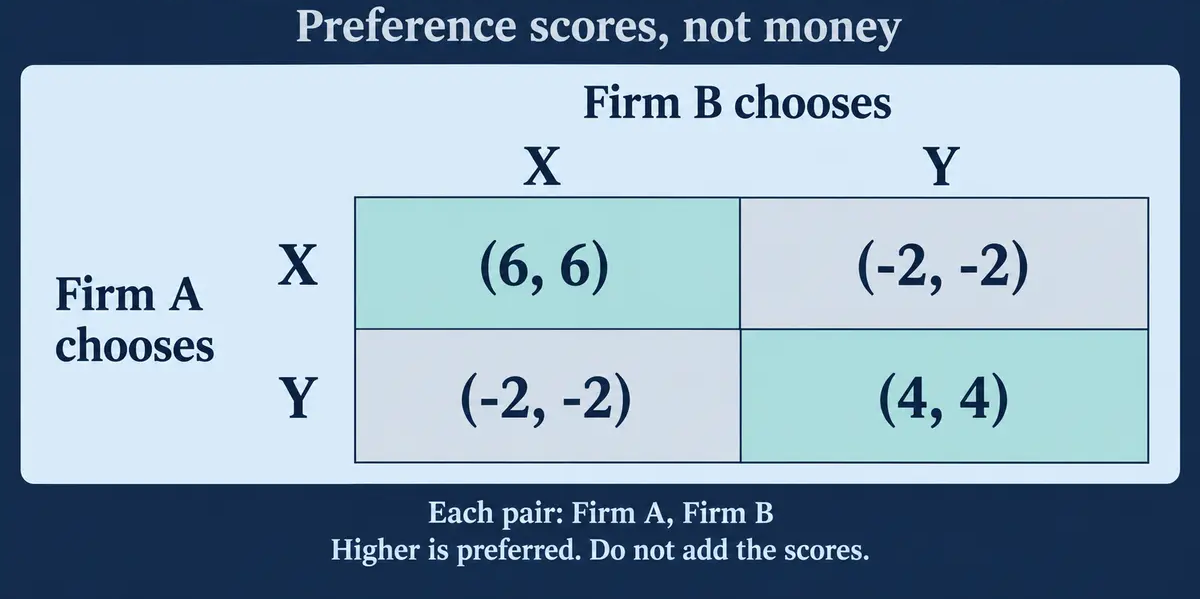
Call the configurations X and Y. Each manufacturer must select one. The choices are made independently, without either seeing the other's final selection first. For this simplified exercise, the products work together as intended when both manufacturers choose the same configuration. A mismatch is less attractive to both. There are no additional participants, no adapter and no later repair round in the model. These are boundaries of the exercise, not statements about battery technology.
The removal of migration costs is deliberate. If an inferior shared configuration remains stable even under these simplified conditions, the explanation cannot be the expense of converting old equipment. It must lie elsewhere. Here it lies in the relationship between the two decisions: the attractiveness of my choice depends on yours. Giving me the technical ability to implement X does not give me control over which configuration you implement.
Four outcomes, not two isolated products
A comparison of X with Y on a product sheet would miss half the problem. There are four possible combinations: both choose X, both choose Y, the first chooses X while the second chooses Y, or the reverse mismatch. Each manufacturer evaluates the resulting combination, not merely the letter printed on its own specification. The other firm's selection is part of the outcome it will experience.
Use three invented scores to make the ranking visible. If both choose X, each receives a score of six. If both choose Y, each receives four. Either mismatch gives each a score of minus two. These are preference labels for the example, not currency, profit, measured performance or a battery-efficiency index. Six ranks above four, and four above minus two. The distance between the numbers is not being interpreted as an economic gain.
- X with X: the first manufacturer's score is six and the second manufacturer's score is six.
- X with Y: both scores are minus two.
- Y with X: both scores are minus two.
- Y with Y: both scores are four.
Both firms therefore prefer the same joint outcome: X with X. Their interests are aligned on that ranking. There is no dispute about dividing a financial surplus and no assumption that one party secretly prefers the other standard. Even with that agreement, however, neither firm's choice of X guarantees the preferred combination. The distinction between liking an outcome and being able to bring it about is the central issue.
The ranking would work the same way if we replaced the scores with the words preferred, acceptable and undesirable. Each stability comparison asks which of two outcomes a particular participant ranks higher. It never asks how many times one outcome is better than another. That makes the numbers a reading aid rather than a valuation system. A different set of numbers preserving each participant's order would leave the following individual-choice tests unchanged. It would not justify calculating compensation, a percentage improvement or a common total from the labels.
Test one decision at a time
Start with X paired with X. Suppose the first manufacturer alone changes to Y while the second stays with X. The first manufacturer's score falls from six to minus two. It has no reason, within the stated ranking, to make that unilateral change. The same reasoning applies to the second manufacturer. With the other firm's choice held fixed, neither wants to leave X. The matched outcome is stable against an individual deviation.
Now perform the same test at Y paired with Y. If the first manufacturer alone switches to X, the result is a mismatch. Its score falls from four to minus two. The fact that both would prefer X with X does not alter this particular comparison: the second manufacturer has not changed. Again, the reasoning is symmetric. Neither wants to switch by itself while the other remains at Y.
That gives the exercise two stable outcomes in pure choices: X with X and Y with Y. In the language of game theory, these are pure-strategy equilibria. The statement concerns definite choices of a configuration, not every possible equilibrium concept or a model of randomised behaviour. We do not need probabilities to see the problem. The individually unattractive move out of Y is already visible in the four combinations.
Why a mismatch does not pass the same test
Suppose the first firm chooses X and the second chooses Y. The first could improve its position by matching Y, moving from minus two to four. The second could improve its position by matching X, moving from minus two to six. Thus this mismatched pair is not stable against individual changes. That does not tell us which change will actually happen, or whether simultaneous revisions would cross again. A stability test is not a prediction of the adjustment path.
A preferred outcome is not a dominant choice
It is tempting to turn the ranking into a simple instruction: X is better, so choose X. But X is better for the first manufacturer when the second also selects X. If the second selects Y, choosing Y is better for the first. The appropriate response changes with the other firm's choice. X therefore does not dominate Y in this example, despite both manufacturers preferring the fully coordinated X outcome.
The same distinction appears in an ordinary planning conversation. Asked which common configuration they would like to reach, both teams can answer X. Asked which configuration they should implement if the other team is definitely implementing Y, both can answer Y. Those answers are consistent. The first question compares two jointly matched outcomes. The second compares one matched outcome with one mismatch while holding the other party's action fixed.
This is why a statement of shared ambition may leave the decision unfinished. Agreement about the destination does not automatically establish the other participant's actual selection. A manager may have complete confidence in the technical merits of the preferred shared arrangement and still need a reliable basis for believing the counterpart will implement its matching part. Additional engineering persuasion does not necessarily answer that coordination question.
Stable does not mean best
Consider Y with Y as an existing agreed configuration for the two new products. Within the model, both would rank a coordinated move to X above staying with Y. Yet either would rank a solitary move to X below staying. There is no contradiction between those comparisons. The first changes two decisions together; the second changes only one. The distinction explains how an outcome can be stable without being the outcome both parties most prefer.
Calling Y inferior here has a carefully limited meaning. It is inferior in the invented common ranking of the two coordinated outcomes. It does not mean that a particular real-world technical standard is inferior, unsafe or obsolete. Nor does stability mean that Y will persist forever. A static comparison says whether an individual deviation is attractive at a given pair of choices. It does not supply a calendar, a theory of negotiation or an inevitable historical trajectory.
It would also be wrong to add the two scores and describe the difference as a social benefit. Each score records a participant's ranking; it is not a transferable amount or a measure of consumer welfare. The useful finding does not require aggregation. We can say that each participant prefers X with X to Y with Y, and that neither prefers departing from Y alone. Those two statements are sufficient.
What a coordination conversation must settle
In the fictional situation, asking each team whether it likes X is not the same as settling which matched configuration will be implemented. A useful conversation would make that difference explicit. One question concerns preference. Another concerns selection. A third concerns whether both parties are working from the same description of the selected interface. These questions are related, but an affirmative answer to the first cannot stand in for answers to the other two.
For example, two project documents might both use the letter X while referring to different revisions. The model treats X as a single unambiguous choice, so such a discrepancy would fall outside it. In practical analysis, identifying the discrepancy would come before applying the model. Otherwise an apparent agreement could be described as coordination even though the parties had not selected the same thing. A shared label is useful only when it refers to a shared object.
Timing creates a similar boundary. The model presents a single selection, not a sequence of releases. Real teams may have different implementation dates or product generations. That does not disprove the coordination mechanism, but it means a single pair of letters cannot describe the whole programme. Analysts should identify the particular decisions being compared instead of treating a broad partnership announcement as one simultaneous industry-wide switch.
None of this is advice to coordinate selling prices, divide customers or restrict competing suppliers. Nor is it a claim that a particular form of agreement is enforceable. The narrow issue is how two matching technical choices relate. Commercial governance, competition rules and contract obligations require their own evidence and analysis. They should not be smuggled into a simple preference model as if the four scores had settled them.
Change the structure and the answer can change
An adapter is one useful thought experiment. If it made unlike configurations work together, the mismatched outcomes might no longer receive the lowest ranking. We would then need a different table. It would be careless to preserve the original conclusion while quietly removing the condition that created it. The model's result depends on matching being attractive relative to a unilateral mismatch, not on the physical presence of any particular component.
Likewise, the two manufacturers might disagree about which matched outcome they prefer. One could favour X while the other favours Y. That would introduce a conflict absent from the current exercise. A discussion about resolving that conflict would be different from explaining why two parties with the same ranking can still face a coordination problem. Keeping these cases separate prevents every standards dispute from being reduced to one convenient story.
More participants would also change the relevant question. A firm's choice might depend on which partners adopt a configuration, not simply how many do. Several configurations could coexist for different applications. The two-party example cannot determine an industry's eventual structure. Its value is smaller and more precise: it reveals a gap between a jointly preferred matched outcome and an individually attractive deviation from another matched outcome.
Read the standard and the selection separately
The business question raised by a compatibility initiative is not exhausted by asking whether one technology is better in isolation. It also concerns which combination of choices participants can actually make together. That is why a technical comparison and a coordination analysis can reach different stopping points. The first may establish a preference; the second asks whether that preference supplies an incentive for an independent move under the choices of others.
For readers evaluating a proposal, the distinction offers a disciplined way to interpret evidence. A statement that participants prefer a common configuration supports a conclusion about their stated preference. A specification supports a conclusion about what is defined. A demonstrated matching implementation supports a different conclusion about what works together. These are not successive guarantees of commercial success, but different kinds of information answering different questions.
In the four-outcome exercise, no one needs to be irrational and no legacy conversion bill is required for the less-preferred matched arrangement to remain stable. Both firms can understand the ranking perfectly. What neither can do through an isolated choice is select the other's action. The important achievement of coordination is therefore not merely recognising a desirable common standard. It is resolving the relationship between separate decisions that must match.