
A lower price for one input does not necessarily make a finished mixture cheaper. If the new input contributes less of a required characteristic, the recipe may need more of an expensive balancing component. The purchasing discount is real, but so is the extra requirement. Comparing the two quotations without recalculating a compliant mixture can therefore point to the wrong economic conclusion.
On 28 January 2026, Reuters reported that Nornickel in Russia attributed changes in metal output to the composition of the ores being processed. The report provides a starting point for considering input characteristics, not the data for a company-specific blending calculation.
The following example is independent of that business. Its prices, quantities and quality index are invented. It does not describe actual ores, metallurgical recovery or a mine plan. A deliberately simple mixture makes one relationship visible: the cost of satisfying an output requirement depends on both component prices and the quantities needed to meet that requirement.
Define the product before comparing its ingredients
Suppose a business must supply 100 units of a blend. There are two available components, A and B, measured in the same physical unit. The buyer requires a quality index of at least five. In this exercise, the index combines as a quantity-weighted average. Mixing causes no loss, and the components have no interaction beyond that stated averaging rule. These are model assumptions, not general properties of industrial materials.
Component A costs four monetary units per physical unit and has a quality index of two. Component B costs ten and has an index of eight. There are no transport, processing, financing or tax differences. Both materials are available in whatever fractional quantities the initial calculation requires. Keeping these conditions explicit prevents a simple price comparison from quietly becoming an unsupported estimate of a real production process.
The commercial task is to find the least expensive blend that meets the stated minimum. It is not to buy the cheapest ingredient, maximise the quality index or preserve an existing recipe. Those are different objectives. A suitable calculation must hold the required finished quantity and minimum quality constant while allowing the component proportions to change.
The cheaper component needs a balancing partner
A blend made entirely from A would cost only four per unit, but its quality index would be two. It fails the requirement. A blend made entirely from B would have an index of eight and cost ten. It passes, but includes more of the expensive component than necessary under the model. Between those extremes lies a lower-cost compliant combination.
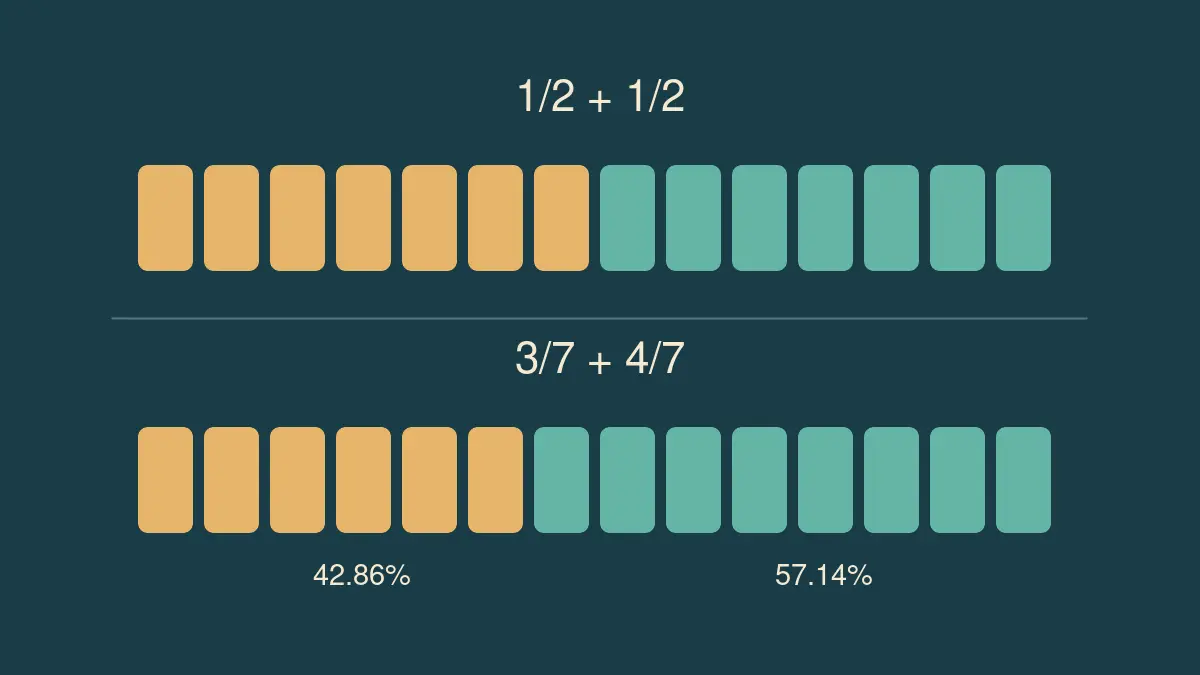
Use 50 units of each component. The quality contribution is 50 times two plus 50 times eight, giving 500 across 100 units. The average is five. The cost is 50 times four plus 50 times ten, giving 700 in total, or seven per unit of finished mixture. The blend meets the minimum exactly.
Why is that the least-cost combination? Each replacement of A with an equal quantity of B increases both quality and cost. Any mixture with less than half B falls below the quality requirement. Any mixture with more than half B costs more while supplying quality above the specified minimum. With no other constraint or benefit for additional quality, the boundary combination is cheapest.
Express the requirement as a component share
Let the share of B be b. The share of A is then one minus b. The blend's quality is two plus six times b, and its unit cost is four plus six times b. To reach quality five, b must be at least one half. These short expressions allow the reader to check the recipe rather than accept it as a production rule.
The equality at the minimum is a consequence of this particular setup. It does not mean every industrial specification should always be met without a margin. Here there is no uncertainty in quality, measurement or mixing. Introducing such uncertainty would require an explicit additional assumption. The exact boundary is useful because it isolates the economics of the component substitution.
Now lower the price and change the material
A supplier offers a replacement for A at 3.5 monetary units instead of four. That is a 12.5% price reduction. However, the replacement has a quality index of one rather than two. B is unchanged: it still costs ten and contributes quality eight. The finished quantity remains 100, and the customer's minimum remains five.
If the business keeps the old half-and-half recipe, the unit cost falls to 6.75. This appears to save 0.25 per unit, or 25 across the order. But quality becomes one half of one plus one half of eight, which is 4.5. The cheaper recipe does not meet the requirement. Its cost is therefore not a valid comparison with the original compliant product.
The price saving has not vanished. It has been calculated for the wrong output specification. To compare the offers fairly, the business must first restore the required quality by adjusting the proportions. Only then can it determine whether the replacement reduces the cost of the product it actually needs to supply.
Restoring compliance reverses the apparent saving
With the replacement, quality is one plus seven times the share of B. Reaching five requires B to occupy four sevenths of the mixture, approximately 57.14%. A occupies the remaining three sevenths, approximately 42.86%. The more expensive component now has a larger role because the cheaper component contributes less toward the quality requirement.
The unit cost becomes 3.5 times three sevenths plus ten times four sevenths. That equals 101 divided by 14, or approximately 7.2143. For 100 units, the cost is approximately 721.43, compared with 700 originally. The price of A fell by 12.5%, yet the least-cost compliant blend became approximately 3.06% more expensive.
| Mixture | B share | Quality | Unit cost |
|---|---|---|---|
| Original | 50% | 5 | 7 |
| New A, old recipe | 50% | 4.5 | 6.75 |
| New A, compliant | 57.14% | 5 | 7.2143 |
The displayed percentages and costs are rounded; the calculation uses exact fractions. The conclusion comes from the changed recipe, not from rounding. It would be misleading to describe the new offer as either universally cheap or universally expensive. It is cheaper per unit of A and more expensive per compliant unit of this particular finished blend.

Find the input price that actually breaks even
The replacement's quality remains one, so its compliant share remains three sevenths. Let its price vary while B stays at ten. A price of three makes the finished unit cost three times three sevenths plus ten times four sevenths, which is exactly seven. At that price, the new compliant recipe matches the original compliant recipe's cost.
Below three, the replacement mixture is cheaper in the model. Above three, it is more expensive. The break-even reduction from the original A price of four is therefore 25%, not the 12.5% offered in the example. The relevant comparison is the discount needed to compensate for the changed composition of the entire mixture.
This threshold is not a suggested negotiating target for a real supplier. It depends on the assumed qualities, the unchanged price of B and the customer's minimum. Change any of those inputs and the threshold must be recalculated. A spreadsheet cell labelled acceptable price has meaning only alongside the conditions that produced it.
An available recipe must also be feasible
So far, B has been available without a quantity limit. Now suppose the business can use at most 55 units of B in the 100-unit order. The original blend remains feasible because it needs only 50. The replacement requires approximately 57.14, exceeding the available quantity. A cost comparison alone can no longer establish that the replacement provides an executable option.
At the maximum permitted B share of 55%, the replacement mixture reaches quality 4.85, still below five. No rearrangement of the same two components within that limit solves the requirement. In this version, the obstacle is not that the compliant recipe costs too much; it is that the specified compliant recipe cannot be assembled from the allowed quantities.
The business could investigate different components, a different order size or a legitimately changed specification, but each would define a new problem. None should be assumed available merely to rescue the attractive quotation. A feasibility test belongs before a claim of savings, because an impossible alternative cannot supply the promised product at any calculated accounting cost.
A different customer requirement changes both recipes
Consider a separate version in which the minimum quality is four rather than five. The original A then requires one third B, producing a unit cost of six. The replacement A requires three sevenths B, producing a unit cost of 44 divided by seven, approximately 6.2857. The replacement is still more expensive, but both recipes and both costs differ from the original exercise.
This shows why a quotation cannot be judged independently of the requirement it must serve. The same pair of materials may be assessed differently for another finished product. A cost calculated for one specification should not migrate into another product's purchasing decision merely because the component names are unchanged.
A lower requirement is not itself a cost-saving action available to the producer. The exercise stipulates it as a separate customer specification. In practice, permission to change the product must come from the actual agreement and applicable requirements. The model provides no basis for selling a lower-quality mixture as though it met the original minimum.
Keep the quality rule separate from the arithmetic
Here, weaker means a smaller contribution to one specified index. It is not a judgment that the replacement is inferior for every possible use. A different customer might require another characteristic or accept another threshold. Naming the relevant property avoids turning a narrow calculation into a universal ranking of materials whose other properties the exercise never examines.
Weighted averaging is an explicit assumption here. Some real characteristics may not combine that way, and other restrictions may matter alongside the chosen index. An additional upper limit, an incompatible component or a different recovery process could alter the feasible combinations. The fact that the arithmetic is transparent does not validate a physical rule that has not been established.
The appropriate real-world model must therefore begin with qualified knowledge of the materials and process. This article does not supply that knowledge. Its narrower contribution is to show how a known requirement interacts with component prices once a mixing rule has been specified. It separates an economic comparison from the technical evidence needed to justify the comparison's inputs.
Likewise, fractional quantities are allowed only because the example permits them. If materials come in indivisible batches, the exact boundary recipe may be unavailable. The analyst would need to test the permitted combinations rather than round a component share casually. Rounding a cost for display is different from rounding a physical recipe and assuming it remains compliant.
Compare three costs, not one
A useful purchasing record distinguishes the quoted component cost, the cost of the unchanged recipe and the cost of a newly compliant recipe. In the example, all three statements are true: A is cheaper, the old proportions are cheaper to buy, and the compliant finished mixture is more expensive. Confusion arises when one statement is used as proof of another.
- Hold the required finished quantity and specification constant.
- Record the characteristics of both the original and proposed input.
- Check whether the old proportions still comply.
- Calculate a feasible revised mixture before comparing its cost.
- Identify any quantity limits on the balancing component.
- Keep physical assumptions visible beside the arithmetic.
The result should preserve both quantity and price changes. Reporting only the supplier discount would hide the extra B. Reporting only the increased use of B would hide the lower price of A. The final cost follows from their combination, which is why responsibility for a purchasing decision cannot be reduced to one favourable percentage on a quotation.
The relevant saving belongs to the required output
The original blend costs seven per unit and meets quality five. Replacing A with a cheaper but weaker component reduces the unchanged recipe's cost to 6.75 but makes that recipe unsuitable. Restoring the requirement raises cost to approximately 7.2143. These are different products or different compositions, not contradictory calculations of a single unchanged purchase.
The broader lesson is to price the result that must be delivered. A component discount is valuable when it lowers the cost of a feasible, compliant output, not simply when it lowers one invoice line. The same discipline also prevents rejecting an unfamiliar material merely because it requires a different recipe. The comparison should follow the stated requirement through to the full mixture and let that complete calculation determine what the quotation actually changes.