
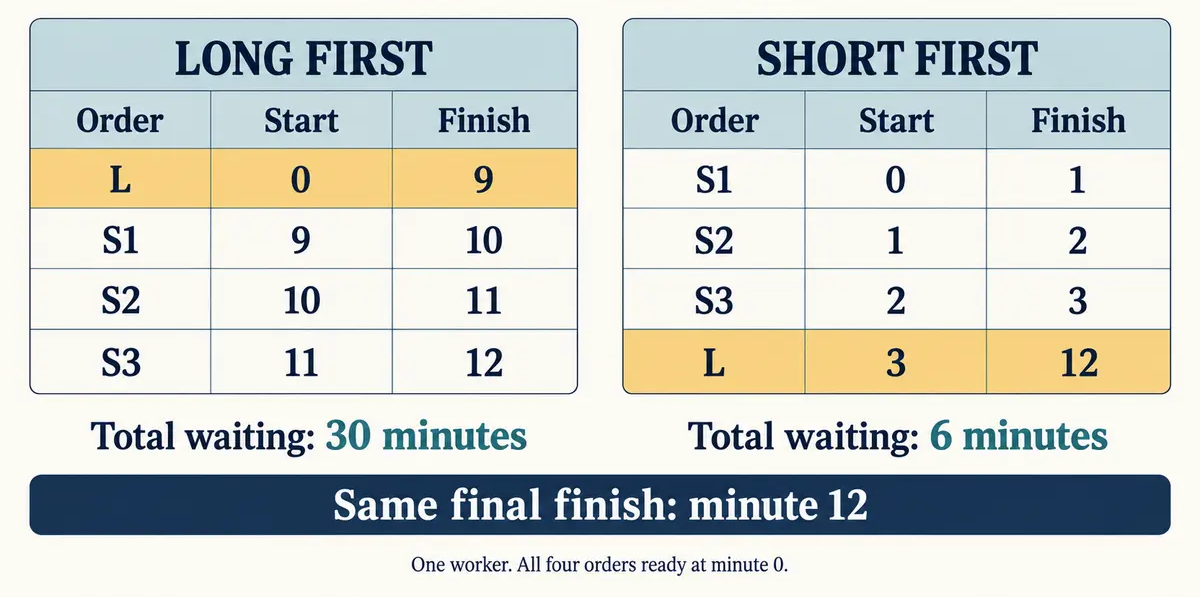
A counter can finish its entire workload at the same time under two different service sequences while making customers wait very different amounts in total. That is not a contradiction. The last completion measures when the work is over; accumulated customer waiting measures what happens to people before that moment. Changing the order can improve the second measure without increasing speed or reducing the amount of work.
On January 28, 2025, Reuters reported Brian Niccol's assessment that mobile-order sequencing was an obstacle to Starbucks' shorter-wait goal in the United States. That was the chief executive's account, not an independent measurement of a particular scheduling rule's effect.
In its same-day company transcript, Starbucks said its sequencing work included staffing and process changes and an algorithm pilot. The public statement does not identify the rule examined below as its actual algorithm. The example isolates a scheduling mechanism rather than reconstructing a coffeehouse or estimating the company's results.
Keep the workload fixed and change only its order
Imagine one anonymous service counter with one worker who can handle one job at a time. Four independent jobs are ready at time zero. One takes nine minutes and three take one minute each. Call the long job L and the short jobs S1, S2 and S3. Their durations are known exactly before work begins, and each must be completed without interruption once started.
There are no later arrivals, changeovers, preparation activities or dependencies between these jobs. Nothing can be done in parallel. The worker uses the same method, equipment and effort in both sequences. The example contains no shortcut in quality or safety and no change in staffing. Nine plus one plus one plus one is twelve minutes of work whichever job comes first.
Customer waiting has a precise definition here: elapsed time from arrival until service starts. Completion time includes the customer's own service as well. Because all four arrive at zero, a job starting at minute three has waited three minutes. A nine-minute job that starts then completes at minute twelve. Those are two different observations, and neither should be substituted silently for the other.
The initial order is a chosen comparison, not a claim that the long job has a stronger arrival priority. Everyone is ready at the same time. This matters because changing a queue of customers who arrived at different times introduces additional questions about promises and priority. We first set those questions aside to see what changing the sequence alone can do.
Putting the long job first holds three others back
Start with the sequence L, S1, S2, S3. L begins immediately and finishes at minute nine. S1 then runs from nine to ten, S2 from ten to eleven and S3 from eleven to twelve. The worker is continuously occupied, no job is abandoned, and all four are completed by minute twelve. On a measure of final finishing time, the counter appears straightforwardly productive.
The waits before service are zero, nine, ten and eleven minutes. Adding them gives thirty customer-minutes, and dividing by four gives an average wait of seven and a half minutes. The completion times are nine, ten, eleven and twelve, which sum to forty-two and average ten and a half. The difference between the two totals is the twelve minutes of actual processing.
The long job has not become more demanding merely because it goes first. Its nine minutes were already part of the workload. Its position means that three other customers experience all nine of those minutes before their own work can begin. The same period of clock time can therefore contribute to several people's waiting simultaneously. Customer-minutes are not a second measurement of the worker's busy time.
That distinction explains why total waiting can exceed the length of the whole service period. During the first nine minutes, three customers are waiting, producing twenty-seven customer-minutes. During the following minute two are waiting, adding two. During the next minute one is waiting, adding one. The result is thirty, although the last job is still completed at minute twelve.
Short jobs first change the experience, not the workload
Now use S1, S2, S3, L. The short jobs start at zero, one and two and finish at one, two and three. The long job starts at three and finishes at twelve. Again, the worker is busy for twelve minutes and all four jobs are completed. The final finishing time has not moved, and no additional processing capacity has appeared.
The waits are now zero, one, two and three minutes. Their sum is six and their average one and a half. Completion times are one, two, three and twelve, giving a sum of eighteen and an average of four and a half. Total waiting falls by twenty-four customer-minutes. Total completion time falls by the same amount because total processing remains twelve.
This improvement is not shared by every customer. L previously began at zero and finished at nine; now it begins at three and finishes at twelve. Its wait increases by three minutes. Each short job, however, begins nine minutes earlier than in the first sequence. Three reductions of nine, offset by an increase of three, explain the net reduction of twenty-four.
The result therefore needs careful language. It is accurate to say that total waiting is lower in this model. It is inaccurate to say that everyone receives faster service or that the worker finishes sooner. A useful account preserves the individual changes alongside the total, because the person whose job moves later experiences a real disadvantage even when the arithmetic improves overall.
Three totals answer three separate questions
- Processing workload remains twelve minutes: how much active work must the counter perform?
- Final completion remains minute twelve: when is the last of these four jobs finished?
- Total pre-service waiting changes from thirty to six customer-minutes: how much waiting is accumulated across the four customers?
These measures are related but not interchangeable. Reporting only the last completion would miss the difference between the sequences. Reporting only the lower total wait would hide the long job's later start. Neither measure is intrinsically wrong. The error occurs when one is presented as answering a question that belongs to another.

A neighbouring pair reveals why the ordering matters
The four-job example can be understood through a smaller comparison. Suppose two adjacent jobs begin after the same accumulated work, at time t. One takes a minutes and the other b, with a greater than b. If the longer comes first, their completion times are t plus a and t plus a plus b. Together these equal twice t plus twice a plus b.
If the shorter comes first, completion times become t plus b and t plus b plus a. Their sum is twice t plus twice b plus a. The second arrangement reduces the pair's summed completion time by a minus b. The pair still ends at t plus a plus b, so any jobs following it can retain exactly their previous starting times.
In our example, exchanging a nine-minute job followed by a one-minute job reduces the completion total by eight. Moving the long job past all three short jobs involves three such exchanges, reducing the total by twenty-four. No job is shortened and no later work is pulled into parallel processing. The improvement comes entirely from who experiences the long operation ahead of their own.
Repeatedly exchanging an adjacent longer-before-shorter pair eventually leaves jobs in increasing duration order. Under the narrow assumptions used here, that minimises the sum of completion times. Because the sum of processing times is fixed, it also minimises the sum of waits. This is a statement about this closed, single-worker, equal-weight problem, not a universal instruction for running a customer queue.
Choosing an objective is part of the business decision
A service team may care about several things at once: how many jobs are finished, when the final job ends, how long each customer waits and whether promised priorities are honoured. Our two sequences show that one measure cannot stand in for all the others. The workload and final completion are unchanged, while the distribution of service across customers is materially different.
Minimising the sum gives each customer's minute the same weight. That is an explicit choice within the model. It does not determine whether a previously agreed deadline, an accessibility requirement or a different service commitment should take precedence in a real setting. Those conditions would alter the scheduling problem rather than merely add a footnote to the same numerical answer.
The sequence also changes when completed work becomes available. By minute three, the short-first arrangement has finished three jobs; the long-first arrangement has finished none. By minute twelve, both have finished four. A single end-of-period count cannot describe that path. The distinction is useful even without assigning a monetary value to earlier completion or predicting any customer's future behaviour.
Nothing in the example establishes that lower total waiting increases sales, retention or profit. No such outcomes are modelled. The result is operational: a different sequence changes the timing experienced by customers. Whether that change supports a particular business objective requires evidence and commitments beyond the four invented jobs.
Do not turn a closed example into an open queue rule
The assumption of no later arrivals is especially important. With four known jobs, putting the long one last delays it by exactly three minutes. In an open queue, new short jobs might keep arriving. A rule that always admits them ahead of a long waiting job could postpone that job repeatedly. The bounded delay in this example supplies no guarantee about such a continuing stream.
Unknown service durations create another difference. The calculation sorts actual known processing times, not optimistic estimates. If a supposedly short job becomes long, the planned sequence no longer describes the work performed. A real system would need to consider how durations are estimated and how exceptions are handled. The example makes no claim that any current algorithm has solved that uncertainty.
Multiple workers also change the problem. Two jobs might be processed together, require different equipment or share a preparation step. Moving one order can affect more than the starting time of its neighbour. The simple exchange argument relies on a single worker and unchanged total duration for the swapped pair. It cannot be transferred unchanged to a complex multi-stage production system.
Likewise, setup times can make apparently short tasks expensive to move. A sequence that repeatedly changes tools or preparations might add work that our model excludes. The reason for stating these boundaries is not to dismiss sequencing as impractical. It is to identify which feature made the calculation work and which new feature would require a different calculation.
Use individual timing records before drawing a conclusion
The minimum useful record for this model contains an arrival time, a service start and a completion for each job. Those three observations make pre-service waiting and service duration separately visible. A completion timestamp alone cannot show whether a customer waited for a long time or received a long service. Mixing those explanations can lead a team to change the wrong part of the process.
Keep each job's identity attached to its times. The long job's disadvantage would disappear if the two lists were compared only through their averages. The same principle applies when checking a proposed sequence: identify who moves earlier, who moves later and whether any existing commitment changes. An improvement in a total is not permission to conceal the people whose experience worsens.
The records should also distinguish a modelled schedule from an observed one. Our times are exact because they were stipulated. Actual timestamps can contain missing entries, inconsistent definitions or work that begins before a status is updated. Resolving those issues is a prerequisite to interpreting a measured improvement, not something that the fictional arithmetic can accomplish for the reader.
A practical review can then name its objective before evaluating an alternative. If the question is final completion, the two sequences tie. If it is summed waiting under the model's assumptions, short-first is better. If it is the long customer's completion, long-first is better. Stating the question prevents a favourable number from silently changing the meaning of success.
The same closing time can hide a different service day
The small example does not need a faster worker to reduce accumulated waiting. It needs a different order for the same twelve minutes of work. The adjacent-pair comparison explains why the result occurs, while the long customer's later completion explains why it should not be described as an improvement for everyone.
That is the useful boundary around the lesson. Sequencing can change the distribution of service even when total workload, staffing and the final finish remain fixed. Recognising that distinction makes a scheduling discussion more precise. It does not select a universal queue policy, replace service commitments or establish the performance of a real company's algorithm.