
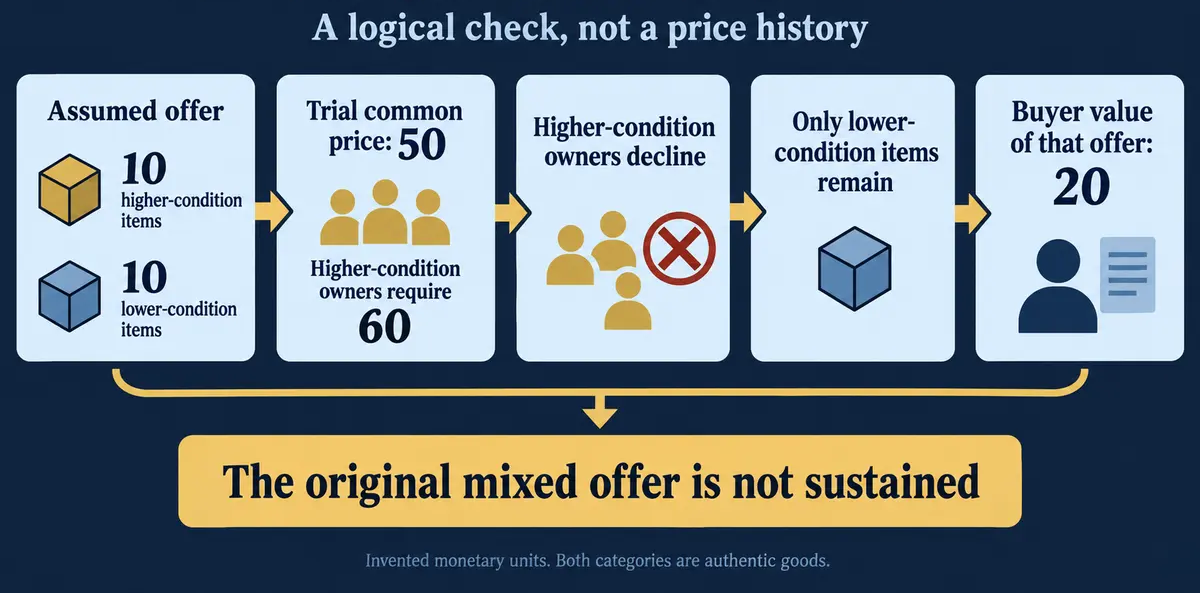
A resale market can lose its better goods without losing the people who would like to buy them. The difficulty may be that buyers cannot distinguish those goods before paying, while their owners know what they would be giving up. A price intended to reflect an average offer can then change the offer itself. Some owners decline to sell, leaving buyers to evaluate a different set of items from the one used to justify the original price.
In Reuters' 21 October 2024 report on luxury resale in China, ZZER founder Zhu Tainiqi linked purchases to trust and authentication. That was an attributed commercial assessment, not an independent measurement of authentication accuracy. The fictional market below does not reconstruct ZZER's transactions or assess its controls.
The question examined here is narrower than whether resale is growing or whether luxury prices are attractive. It concerns the relationship between information and participation. When an owner can retain an item instead of accepting an offer, the composition available to buyers is not necessarily fixed. A valuation based on all potential items must therefore be checked against the decisions of the owners whose items it assumes will be offered.
Give the owners a reason to keep some items
Imagine twenty anonymous pre-owned items. Ten are in a higher-condition category, and ten are in a lower-condition category. Both categories contain authentic, lawful and useful goods. Lower condition does not mean counterfeit. Each owner knows the condition of the item being considered for sale, but buyers cannot distinguish the two categories before purchase. There is no observable certificate, trusted history or other reliable signal in this baseline example.
All buyers value a higher-condition item at eighty monetary units and a lower-condition item at twenty. These are invented valuations, not retail quotations. Buyers are assumed to evaluate an unidentified item by its expected value, without an additional penalty for uncertainty. There are enough potential buyers for every item, and an unidentified purchase is drawn uniformly from the items actually offered. These assumptions make the composition of the offer directly relevant.
Owners also have a choice. A higher-condition owner requires at least sixty units to sell; a lower-condition owner requires at least ten. Those thresholds represent the minimum each is willing to accept rather than retain the item. They are not production costs, accounting profits or evidence of what the owner originally paid. A person can have a valuable reason to keep a possession even after its original purchase expense is long past.
For clarity, the exercise leaves out platform charges, transport, repair, search costs, financing and changing market conditions. It assumes a common price for indistinguishable items. No owner can obtain a separate credible quality classification merely by asking for more. An unsupported description does not reveal the category. The purpose is to isolate hidden quality and voluntary participation, not to represent every feature of an actual marketplace.
The population counts, valuations and participation thresholds are known within the exercise. What buyers cannot observe is the category of an individual offered item. This distinction matters: the problem is not that the analyst lacks a spreadsheet of assumptions. Even with the aggregate information available, buyers must evaluate the particular pool whose owners accept the proposed terms. Aggregate knowledge does not supply item-level identification.
The initial average looks reasonable
If all twenty items were offered together, half would have a buyer valuation of eighty and half a valuation of twenty. The expected value of an unidentified item would be fifty: half of eighty plus half of twenty. A buyer who truly faced that equal mixture would not value it above fifty under the stated assumptions. There is no arithmetic error in that calculation. The problem begins with the assumption that the mixture remains available.
At a common price of fifty, the lower-condition owners are willing to sell because fifty exceeds their minimum of ten. The higher-condition owners are not willing because fifty falls below their minimum of sixty. The proposed price therefore fails to retain the very items that gave the original mixture half its higher-condition content. The supply assumed in the valuation is different from the supply the price would actually attract.
Once the higher-condition items are absent, the buyer is no longer choosing from an equal mixture. Only lower-condition items remain. Their buyer valuation is twenty, not fifty. Persisting with the original average would mean paying for a composition that the sellers' participation decisions do not support. The analytical task is not simply to calculate an average more carefully; it is to determine which items belong in that average at the proposed price.
A failed proposal is not an observed price path
This sequence is a test of consistency, not a story claiming that a real marketplace first traded at fifty and then fell to twenty. No trade at fifty is required for the reasoning. An analyst can propose a pool, test its owners' willingness to participate, and reject it before any transaction occurs. Nor does the example estimate a speed of adjustment. It identifies why one proposed combination of price and composition cannot sustain itself.
Check every relevant price range
Could a higher common price solve the problem? At sixty or more, both classes of owners would be willing to participate. But that restores the equal mixture, whose expected buyer value is only fifty. Paying sixty or more would exceed what buyers value the unidentified purchase at. Raising the price enough to attract higher-condition owners therefore does not create an acceptable common offer for buyers in this particular example.
Between twenty and sixty, excluding the endpoints for this comparison, only lower-condition owners participate. The higher-condition threshold has not been reached. Buyers would receive an item worth twenty to them, so a price above twenty is not acceptable. This eliminates another possible range without appealing to impatience, irrationality or a shortage of buyers. The obstacle comes from the composition associated with the price, not from a missing desire for better goods.
Between ten and twenty, inclusive, lower-condition owners are willing to sell and buyers are willing to buy those items. That range can support trade under the model's participation rules. A price below ten brings no willing seller. The exercise does not specify bargaining power or an auction rule, so it does not select one unique transaction price within the ten-to-twenty interval. In particular, twenty is a buyer limit, not a demonstrated universal selling price.
- Below ten: neither owner category is willing to sell.
- From ten through twenty: lower-condition items can trade.
- Above twenty but below sixty: only lower-condition items are offered, at prices buyers will not accept.
- At sixty or above: both categories would be offered, but their equal mixture is worth only fifty to buyers.
These comparisons leave the higher-condition items out of trade under the baseline common-price arrangement. They do not imply that the items have ceased to exist, deteriorated or lost all demand. Their owners retain them. The distinction between potential stock and participating stock is essential: a market can contain people who own desirable goods while offering buyers only a less desirable subset of those goods.
The missing trade is not a missing preference
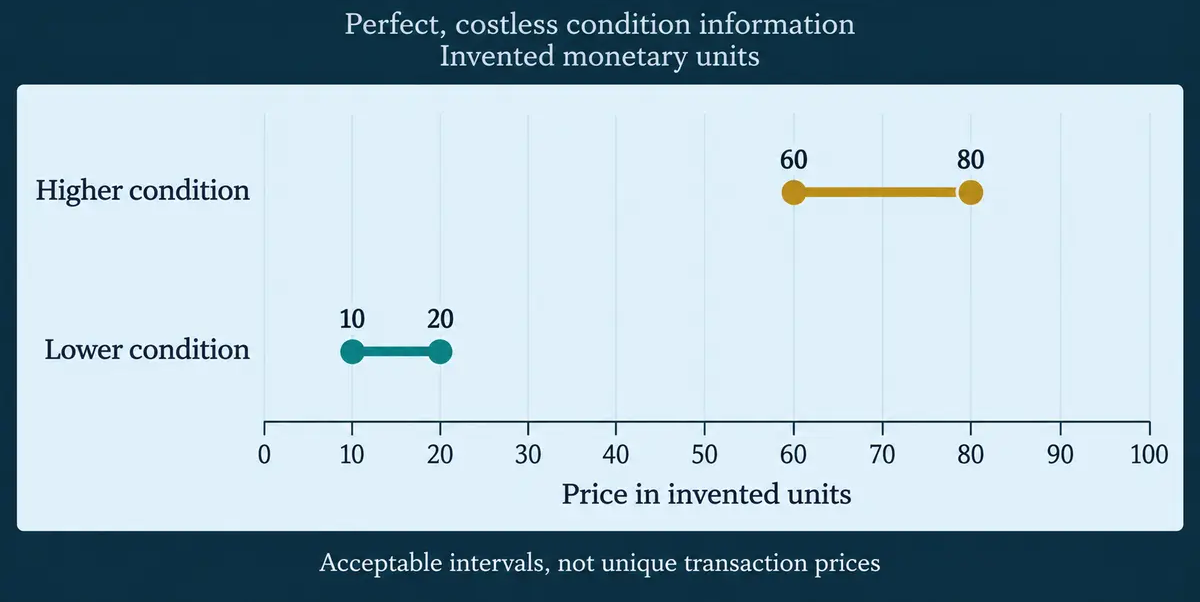
For an identifiable higher-condition item, a buyer would be willing to pay up to eighty and its owner would accept at least sixty. There is room between those limits for an exchange both would accept. Yet that possibility is unavailable when the item cannot be credibly distinguished within the common offer. The difficulty is therefore not that the buyer values the good less than its owner does. The difficulty is that the relevant quality cannot support a separate transaction.
This is the adverse-selection mechanism in the example. The terms offered to an unidentified group influence which members of the group accept them. Those participation decisions then change what a buyer should expect from the group. Treating the original population as if it were automatically the offered population breaks the connection. The same physical goods can remain in existence while their owners' decisions alter the market visible to buyers.
No dishonest behaviour is necessary to produce this result. A lower-condition owner can simply accept an offer that meets the stated threshold, while a higher-condition owner declines an offer that does not. The baseline does not require a false claim about condition. It requires only that buyers cannot reliably tell the categories apart before purchasing. The model should not be turned into an accusation that sellers of lower-condition goods are committing fraud.
Let information change participation
Now introduce a deliberately demanding benchmark: a perfect, costless and credible condition check whose result is visible to buyers. This is an assumption for comparison, not a claim about any actual authentication service. The check separates the categories without repairing either item or changing anyone's valuation. Higher-condition goods remain worth eighty to buyers and require sixty from their owners. Lower-condition goods retain the twenty and ten limits.
With the categories distinguishable, higher-condition trade can occur at a price between sixty and eighty, while lower-condition trade can occur between ten and twenty. Again, the intervals do not determine exact prices. The important change is that owners of higher-condition items can now participate in a transaction based on their own category rather than on an unidentified mixture. Information changes the set of feasible exchanges without increasing the number of physical items.
This is a different outcome from merely raising the average price of existing transactions. The newly visible high category was absent from the baseline offer. If it enters after verification, the composition changes because previously unwilling owners can accept category-specific terms. An observed average could move, but the mechanism is participation. Measuring only the average would miss the distinction between repricing the same items and bringing a different group of owners into trade.
Authenticity and condition answer different questions
A claim that an object is genuine does not automatically establish its condition. An authentic item may have more wear than another authentic example of the same model. Conversely, a convincing description of wear does not itself establish origin. The numerical exercise concerns a condition distinction among authentic items. Its perfect-information benchmark should not silently become an assertion that an authenticity check reveals every property a buyer might value.
The fictional categories must also remain separate from a general label such as premium. In the exercise, each category identifies the property responsible for the buyer's valuation. A broad marketing description might combine appearance, origin and many other features without distinguishing that property at all. Substituting such a description for the assumed condition check would change the available information. The original participation result could no longer be transferred automatically.
Actual checks can also have an incomplete scope. They may address one property while leaving another unresolved. A marketplace label is meaningful only in relation to what it establishes. The useful analytical question is not whether a label sounds reassuring, but whether it distinguishes the property responsible for the buyer's valuation and the seller's participation in the proposed explanation. If it does not, the perfect-check comparison is not applicable as written.
Why this is more than a changing sales mix
A conventional sales-mix calculation takes categories and their quantities as given, then asks how their proportions affect an average. Here the proportions are an outcome of the proposed terms. At fifty, the assumed equal mixture cannot survive because one category's owners do not participate. At sixty, the equal mixture returns on the seller side but buyers reject its price. Composition and willingness to trade must be examined together.
This also explains why an initial survey of possessions would not settle the market question. Finding ten items in each category establishes the potential population. It does not show that owners in both categories would accept the same offer. A list of potential suppliers is not yet a list of willing suppliers at specified terms. The difference is behavioural, even though it eventually appears as a change in the observed assortment.
Evidence from a real marketplace would therefore need to connect offers with acceptance and withdrawal, while respecting the available information about item quality. A change in average prices alone cannot prove adverse selection. Demand shifts, changing item characteristics and other mechanisms can produce a different average too. The fictional example identifies a possible causal structure; it does not grant permission to diagnose that structure from one aggregate statistic.
Keep the benchmark separate from a business forecast
Perfect, costless verification is useful because it isolates the role of information. A paid or fallible inspection would require another analysis. Its cost could affect participation, and its errors could leave buyers uncertain about the categories. The present model does not calculate the appropriate fee, the necessary accuracy or the profitability of a verification service. Those questions cannot be answered by treating the benchmark as if it were an available commercial product.
Likewise, reputation, repeated dealings, warranties or observable histories could alter the baseline. They are excluded to make the selection mechanism visible, not because real businesses necessarily lack them. A market with reliable distinguishing information may support exchanges that the anonymous pool cannot. The right conclusion is conditional: hidden quality can change who is willing to sell, and that change must enter a buyer's assessment of what is actually offered.
The better goods disappear from the offer in this exercise because the common price and the assumed mixture cannot be made consistent with everyone's stated limits. Buyers still prefer them, and owners still possess them. What is missing is a credible way for their quality to support separate terms. Understanding that gap turns the discussion from a general appeal for trust into a precise question about information, participation and the goods available for exchange.