

On 18 December 2025, Reuters reported a fisheries agreement between Norway and Russia for 2026. The agreement reduced the total Northeast Arctic cod quota. That announcement provides a starting point for examining a shared-resource incentive, not evidence for the numerical assumptions below.
A business can receive all the revenue from an additional unit it extracts while bearing only part of the consequence of leaving less for everyone else. Whether that difference matters depends on how the remaining resource is valued. A simple constructed example can make the distinction visible without estimating a real fish population or assigning motives to either government.
The example in this article is entirely fictional. Its two participants are called A and B, and neither represents a country, company or actual fleet. Its units are not tonnes, and its payoff numbers are not profits or national income. It is a comparison of stipulated choices that asks a narrow question: can individually attractive extra extraction leave both participants worse off?
Start with a stock, not just a sales target
Imagine a shared resource with an opening stock of 100 units. Before extraction, a further twenty units are added by assumption. There are therefore 120 units available for the exercise. This addition is fixed; it is not a claim about reproduction, recruitment, survival or the growth rate of any species. We examine one period only and do not project the calculation through a sequence of years.
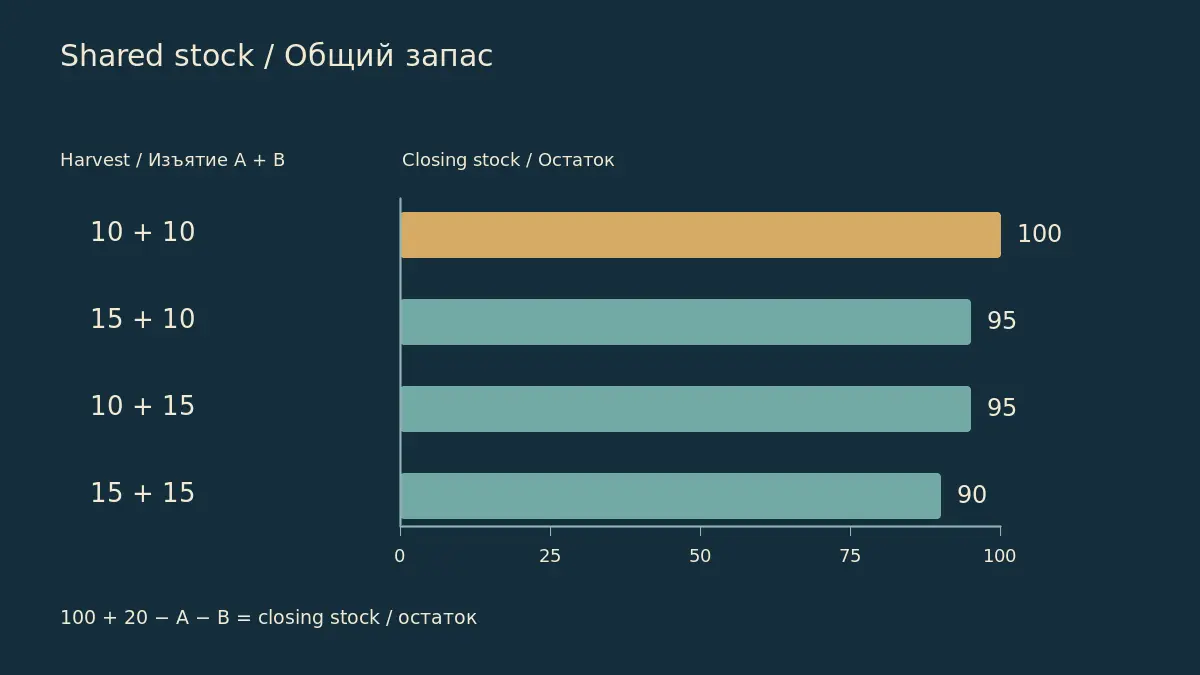
Each participant chooses between extracting ten units and extracting fifteen. Both choices are feasible by construction. The amount left at the end equals 120 minus A's extraction minus B's extraction. If each chooses ten, the closing stock is 100. If one chooses fifteen and the other ten, it is ninety-five. If both choose fifteen, it is ninety.
Opening stock, additions, extraction and closing stock are different entries. They must not be substituted for one another simply because all are expressed in the same units. A catch allowance is a permitted flow over a period; a remaining stock is an amount present at a point in the sequence. Our arithmetic links a flow to a stock, but only under the assumptions just specified.
Define what each participant values
Give each extracted unit a revenue value of one. Ignore extraction costs, fixed costs, taxes and price changes. Next, suppose each participant assigns a terminal value of 0.6 to every unit remaining in the common resource. A participant's score is its own extraction revenue plus 0.6 times the closing stock. Both participants use the same scoring rule in this first comparison.
The terminal component needs careful interpretation. It is a stipulated valuation of the remaining resource, not a second sale, a payment from the other participant or a claim on a bank account. The model does not say that each owns sixty per cent of the fish. Nor does it promise that either can convert its entire valuation into cash at the end of the period.
Instead, the score represents a preference over two things: current receipts and the condition in which the shared resource is left. Combining them requires an assumed conversion factor. We choose 0.6 to expose a particular incentive pattern and later change it to show the boundary of the result. The number is not estimated from the agreement, the source report or observed behaviour.
Work through all four outcomes
When A and B each extract ten, each receives ten in current revenue. The closing stock is 100, which contributes sixty to each participant's score. Each therefore ends with a score of seventy. Adding the two scores gives 140. That sum is a measure defined for this exercise, not an estimate of social welfare in a real economy.
Now let A increase extraction to fifteen while B stays at ten. Closing stock falls to ninety-five, and the terminal component becomes fifty-seven for each participant. A's score is fifteen plus fifty-seven, or seventy-two. B's score is ten plus fifty-seven, or sixty-seven. The combined score is 139: A gains two, B loses three and their total falls by one.
Reverse the choices and the results reverse as well. If A extracts ten and B extracts fifteen, A receives a score of sixty-seven and B receives seventy-two. This symmetry follows from identical assumptions about prices and terminal valuations. It is not a claim that real participants have equal fleets, costs, bargaining power, resource access or dependence on future catches.
Finally, let both extract fifteen. Thirty units leave the resource and ninety remain. Each participant receives fifteen now and assigns fifty-four to the remainder, for a score of sixty-nine. Their combined score is 138. Each has more immediate revenue than in the ten-and-ten case, yet each has a lower total score under the valuation rule we selected.
The complete comparison
- Ten each: closing stock 100; scores seventy for A and seventy for B.
- A takes fifteen, B takes ten: closing stock ninety-five; scores seventy-two and sixty-seven.
- A takes ten, B takes fifteen: closing stock ninety-five; scores sixty-seven and seventy-two.
- Fifteen each: closing stock ninety; scores sixty-nine for A and sixty-nine for B.
The private increment is not the joint increment
Hold B's choice fixed and ask whether A benefits from taking five more units. The extra revenue is five. Five fewer units remain, reducing A's terminal valuation by three. Its net gain is two. The same calculation applies whether B has chosen ten or fifteen. Under these assumptions, A prefers the larger extraction in either case; B faces the identical choice.
But the change also reduces the other participant's terminal valuation by three. A does not subtract that loss from its own score. Counting both participants, the additional revenue of five is offset by a total loss of six in terminal value. That is why the same extra extraction can look attractive in an individual comparison and unattractive in the combined comparison.
No participant has to misunderstand the arithmetic for this pattern to arise. Both can see every outcome and still prefer the larger action when the other's choice is held fixed. Describing the result as merely a shortage of information would miss the model's central feature. The disagreement lies between the costs included in an individual decision and those included when both scores are added.
An agreement changes the question, not automatically the outcome
Suppose the fictional participants discuss a joint ceiling of twenty units. Ten each would satisfy it and deliver seventy apiece. However, announcing that ceiling does not alter the calculation showing a two-point individual gain from unilateral extra extraction. A complete account would need to explain how choices become consistent with the agreement, rather than assuming that the announcement itself removes the incentive.
There are several distinct questions here. What choices are permitted? How is the permitted total divided? What is observed about actual extraction? What follows if conduct differs from the agreed choices? Our model does not specify institutions or answer those questions for a real fishery. Keeping them separate prevents a numerical ceiling from being mistaken for a complete description of implementation.
It would also be a mistake to read the example as an accusation that actual participants will disregard their commitments. We have intentionally left out many factors that could change behaviour, including relationships, consequences for non-compliance and preferences not captured by the score. The exercise establishes a possible incentive tension under stated assumptions, not a prediction about any named party.
A different valuation can reverse the result
Change each participant's terminal value from 0.6 to 0.4 while leaving every other assumption unchanged. Taking five more units still yields five in revenue, but now costs the decision-maker only two in terminal value. The other participant also loses two. The combined change is positive one rather than negative one. Extra extraction now raises the combined score within this altered model.
At the other extreme, set the terminal value at 1.2 for each participant. Five extra units yield five in revenue and remove six from the extractor's own terminal valuation. The individual change is negative one. The larger extraction is no longer privately attractive, even before considering the other participant's loss. The incentive conflict identified earlier therefore does not follow from sharing alone.
For a general terminal value called v, the five-unit private increment is five minus five times v. The combined increment is five minus ten times v. With these equal valuations and fixed revenue assumptions, private and joint rankings differ when v lies between 0.5 and one. At the boundary values, one comparison becomes a tie. These thresholds belong to the constructed scoring system, not to fishery management practice.
Separate the total from its distribution
A limit on total extraction and a rule dividing that limit solve different parts of the fictional problem. The total determines the closing stock in our equation. Distribution determines which participant receives the immediate revenue. Two allocations with the same total can leave exactly the same stock while producing different individual scores. An agreement about the total does not, by itself, specify an acceptable division.
For example, replace the ten-and-ten allocation with twelve for A and eight for B, holding the total at twenty. Closing stock remains 100 and each terminal component remains sixty. Scores become seventy-two and sixty-eight. The combined score stays at 140, but the participants no longer receive equal scores. This additional example is an allocation comparison, not a proposed sharing formula for the actual agreement.
The distinction matters when reading a percentage. A participant can retain the same percentage of a smaller total and still receive a smaller absolute allowance. Conversely, a larger percentage need not mean more units if the overall ceiling falls enough. Neither statement determines who benefits from an actual negotiation; they identify which quantities must be kept separate before such a conclusion is attempted.
Do not turn the exercise into a biological forecast
The twenty-unit addition was imposed at the beginning, regardless of the opening stock or subsequent choices. We did not model the size or age distribution of a population, environmental conditions, natural mortality or interactions among species. We also did not model uncertainty about those quantities. Repeating the arithmetic indefinitely would not supply the missing relationships; it would simply repeat an unsupported assumption.
Likewise, a larger closing stock in this exercise is not proof of a particular future catch, recovery date or income stream. Its value enters only through the stipulated terminal score. If someone wanted a forecast, they would need evidence and a model designed for that purpose. The payoff comparison cannot supply either merely because its numbers are internally consistent.
There is a useful limit to the business lesson. Current revenue alone may omit something the decision-maker values about what remains, and individual accounting may omit consequences valued by others. Recognising those omissions helps frame a question. It does not tell us the correct valuation, the appropriate catch ceiling or the reliability of measurements in a specific place.
Read a quota headline as the beginning of a comparison
A careful reading starts by identifying the period and the object being limited. It then distinguishes the overall ceiling, any participant's allocation and the extraction that actually occurs. Finally, it asks which claims concern observed facts, which express an intention and which depend on a forecast. These categories should remain visible even when a headline compresses them into one short statement.
The constructed example adds one further question: whose consequences appear in the decision? Under one set of assumptions, both participants prefer a larger individual action even though both would score better with mutual restraint. Under another valuation, that conflict disappears. The result is conditional, and making the condition explicit is more informative than declaring that either competition or cooperation must always prevail.
That is the narrow conclusion to carry away. A shared resource can connect decisions that look separate on individual revenue sheets. A joint ceiling, its distribution and the behaviour needed to respect it are distinct parts of the picture. Understanding their relationship requires keeping the assumptions visible, rather than treating a quota announcement, a payoff exercise and a demonstrated recovery as interchangeable evidence.