
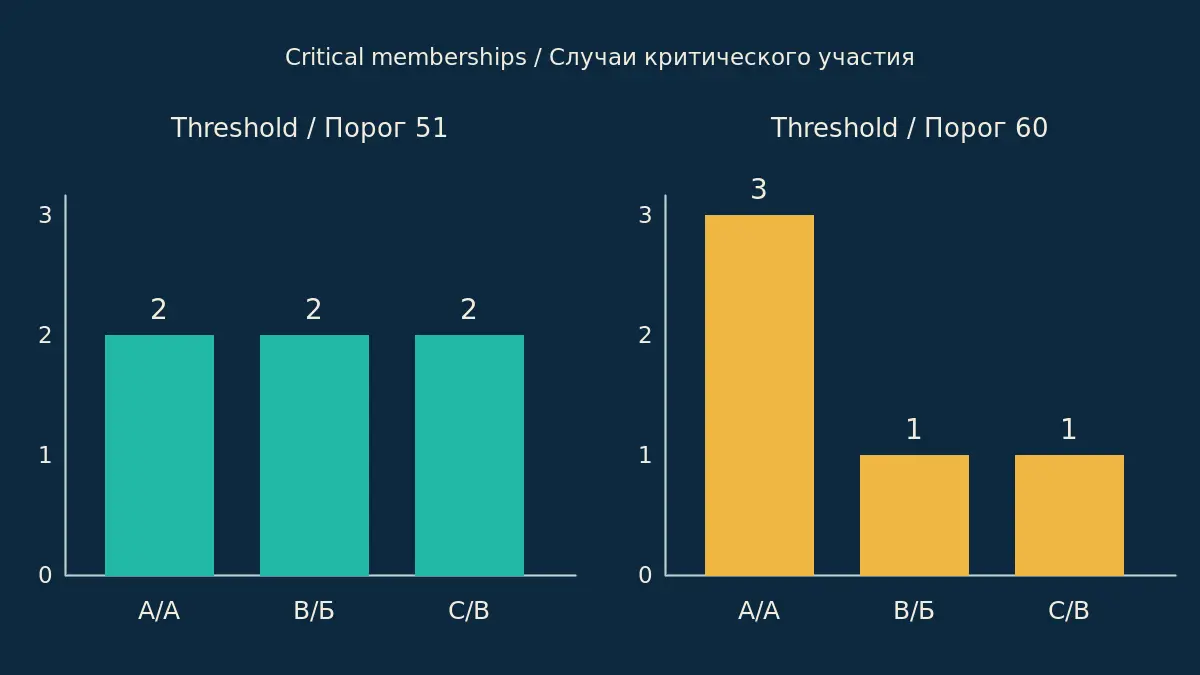
Three owners hold forty-six, thirty-seven and seventeen votes. The largest has more than twice the smallest owner's holding. Yet a complete count of the combinations in which each owner's support makes the difference can put all three on equal terms. Change the approval threshold, without transferring a single vote, and that equality disappears. The interesting change is not in the ownership register. It is in one combination that stops being sufficient and another in which a particular owner becomes indispensable.
Reuters reported on 12 February 2026 that the Toyota Industries tender offer had been extended to 2 March. The company's contemporaneous notice confirmed the extension. Tendering shares is not casting a shareholder ballot: the fictional voting exercise below does not represent this transaction's participants or conditions.
The distinction between voting weights and decisive membership belongs to established voting theory. A research paper on weighted voting games describes coalitions that meet a quota and measures based on decisive votes. Here, a member is called critical when removing its support changes a passing coalition into a failing one. Counting such memberships is not estimating how shareholders will actually vote.
Write down the whole imaginary register
Call the three fictional owners A, B and C. Their holdings carry forty-six, thirty-seven and seventeen votes respectively, making exactly one hundred. Each owner casts its entire holding together. There are no further owners, split instructions or unrepresented votes in this exercise. A proposal either passes or fails under the stated arithmetic rule. Start with a requirement of at least fifty-one supporting votes; later replace that requirement with sixty, leaving everything else in the register unchanged.
These are invented conditions, not an account of a company's constitution. In particular, A's forty-six votes do not confer an extra appointment right, and C's seventeen have no special veto attached. A, B and C are simply convenient labels for the three holdings. Nothing in the exercise specifies their wealth, the value of their shares, their relationship with management or whether they like the proposal. The table records possible supporting groups rather than a forecast of negotiations.
- No owner supports: zero votes.
- A alone supports: forty-six votes.
- B alone supports: thirty-seven votes.
- C alone supports: seventeen votes.
- A and B support: eighty-three votes.
- A and C support: sixty-three votes.
- B and C support: fifty-four votes.
- All three support: one hundred votes.
That list exhausts the choices available to the three named holdings. It also makes a useful distinction visible before any calculation of critical membership. The pair A and B supplies twenty-nine more votes than B and C. Nevertheless, both totals clear fifty-one. A count of which combinations pass will initially record the same outcome for these very different margins. The later removal test asks a separate question about each member inside those passing combinations.
At fifty-one, each pair needs both owners
Begin with A and B, whose eighty-three votes pass comfortably. Remove A's support and thirty-seven remain, which is fourteen short of fifty-one. Remove B's support instead and forty-six remain, which is five short. Both removal tests turn this passing pair into a failing single holding. A and B therefore each receive one entry in the count of critical memberships. Their different holdings and different shortfalls do not produce different numbers of entries in this particular pair.
The A and C pair passes with sixty-three. Without A, only seventeen remain; without C, forty-six remain. Both are below fifty-one, so the pair gives one critical membership to A and one to C. Compared with the previous pair, the supporting total has fallen by twenty, but the two removal results are still failures. At this stage A has two entries, one from its pairing with B and another from its pairing with C.
B and C together provide fifty-four, just three above the requirement. Removing B leaves seventeen; removing C leaves thirty-seven. Again, either removal defeats the proposal. This pair supplies B's second entry and C's second entry. The smallest holder has now appeared in two passing pairs in which its departure matters. B has done the same, and so has A. We have not needed to pretend that seventeen, thirty-seven and forty-six are equal quantities.
The all-owner group requires a different check. Its one hundred votes pass, but removing A leaves B and C with fifty-four, still enough. Removing B leaves sixty-three, also enough. Removing C leaves eighty-three, again enough. Consequently this group adds no critical memberships at fifty-one. Although everybody supports in this row, nobody is needed to preserve a passing result after one isolated removal. The three successful removal outcomes are part of the calculation, not missing observations.
The first total is two, two and two
A's entries come from AB and AC. B's come from AB and BC. C's come from AC and BC. The all-owner row contributes nothing, and the single-owner rows cannot contribute because none passes in the first place. Thus there are six recorded critical memberships, divided equally among the three labels. This is an equality of entries in this eight-row exercise, not an equality of holdings, income or influence measured from an actual shareholder meeting.
Notice that the pairs overlap. A is not spending its forty-six votes twice in one meeting when it appears in both AB and AC. Those rows describe alternatives: one with B supporting and C not supporting, the other with the opposite arrangement. The count compares those alternatives on paper. Combining their supporting totals into a supposed amount of voting capital would mix different possible ballots and would answer no question posed by this register.

Raise the requirement to sixty
Now retain the same three owners and the same eight supporting totals, but require at least sixty. A alone still fails, as do B alone and C alone. AB still passes with eighty-three. AC still passes with sixty-three. All three still pass with one hundred. The only row whose result changes is BC: its fifty-four votes were sufficient at fifty-one and are insufficient at sixty. No share has moved between accounts during this change.
In AB, the removal calculations remain thirty-seven without A and forty-six without B. Both fail against sixty, so both owners retain their entries. In AC, the corresponding remainders are seventeen and forty-six; those also fail, preserving A's and C's entries. Raising the requirement has not altered the internal count in either surviving pair. The first four critical memberships can therefore be carried across from the earlier calculation without inventing a new explanation for them.
BC contributes nothing at sixty because it no longer passes. Previously, it supplied one entry each to B and C. Those entries disappear together. They cannot be preserved merely because removing a member would make fifty-four smaller: the starting coalition itself already fails. In this example, B and C still possess every vote they held before, but their two-owner combination no longer supplies the successful starting point required for either of those two recorded memberships.
The all-owner row changes in the opposite direction. Remove A from one hundred and fifty-four remain, now below sixty. A therefore becomes critical in ABC. Remove B instead and sixty-three remain, enough; remove C and eighty-three remain, also enough. Only A gains an entry from this row. Its gain does not come from increasing forty-six or reducing another holding. It comes from the changed result of the specific remainder, BC, after A's removal.
One changed row produces three changed entries
At sixty, A is critical in AB, AC and ABC: three entries. B is critical only in AB: one. C is critical only in AC: one. There are now five critical memberships in total rather than six. The movement from two, two, two to three, one, one can be accounted for precisely. Delete B's and C's entries from the newly failing BC row, then add A's entry in the still-passing ABC row. All other entries remain unchanged.
This accounting is more informative than simply saying the largest holder becomes stronger. It identifies two losses and one gain attached to two particular rows. BC's loss of passing status simultaneously removes two memberships and changes the outcome when A is removed from ABC. These are connected consequences of the same total, fifty-four, falling between the old and new requirements. The two tables differ because of that position, not because we assigned a new personality or negotiating skill to A.
B's thirty-seven and C's seventeen still yield equal counts at sixty. That may initially look surprising because B retains twenty more votes. Check their surviving entries rather than the size gap: B supplies the necessary partner to A in AB, and C supplies the necessary partner to A in AC. Neither is needed when all three support, because removing either leaves a passing pair involving A. That exact symmetry in the removal results coexists with unequal numerical holdings.
Locate the boundary rather than guessing a smooth change
The eight supporting totals also let us examine nearby requirements without rebuilding the example. A requirement of fifty-two, fifty-three or fifty-four gives the same passing rows as fifty-one. BC has fifty-four, and meeting the requirement exactly is sufficient under our invented rule. Its two entries remain, while removing A from ABC still leaves a passing result. The count therefore stays two, two, two throughout the inclusive interval from fifty-one through fifty-four.
At fifty-five, BC falls short for the first time within this interval of requirements. The calculation becomes three, one, one and stays that way at fifty-six, fifty-seven, fifty-eight and fifty-nine. Sixty belongs to the same range, as do sixty-one, sixty-two and sixty-three. AC's sixty-three still qualifies at the upper endpoint. Thus the second count holds from fifty-five through sixty-three inclusive. The table gives two stretches of unchanged results, separated by one decisive boundary.
Moving from fifty-one to fifty-four changes the requirement by three without changing any entry. Moving from fifty-four to fifty-five changes it by one and changes three entries. In this particular register, the numerical size of a threshold adjustment is therefore a poor description of the adjustment's effect on the count. The important comparison is with the listed supporting totals. An interval containing no such crossing behaves differently from one that moves past fifty-four.
We stop this comparison at sixty-three deliberately. At sixty-four, AC's total would no longer meet the requirement, so extending the second result past that boundary would be wrong. A reader can identify that error directly from the eight-row list without trusting an interpretation of anyone's motives. The lower boundary also matters: the first interval begins at fifty-one here, not at every conceivable requirement. The two specified ranges are statements about this arithmetic exercise, not universal corporate voting rules.
Keep the count attached to its question
Another check on the same register compares the margin above sixty with the number of critical members. AB has eighty-three votes, a margin of twenty-three, and two critical members. AC has sixty-three, a margin of three, and also two critical members. ABC has one hundred, a margin of forty, and one critical member. The highest margin therefore does not give a group with no critical member. Nor does reducing the margin from twenty-three to three increase the count beyond two.
ABC's forty-vote margin is smaller than the forty-six removed with A. That subtraction produces fifty-four and defeats the proposal. The same margin is larger than B's thirty-seven and C's seventeen, so either of those subtractions leaves enough. For AC, its margin of three is smaller than both available removals, forty-six and seventeen. These comparisons explain the different entries without treating a margin as an independent reserve that can replace a missing owner. Each subtraction removes a particular whole package.
At fifty-one the margins of AB, AC and BC are thirty-two, twelve and three. Each pair still has two critical members. ABC's margin is forty-nine, larger than any of the three individual holdings, which explains why all three removal tests preserve approval there. The comparison between ABC's forty-nine and forty is especially revealing: the first exceeds forty-six, while the second does not. It is another way to locate A's new entry, using exactly the same totals rather than introducing another source of influence.
Nor does A's three-entry result mean that A can approve the proposal alone. Its forty-six still fail at sixty. Every passing row contains A, but every passing row also contains at least one other owner. These two observations are compatible: A is needed in every successful combination available in this table, while A by itself is insufficient.
The example ends with the same register it started with: forty-six, thirty-seven and seventeen. What has changed is the requirement against which their possible combinations are tested. At fifty-one all three pairs pass and no single removal defeats the all-owner group. At sixty the BC pair fails and its absence makes A critical in that larger group. Looking at the holdings alone would miss this exact rearrangement; looking at the full list makes every changed entry traceable.