
A subscription bundle sells several rights of access for one price. Its commercial appeal depends on more than the number of services inside the package. Two audiences can have exactly the same demand for each service considered separately, yet respond very differently when those services are sold together. The missing information is how preferences are paired within each customer.
On August 6, 2025, Reuters reported Disney's plans to bundle Disney+, Hulu and ESPN, with management linking the offer to engagement and retention. Those were commercial intentions, not proof that a particular package had already delivered the expected result. The announcement provides a starting point for examining the economics of selling access together.
Start with a customer's alternatives
The analysis below uses invented customers, prices and costs. It does not estimate Disney's audience, contracts or optimal tariffs. There are two unnamed services and one selling period. All monetary values are expressed in abstract credits, with no currency conversion, taxes, advertising receipts or financing. The exercise isolates a pricing mechanism rather than reconstructing an actual streaming business.
A customer's valuation means the largest payment that customer would accept for access during the period. It is not the posted price, a production cost or a prediction of viewing hours. Valuations are assumed to be known and additive: someone valuing the first service at fourteen and the second at four values access to both at eighteen. This assumption excludes any extra benefit or inconvenience from combining the services.
Each buyer chooses the available option with the greatest surplus, defined as valuation minus price. Buying nothing gives zero surplus. A customer may buy both separate services when they are offered, but does not buy duplicate access after selecting the bundle. The comparisons use prices that give a clear preferred option, so the results do not rely on a hidden rule for resolving indifference.
Three menus, not three extra customer groups
Separate selling offers each service at its own price. Pure bundling offers only the combined package. Mixed bundling leaves the separate services available alongside the package. These are alternative menus offered to the same customers. A calculation cannot add the customers from all three menus as if they were different people arriving independently.
The distinction is particularly important when a bundle is introduced into an existing offer. A person who previously bought a standalone service might switch rather than add a second payment. Another might enter for the first time. A third might leave if the standalone option disappears. Our small examples allow every choice to be tracked rather than inferred from a total subscriber count.
Opposite tastes can support a common package price
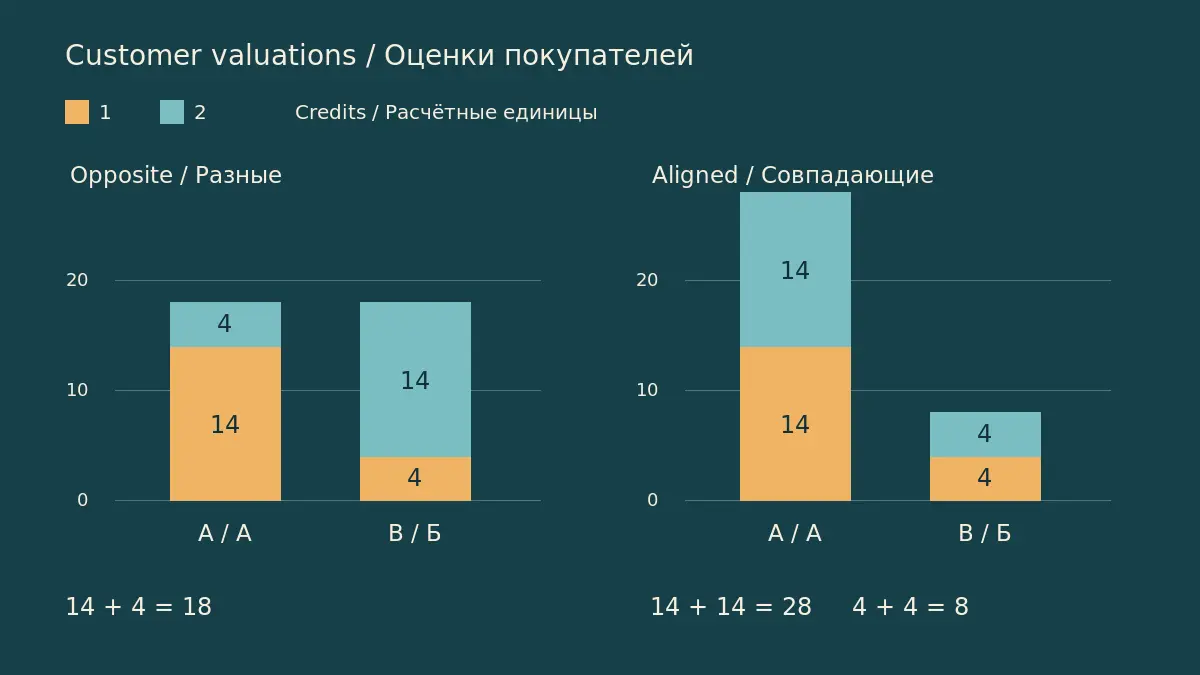
Consider two customers. Customer A values service one at fourteen and service two at four. Customer B has the opposite preferences: four for service one and fourteen for service two. Both value the package at eighteen, although their favourite services differ. Equal package valuations emerge from different tastes, not from identical preferences.
Set each standalone price at thirteen. A buys service one and B buys service two. Each receives a surplus of one. Buying both separately would cost twenty-six, exceeding either customer's total valuation. Revenue is therefore twenty-six, representing two payments of thirteen and two service entitlements. No one has purchased the less valued service.
Now replace the standalone menu with a pure bundle priced at seventeen. Each customer values the package at eighteen and receives a surplus of one, so both buy. Revenue becomes thirty-four and the number of service entitlements rises to four. The package has collected four more from each customer while also supplying access to an additional service.
Notice what has not been established. The calculation does not show that either customer watches more programmes, remains subscribed longer or recommends the service. It does not prove that seventeen is the best possible price. It compares two specified menus under specified preferences. The gain in receipts is eight; whether that improves the commercial result also depends on cost.
More revenue is not the whole contribution calculation
Assume supplying one service entitlement for the period incurs a variable cost of two credits. The standalone menu incurs four of cost and contributes twenty-two after that cost. The bundle incurs eight and contributes twenty-six. The revenue improvement of eight has become a contribution improvement of four because four more credits are spent serving the additional entitlements.
These are not estimates of a streaming platform's delivery costs. In particular, the model does not assume that actual programme rights are charged per entitlement. It simply gives the exercise an explicit cost rule. Fixed content investment, overhead and acquisition spending are outside the calculation, so the resulting contribution must not be labelled total company profit.
The same comparison can be written without fixing the cost at two. Let c be the cost per entitlement. Separate selling contributes twenty-six minus two times c; bundling contributes thirty-four minus four times c. The bundle's advantage is eight minus two times c. It is positive below a cost of four, zero at four and negative above four.
This threshold is a consequence of the invented inputs, not a recommendation about a real subscription. At a cost of six, for example, the bundle's contribution is four below the separate offer despite its higher revenue. The question is not whether the package looks more generous, but whether its additional receipts exceed the additional cost under the stated comparison.
The same product totals can conceal another audience
Keep each service's list of valuations unchanged, but rearrange who holds them. Customer A now values both services at fourteen each. Customer B values both at four each. For each individual service, there is still one high valuation and one low valuation. A product-by-product summary would look exactly as it did in the first example.
At standalone prices of thirteen, A buys both services for twenty-six and B buys neither. Revenue is twenty-six and there are two entitlements, giving a contribution of twenty-two at the stipulated cost of two. These totals also match the first example's separate-selling outcome. Even the realised standalone revenue does not reveal how differently preferences are paired.
Offer the same pure bundle price of seventeen. A buys because the package is worth twenty-eight, but B declines because it is worth only eight. Revenue falls to seventeen. Two entitlements still cost four, leaving a contribution of thirteen. A bundle price that improved the first audience's result now reduces the second audience's contribution by nine.
A different package price could change the outcome. At twenty-six, A still buys and B still declines; revenue returns to twenty-six and contribution to twenty-two. That is a separate price comparison, not evidence that the unchanged seventeen-credit offer succeeded. It also makes no claim about a globally optimal tariff. The useful finding is that the customer-level pairing matters even when every standalone valuation list is held constant.
Leaving room for specialists
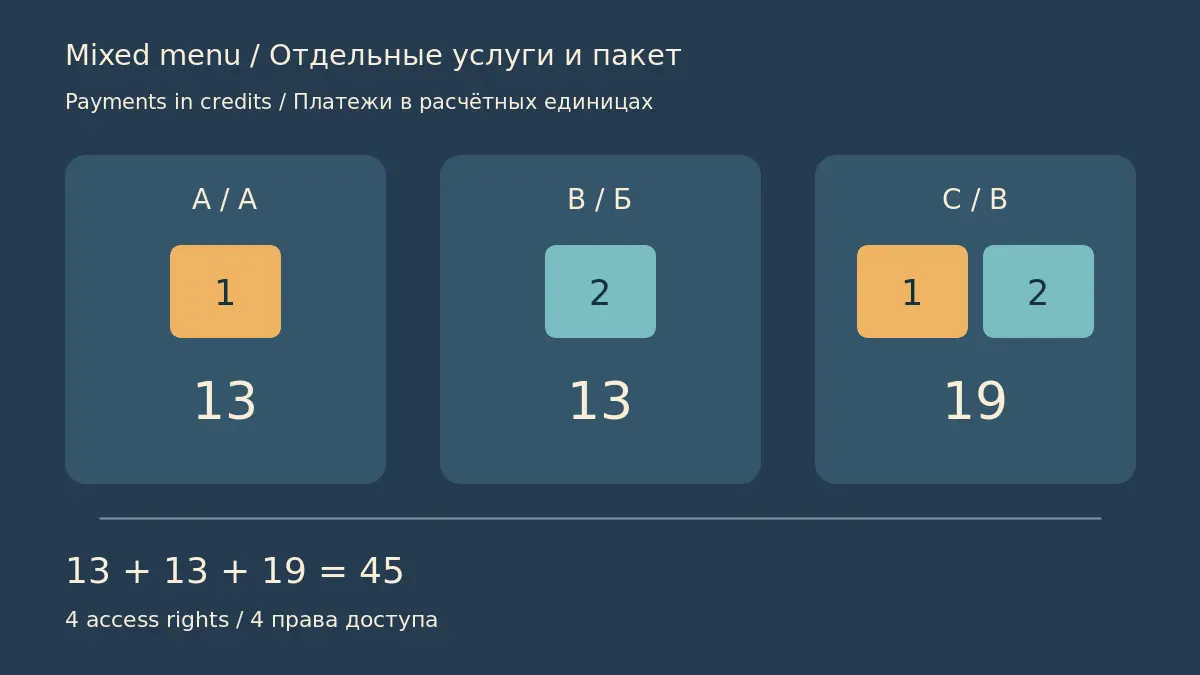
Pure bundling is not the only option. Consider a different audience with three customers. A values service one at fourteen and service two at zero. B values them at zero and fourteen. Customer C values each at ten. The first two are specialists; the third has moderate interest in both. Again, these labels describe only the invented valuations, not observed audience segments.
Offer each standalone service at thirteen and the package at nineteen. A buys only service one, receiving a surplus of one. B does the corresponding thing with service two. C buys the bundle, receiving a surplus of one from a total valuation of twenty. For C, buying either standalone service would produce a negative surplus, and buying both separately would cost twenty-six.
The mixed menu collects thirteen, thirteen and nineteen, totalling forty-five. It supplies four entitlements: one to each specialist and two to C. At two credits per entitlement, cost is eight and contribution is thirty-seven. Every buyer is counted once, even though one buyer obtains two services. This is a menu-choice calculation, not the sum of independent sales forecasts.
Remove the bundle while keeping standalone prices at thirteen. Only the specialists buy, giving revenue of twenty-six and contribution of twenty-two. Instead, remove the standalone options while keeping the bundle at nineteen. Only C buys, giving revenue of nineteen and contribution of fifteen. In this audience, preserving separate options prevents the package from excluding the specialists.
A cheaper pure bundle is a different comparison
A pure package priced at thirteen attracts all three customers. Revenue becomes thirty-nine, but six entitlements cost twelve, leaving twenty-seven of contribution. The specialists now receive access they value at zero. Under this particular cost rule, supplying that access still costs something. Lowering the package price changes both receipts and the number of entitlements supplied.
Likewise, lowering each separate price to nine brings C into the separate-selling menu. A pays nine, B pays nine and C pays eighteen for both services. Revenue is thirty-six; four entitlements cost eight, leaving twenty-eight. This is better than the thirteen-credit separate menu in this example, but remains below the mixed menu's thirty-seven. None of these comparisons establishes that the tested prices exhaust every possible strategy.
Track switching before adding sales
The most useful discipline in the mixed example is to calculate choices from the complete menu. A bundle is an alternative to other options, not an extra invoice that can simply be attached to every existing subscriber. Expected revenue must use the option each customer selects after comparing all available prices and benefits.
Suppose an analyst starts from the cheaper separate menu, where C pays eighteen. Moving to the mixed menu changes C's payment to nineteen, an increase of one rather than a new nineteen on top of eighteen. The specialists' payments also change from nine to thirteen. Together those movements produce nine more revenue, from thirty-six to forty-five. Entitlements remain four, so contribution also rises by nine under the unchanged cost assumption.
Starting from another baseline produces a different explanation. Compared with separate prices of thirteen, the mixed menu introduces C as a paying customer. The same final forty-five therefore contains an entry effect in one comparison and a switching effect in another. Both accounts can be correct, but only if the baseline is identified. Combining them would count the same improvement twice.
Access is a different unit from use
Our cost rule counts service entitlements, not viewing minutes, registered profiles or households. A buyer of the package receives two entitlements whether either service is used frequently or barely at all. Revenue is measured per purchasing customer for one period. Changing any of these units halfway through a calculation would break the connection between the prices and the costs.
A different operational model could make cost depend on usage rather than access. It would then need a separate assumption about how much each buyer uses each service under each menu. The valuation numbers alone cannot supply that assumption. A willingness to pay fourteen does not mathematically specify fourteen hours of viewing, nor does a zero valuation prove that delivery imposes no cost.
The same caution applies to renewal. A one-period purchase does not reveal whether the customer returns next month. Adding retention requires another period, another choice and evidence about how valuations change. The current exercise can explain a revenue difference without supporting any claim about lifetime value. Its narrowness is what makes each result reproducible.
What information would improve a real comparison?
Separate sales reports reveal what customers bought at the offers they encountered. They do not automatically reveal valuations for products those customers never bought. A person declining a service priced at thirteen might value it at twelve, four or zero. All three would make the same observed purchase decision but could respond differently to another package.
Likewise, knowing the proportion of people interested in each service is insufficient to reconstruct the overlap. The opposite and aligned examples deliberately preserve each product's valuation list. What changes is whether strong interest in one service belongs to the same people as strong interest in the other. A real evaluation would need evidence that connects responses across products at the customer level.
- Specify the standalone and package options customers can actually choose.
- Keep the period, access rights and prices comparable across menus.
- Distinguish people entering the offer from existing buyers changing options.
- Estimate the costs caused by the chosen entitlements or usage, using a stated rule.
- Separate observed purchases from assumed valuations and future renewals.
Any observation would also need its context. A short introductory offer is not automatically evidence about willingness to pay a later standard price. A customer shown only a package has not demonstrated a preference for it over an unavailable standalone option. These are limitations on what a comparison identifies, not claims that any particular company's customer research is inadequate.
The package does not create the same value for everyone
Bundling changes the menu through which valuations become payments. In the first audience, opposite tastes create identical totals and support a common package price. In the second, the same standalone demand lists conceal highly unequal package values. In the third, keeping standalone services protects access for specialists while a package serves a customer interested in both.
The commercial conclusion must follow those choices and their costs, not the count of logos in the offer. Higher bundle revenue can come with higher service costs; more entitlements need not mean more customers; and a new package payment may replace an old payment. A sound comparison keeps customers, alternatives and units visible until the final contribution has been calculated.