

The highest estimate in a collection has passed a test that the other estimates have not: it was selected for being high. That sounds obvious, but it changes the meaning of an error calculation. A method can be balanced across repeated uses while the number retained after comparison is systematically above the truth. The accuracy of one estimate and the accuracy of the selected maximum are different properties.
In Russia, Interfax reported on 9 September 2024 that an Ak-Sug rights auction was scheduled; its 14 October report described a suspension. Neither report establishes bids or overpayment.
In a 2020 NSF interview, Paul Milgrom described the winner's curse as a connection between winning and overestimating value. The independent exercise below examines only selection of estimates, not an auction strategy.
The question can be made precise without reconstructing anyone's decisions. Imagine that several people estimate the same anonymous object's value. Before comparing their reports, each person's method makes positive and negative errors equally often. A reader might therefore expect the highest report to inherit that balance. It does not necessarily do so. Selection can preserve the positive errors more often than the negative ones, even when nobody deliberately exaggerates.
Separate the object from the reports about it
Set the object's true value at one hundred invented units. That number is a premise known to the analyst constructing this example. It is not information supplied to the estimators. Giving everyone the true value would remove the estimation task rather than explain it. The exercise describes the distribution of their errors from an outside perspective, where the benchmark can be specified and comparisons can be checked.
Each estimator reports either eighty or one hundred and twenty. The first report is twenty units below the benchmark; the second is twenty above it. Each outcome has probability one half. For now, different estimators' errors are independent: knowing that one reported eighty does not change the probability assigned to another's report. These are deliberately simple assumptions, not measurements of professional valuation accuracy.
The reports are raw outputs of the stipulated estimation process. They are not promises to purchase, instructions to bid or demonstrated beliefs formed from a complete model of the world. In particular, the exercise does not claim that eighty or one hundred and twenty is a participant's optimal assessment after considering every available piece of information. It begins with an error mechanism so that the effect of a later selection rule can be isolated.
Every estimator participates. There are no fees, eligibility tests, withdrawals or differences in the object being assessed. Nobody receives a superior physical item for making a higher report. The benchmark remains one hundred throughout. These restrictions prevent the comparison from turning into a story about changes in quality, the composition of goods offered for sale or which people choose to enter a market.
One estimate is balanced across its two possibilities
Take a single estimator before applying any comparison. Half the time the report is eighty; half the time it is one hundred and twenty. The mean report is therefore one hundred. Equivalently, the mean error is zero because the equally likely errors of minus twenty and plus twenty cancel. This is the precise sense in which the individual method is unbiased in the example.
Unbiased does not mean accurate on every occasion. This estimator never reports exactly one hundred. Each realised report is twenty units away from the benchmark. The zero mean describes a balance across possibilities, not an assurance about the next result. It also does not tell us how a decision based on the report would perform, because no decision or payment rule has yet been specified.
Now add another estimator with the same individual error pattern. Neither method improves or deteriorates. The only new operation is to compare the two reports and retain the higher one. A tie can be resolved by a fixed arbitrary rule because both tied reports have the same value. The identity of the selected person will not affect the selected number in this exercise.
Write down all four pairs
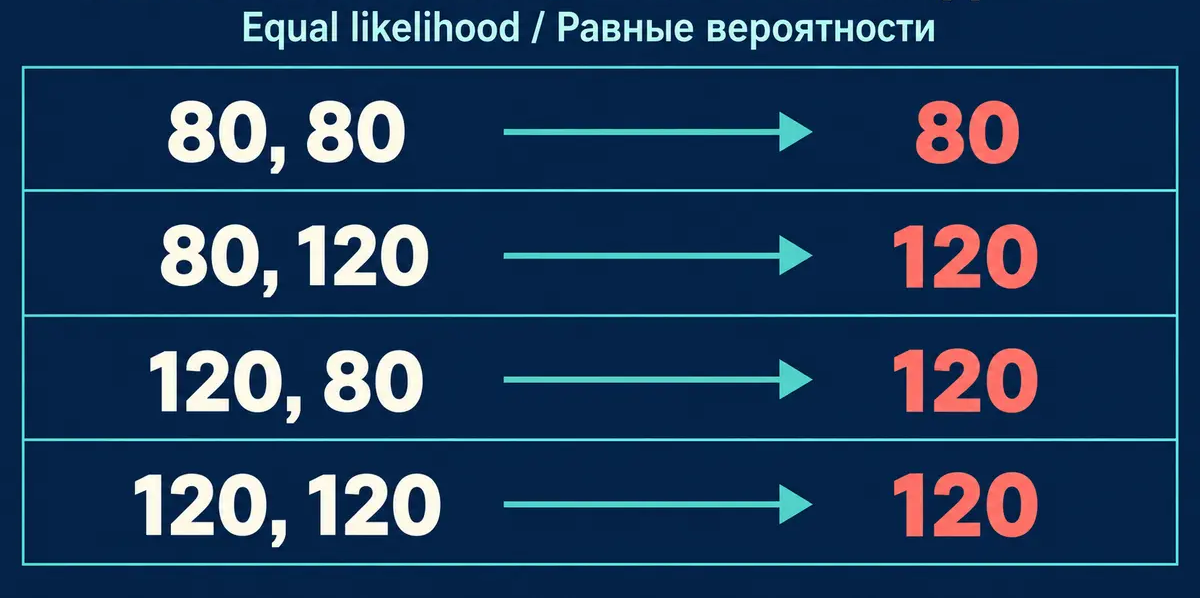
There are four equally likely combinations. Both estimators can report eighty. The first can report eighty while the second reports one hundred and twenty. The first can report one hundred and twenty while the second reports eighty. Or both can report one hundred and twenty. Independence and the half-and-half individual probabilities make each combination occur with probability one quarter.
- Reports of eighty and eighty produce a selected maximum of eighty.
- Reports of eighty and one hundred and twenty produce a maximum of one hundred and twenty.
- Reports of one hundred and twenty and eighty produce the same maximum of one hundred and twenty.
- Reports of one hundred and twenty and one hundred and twenty also produce a maximum of one hundred and twenty.
The selected maximum is low in one case and high in three. Its mean is one quarter of eighty plus three quarters of one hundred and twenty, which equals one hundred and ten. Relative to the fixed benchmark of one hundred, the mean selected error is plus ten. Each individual estimator remains unbiased, but selecting the higher report produces an upward average error.
The mixed pairs do the important work
In the two mixed combinations, the negative and positive errors both exist. The selection rule retains only the positive one. By contrast, retaining a negative error requires both reports to be low. The rule does not change any estimate after it has been produced. It changes which existing estimate becomes the reported result. That is why an audit of the individual methods alone would miss this difference.
The all-low combination is equally important. It prevents the calculation from becoming a claim that the selected maximum must always be too high. In one quarter of the cases, the selected report is eighty, below the benchmark. A positive mean error is compatible with occasional underestimation. Nor does the calculation identify which of the four combinations occurred merely because someone says a report was selected.
Another detail of the table is worth noticing: selection does not create one hundred and ten as a possible realised result. Each comparison retains either eighty or one hundred and twenty. One hundred and ten is the mean across all four possibilities with their probabilities. Entering it in a record of the estimate actually obtained would describe a different situation. Confusing a procedure's mean result with one execution obscures the mechanism being examined.
A third estimate changes the selection distribution
Add a third independent estimator with exactly the same two possible errors. There are now eight equally likely combinations of low and high reports. Only one combination has all three reports low. Every other combination contains at least one high report, so its maximum is one hundred and twenty. The low maximum therefore has probability one eighth; the high maximum has probability seven eighths.
The mean selected report becomes one eighth of eighty plus seven eighths of one hundred and twenty: one hundred and fifteen. The selected mean error is now plus fifteen. Nothing happened to the true object value, the possible individual errors or their individual probabilities. The change comes entirely from applying the maximum rule to a larger collection of independent reports.
This comparison has a narrow interpretation. Under these specified assumptions, adding a third estimate increases the average upward error of the maximum. It does not establish that obtaining more information is generally harmful. A different way of using the reports would be a different calculation. It also does not establish a rule about actual competition, where participants may revise their assessments or choose actions that are not equal to their raw reports.
The two possible report values also place an obvious ceiling on this example. The maximum can never exceed one hundred and twenty, regardless of how many reports are collected. More opportunities to encounter the high value do not create values outside the stipulated range. This boundary is a useful check against language suggesting that the selection effect grows without limit.
Shared errors produce a different result
Keep each estimator's individual distribution unchanged, but replace independence with a common error. On a given occasion everyone reports eighty, or everyone reports one hundred and twenty. Each of those collective outcomes has probability one half. Every individual still has mean report one hundred and mean error zero. Looking at one person's error record would not distinguish this case from the earlier individual distribution.
Taking the maximum now changes nothing. When all reports are eighty, the maximum is eighty. When all are one hundred and twenty, the maximum is one hundred and twenty. Its mean is one hundred for two estimators, three estimators or any larger number of identical reports. There is no additional upward mean error from choosing among exact copies of the same realised estimate.
This result does not make shared errors desirable. When the common report is wrong, everyone is wrong together. The comparison answers a smaller question: how much additional average error does the maximum-selection step create? In this particular perfectly shared-error case, none. Individual accuracy, dependence between errors and the rule used to select a result are three separate features of the exercise.
A count of reports alone therefore cannot identify the relevant distribution. Three independently generated errors and three copies of one error both yield three visible numbers. Yet the mean maximum is different. The distinction concerns the relationship between the errors, not the number of names printed on the reports. Calling every additional document another opinion would not establish the independence assumed in the first calculation.
The extreme case of a fully shared error is deliberate: it can be checked without additional coefficients or complicated formulas. An intermediate dependence would require a separate specification of joint outcome probabilities. One cannot simply take the independent-report result and reduce it by an arbitrary percentage. These two clearly defined cases are sufficient to show why identical individual characteristics do not guarantee an identical selection result.
The selected number is not automatically a price
So far, nobody has paid anything. The model selects a report, not a transaction. Turning the selected estimate into a price would require another rule specifying how offers are made and what the selected party must pay. That rule has deliberately been left out. The means of one hundred and ten and one hundred and fifteen must not be relabelled as expected selling prices.
Similarly, the exercise does not supply a suitable reduction to apply to a real offer. Subtracting the selected average error would not, by itself, solve a strategic decision problem. Such a problem would need assumptions about what participants know, how they respond and what alternatives they face. A small table of raw errors does not contain that information, and its neat arithmetic does not substitute for it.
The same object also need not have the same value to every potential user outside this example. One might have a different use for it or a genuine advantage in operating it. Then a higher report could reflect a different underlying value rather than a more positive estimation error. Our fixed common benchmark excludes that possibility expressly. It cannot be restored casually while preserving the original interpretation of every difference.
Keep the full collection visible when checking the result
Suppose a record contains only the report that was retained. That record may accurately state the selected number while omitting the comparison that produced it. To understand the selection calculation, the analyst needs the rule and the relevant collection, not just the final entry. A maximum of two reports and a maximum of three reports have different distributions in the independent version even though both can display exactly the same value.
In the fictional exercise, all possible reports and their probabilities are supplied in advance. A real review would not acquire that knowledge simply by reading the selected figure. It would need evidence about the original estimation process and an appropriate benchmark for assessing errors. A high selected number alone does not reveal whether the individual methods were biased, whether their errors were independent or whether values genuinely differed.
There is also a distinction between an expected value and a realised average from a small record. The value of one hundred and ten comes from four equally likely possibilities, not from a promise that every four completed exercises will contain each combination exactly once. A short run can contain repeated combinations. Keeping the probability statement intact avoids turning an analytical mean into a schedule of what must happen next.
The table is therefore not a list of reports already collected, but a complete account of possibilities under the assumptions. Its mixed pairs occupy separate rows: the first person supplies the high number in one, the second person in the other. Combining those rows without adding their probabilities would give an incorrect mean. Conversely, counting two identical high reports as two selected maxima in one comparison would change the number of results. Correct counting preserves a simple correspondence: each combination of initial estimates produces exactly one selected maximum, carrying that combination's probability.
A comparison can change what an estimate represents
The exercise began with individually balanced errors and ended with a selected report that was high on average. The bridge was not dishonesty, a change in the object or a failure to calculate the individual mean. It was the rule that retained the largest report. Two mixed combinations were enough to show why negative and positive errors no longer received equal weight after selection.
The correlated comparison establishes the other half of the lesson. A maximum rule does not create the same effect under every relationship between reports. When all errors are identical, there are no mixed combinations for selection to favour. The assumptions about dependence are therefore part of the explanation, not a technical footnote that can be removed while keeping the same conclusion.
A careful description can state both properties at once: each estimation method is unbiased in the stipulated experiment, and the maximum of independent reports is upward biased in that same experiment. Those statements are compatible because they concern different quantities. Recognising the difference is the useful analytical result. It explains why selecting a number changes the question that an accuracy claim must answer.