

A ranking raises a question about execution
Banking artificial intelligence is moving from a collection of experiments towards a question of institutional execution. A model can produce an impressive demonstration without becoming a dependable part of a bank’s work. The October ranking of major lenders therefore matters less as a simple league table than as an opportunity to ask how talent, research, management attention and governance are converted into useful operating results.
The 2026 Evident AI Index covers 50 major banks using public information. JPMorgan Chase and Capital One of the United States lead; Royal Bank of Canada is third, Australia’s CommBank fourth, and UBS of Switzerland sixth. Its four pillars weight talent at 45%, innovation at 30%, leadership at 15% and responsible-use transparency at 10%.
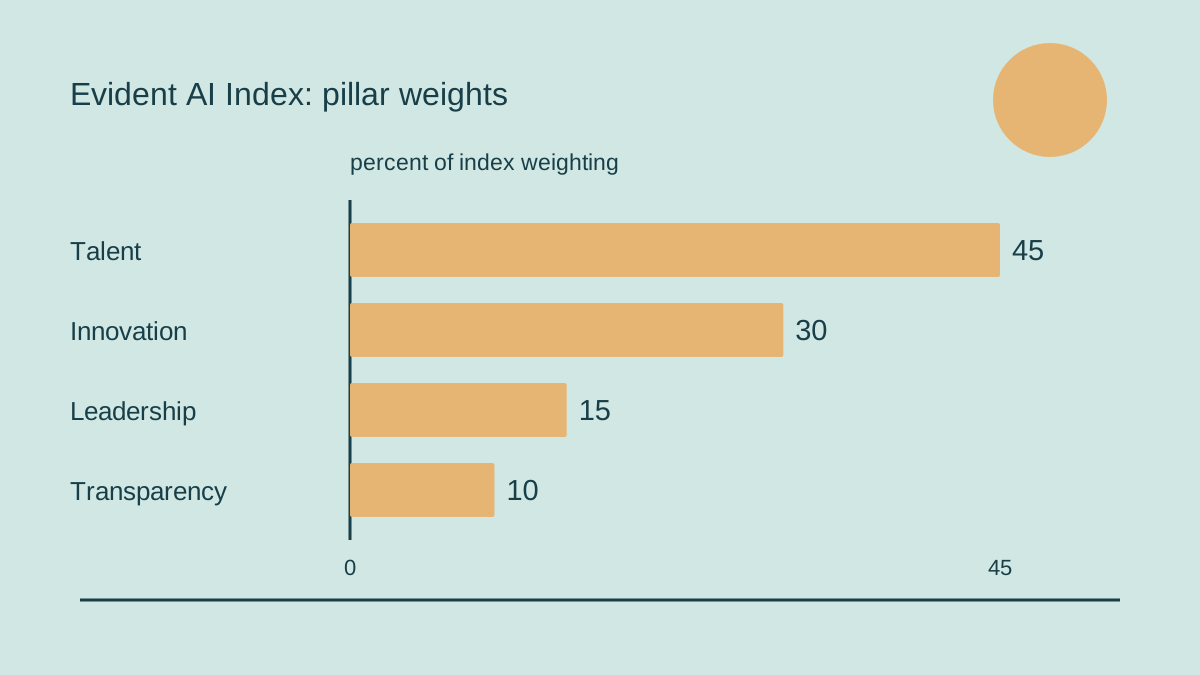
The weighting tells readers what the benchmark is designed to observe. It places substantial emphasis on the capacity to build and deploy systems, while also examining research, institutional leadership and visible responsible-use activity. A high score can indicate an organisation well positioned to execute. It does not, on its own, demonstrate that a particular application has delivered a specific profit, customer outcome or reduction in operating risk.
An outside view has a defined boundary
The index describes its methodology as an outside-in assessment. That distinction matters because public reporting is an observation window rather than the whole institution. Disclosed work, staff profiles, research and governance material can reveal a great deal about organisational effort. They cannot give an external observer unrestricted access to internal testing, every failed deployment or the actual experience of each customer.
The useful reading is therefore conditional. A strong position in the table supports an argument about observable maturity under the published methodology. It should not be translated automatically into a claim that every system at that bank is superior to a competitor’s system. Nor should a lower position be treated as proof that no useful internal work exists. Differences in disclosure and the measures chosen can affect what an outside assessment sees.
Readers can still use the benchmark productively. The pillar structure makes it possible to ask where a bank’s strengths sit and whether its public evidence supports those strengths. That is more informative than drawing a conclusion from the headline rank alone. The table begins an investigation into execution; it does not end the need to understand the applications, their users and their consequences.
Relative positions and absolute progress can diverge
Euronews reported on 7 October that HSBC of the United Kingdom moved from eighth to eleventh, while Lloyds remained fifteenth, NatWest ranked seventeenth and Barclays nineteenth. Across the lenders, software implementation roles grew 4.3%. Twelve banks disclosed realised or projected AI returns, compared with eight previously.
A lower rank is a relative observation. It does not establish that a bank became less capable in absolute terms. If competitors improve more quickly, an institution can make progress and still move down the table. Conversely, a stable rank can conceal substantial improvement when the whole comparison group advances. Reporting the position and the underlying measures separately avoids confusing the race with the distance each participant has travelled.
The same principle applies to claims about acceleration. Rapid sector progress can raise expectations for everyone, making yesterday’s differentiator today’s routine capability. For management, the practical question becomes whether improved tools are embedded in work that customers and employees actually perform. More visible activity can be a signal of ambition, but a competitive argument needs to connect that activity to operating choices and results.
Talent measures capacity rather than automatic value
Specialist staff are part of the capacity needed to develop, implement and supervise AI systems. Hiring can therefore coexist with automation rather than contradict it. A bank may need more people with implementation and control skills precisely because it is applying the technology across more processes. A headcount observation alone cannot establish whether the final effect on employment is growth, redeployment or contraction.
The organisational question is how those skills connect. Research expertise can identify a promising approach; implementation expertise can make it work inside a production environment; risk expertise can establish how its behaviour is tested and constrained. If these functions remain disconnected, a bank can possess impressive specialists without a dependable delivery process. The index’s talent emphasis is meaningful, but it remains a starting measure of institutional capability.
Value also depends on whether employees can use an application effectively. A technically competent deployment may still fail to fit the actual task or require so much checking that its apparent time saving disappears. Training and feedback therefore belong in the execution story. They help an institution distinguish the availability of a tool from its productive use and identify where human judgement remains essential.
Research and implementation have different outputs
Innovation can create knowledge, patents, partnerships and new technical options. Implementation turns selected options into a working process. Those outputs have different time horizons and should not be evaluated as if they were interchangeable. A research programme can be valuable before a particular commercial application is ready, while a mature implementation can deliver practical benefits without producing a new scientific result.
For a bank, the connection between the two is a selection problem. Which research opportunities address a genuine operating constraint? What evidence justifies moving from experimentation to a production trial? Which dependencies must be resolved before a wider rollout? Asking these questions prevents an impressive research portfolio from being used as a substitute for evidence that a specific application is useful in practice.
It also protects long-term work from an inappropriate short-term comparison. Some research is intended to build options and expertise rather than deliver immediate savings. That purpose should be stated clearly. The institutional advantage comes from being able to explain the relationship between the portfolio and the operating strategy, rather than insisting that every research activity has already paid for itself.
Company-reported adoption offers another observation
In its 6 October statement, Royal Bank of Canada reported that more than 72,000 employees used RBC Assist or Aiden, while 10,000 technologists used other AI tools. It said its Aiden platform reached all 8,000 Capital Markets employees and that Aiden QuickTakes produced draft research reports up to 95% faster. These are the bank’s own claims, with specific task boundaries.
The distinction between a draft and a finished report is particularly important. Faster creation of an initial text does not establish that verification, editorial judgement or approval takes proportionally less time. A useful assessment follows the task through its later stages. If a faster draft needs additional correction, some of the apparent benefit shifts into another part of the process.
Adoption counts also answer a narrower question than business value. They indicate that tools have reached an employee population, but do not show how frequently every employee uses them or which outcomes follow. The information is still valuable: it describes distribution and potential reach. The next analytical step is to connect that reach to meaningful use and to establish which part of the workflow actually improves.
Time released is not the same as cash released
A system that reduces the effort required for a task can produce several different outcomes. Employees might use the available time for more work, more checking, a wider service or a different assignment. Cash expenditure changes only when the operating organisation changes how resources are purchased or deployed. Treating all time saved as immediate cost reduction skips an essential step in the argument.
The observation should also specify the denominator. Time per draft, time per completed case and total work completed are different measures. A faster subtask may improve the whole process, but the size of that improvement depends on how important the subtask is within the workflow. No invented numerical example is needed to see the issue: accelerating one activity cannot remove delays elsewhere unless the connection between them is addressed.
This is why a report of realised value should explain the mechanism rather than supply a large number alone. Was the benefit additional output, improved service, avoided rework, reduced spending or a combination? Did it persist after operating costs and supervision? Clear answers make the claim more comparable across applications and help distinguish an implemented result from a forecast.
Reported returns need a common vocabulary
The Euronews distinction between realised and projected returns is material. A bank that estimates future value and a bank that reports a completed result are supplying different evidence. Both can be relevant to understanding strategy, but they should not be placed into a single undifferentiated total. The expected benefit of an announced rollout remains dependent on execution and on the assumptions used to estimate it.
Comparability requires attention to what has been counted. An institution might describe additional revenue, released employee capacity or lower operating expenditure as value. Another might report a narrower accounting outcome. Without a definition, two similarly labelled figures can concern different things. An article can explain this problem without claiming that any particular bank’s disclosed number is wrong.
For management, a consistent internal vocabulary also helps allocate investment. It becomes easier to compare applications when the institution records their cost, intended result, evidence and maturity on the same basis. The purpose is to make competing claims understandable, not to force every application into one financial measure when its legitimate objective may involve quality or risk control.
Governance belongs inside the operating process
The Canadian lender’s statement discusses responsible deployment, and an earlier primary framework helps explain the operational issue. The US National Institute of Standards and Technology released its voluntary AI Risk Management Framework in January 2023. Its core functions are govern, map, measure and manage, applied in the context of an AI system’s use.
These functions describe a continuing responsibility rather than a document produced once and forgotten. The institution needs to understand who is accountable, what the system is intended to do, how its behaviour is assessed and what happens when the results differ from expectations. The appropriate detail depends on the application, but responsibility does not disappear when a model becomes easier to deploy.
In a banking workflow, the distinction between assistance and authority is especially useful. A system that prepares information for an employee and a system that determines an outcome occupy different positions in the decision chain. The article does not assert that a named bank has delegated a particular decision. It identifies why governance should follow the actual role of the application rather than the general label “AI”.
Transparency is evidence of disclosure, not a universal guarantee
Public descriptions of safeguards help outsiders understand an institution’s approach. They can identify responsible teams, testing practices, escalation paths and the intended limits of applications. That visibility is useful. However, a disclosure-based measure cannot certify the outcome of every deployment or guarantee that a control works equally well in every context.
Nor is a safeguard necessarily a separate obstacle to value. If an application needs reliable checking before its output can be used, that checking is part of the cost of delivering the service. Removing it from a productivity estimate can make the benefit look larger than the operating process actually permits. A more useful account considers both the application and the supervision required to use it responsibly.
Transparency becomes stronger when it explains how performance is observed after deployment. Conditions, users and input data can change. A bank’s ability to notice a problem and respond is therefore relevant to execution alongside its ability to launch the tool. The public index makes visible responsible-use activity worth examining, while the substantive assessment still requires attention to the work itself.
The strongest benchmark follows the whole task
A useful operating comparison begins with the completed task rather than the most impressive intermediate output. For a draft-producing application, that means considering verification and approval. For a software assistant, it means considering whether the resulting code works in the intended environment. For a client-support tool, it means considering whether the response resolves the actual problem within the service’s rules.
This does not demand that every application be evaluated in precisely the same way. It demands consistency between the promised benefit and the observation used to support it. A tool intended to improve coverage needs a coverage measure; a tool intended to reduce rework needs a rework measure. Choosing the observation after seeing which number looks best would weaken the evidence.
The institutional connection is important because several teams may contribute to the same final result. If each reports the full improvement as its own benefit, aggregate value can be overstated without any individual task measurement being fabricated. Following the completed workflow makes overlapping contributions easier to identify and helps management allocate credit and investment more accurately.
Questions to ask before turning a rank into a conclusion
The index can support a structured assessment of a bank’s AI programme. The following questions connect visible maturity to operating evidence:
- Which capabilities and disclosed activities explain the institution’s position?
- Is the cited application experimental, deployed or operating at meaningful scale?
- Does the claimed result concern a subtask or a completed workflow?
- Are realised outcomes separated from expectations and forecasts?
- Are checking costs, accountability and the response to errors included?
Each question tests a different part of the execution argument. A bank can have substantial specialist talent but limited deployment, substantial deployment but uncertain outcome measurement, or useful outcomes that remain hard for an outside observer to see. Treating these circumstances separately is more informative than assuming a single ranking can describe them all.
The questions also preserve the role of judgement. A benchmark supplies a defined comparison, and company disclosures supply additional claims. An analyst’s task is to explain how the evidence fits together and where it stops. That approach gives the league table practical value without turning it into an unsupported recommendation about a bank’s future financial performance.
What the October evidence supports
Evident co-founder Alexandra Mousavizadeh described banking AI as entering an industrial phase; its banking managing director Daniel Shackleford Capel emphasised proof of returns, according to Euronews’ report. The published index and methodology show the benchmark’s scope. The NIST framework announcement provides dated context for interpreting operational governance.
The central conclusion is about the movement from visible capability towards evidenced execution. Talent, research and leadership can make delivery possible. Company disclosures can describe adoption and claimed benefits. A stronger assessment connects these inputs to completed work, its cost and its consequences while maintaining the distinction between projection and achievement.
That is the useful commercial reading of the October results. The ranking identifies institutions with substantial observable AI maturity; it does not remove the need to investigate how particular applications work. The next competitive question is whether an organisation can demonstrate repeatable value under the controls its tasks require, rather than simply accumulate more tools or more announcements.