
On 5 September 2025, Reuters described Tesla's proposed performance-linked share award for Elon Musk, including conditions for later vesting. A proposal of this kind is not the same event as a cash payment.
That distinction raises a measurement question which can be explored without estimating the proposed package. When a report puts a monetary amount next to an award of shares, what exactly has been counted? The answer might concern an opportunity, an entitlement subject to conditions, shares that have become available, or money received after a sale. Those descriptions identify different stages. They cannot be interchanged merely because each can be expressed using a currency symbol.
Follow the units before comparing the money
Consider an independent example involving an unnamed employer and employee. All quantities, prices and events below are invented to explain the bookkeeping of stages; they do not represent Tesla's proposal. The employer grants an award covering 100 share units, subject to conditions. A reference price of 10 monetary units gives a multiplication of 100 by 10, or 1,000. This number is a reference calculation only. It is not an estimate of accounting fair value, a probability-weighted valuation or a promise to pay 1,000 in cash.
For this exercise, a proposed award has not yet entered the employee's award register. A granted award enters that register but remains conditional. Vested units become shares available for sale under our stipulated terms. Sold shares leave the employee's holdings in exchange for money. These are definitions for the example, not universal legal definitions. Real documents may distinguish more stages or attach restrictions after an event called vesting. None of those additional terms is silently assumed here.
The first useful record therefore contains a quantity and a status, not just a monetary headline. At the start it reads: 100 conditional units, zero vested shares and zero shares sold. The reference price belongs in a separate field, alongside its date. Keeping that separation makes it possible to update the price without pretending that the employee has satisfied a condition, and to update the award's status without pretending that a market transaction has taken place.
One award, three later destinations
At a later point, suppose that the conditions for 40 units have been fulfilled and those units vest. The remaining 60 are still conditional. Under the example's assumptions, the employee now has 40 shares that may be sold, but has sold none. The award register still accounts for the original 100 units. It has not expanded to 140 simply because 40 units have moved into another category. The event is a transfer of status within one award, not a second grant.
Suppose the reference share price at that point is 12. Multiplying the 40 vested shares by 12 gives 480. This describes the quoted value of a specified holding at a specified moment. The calculation does not establish that the employee received 480 in money. No sale has occurred in the example. Nor should the remaining 60 conditional units be casually appended as if they were another unrestricted holding. Their conditions remain unresolved even though a share price is observable.
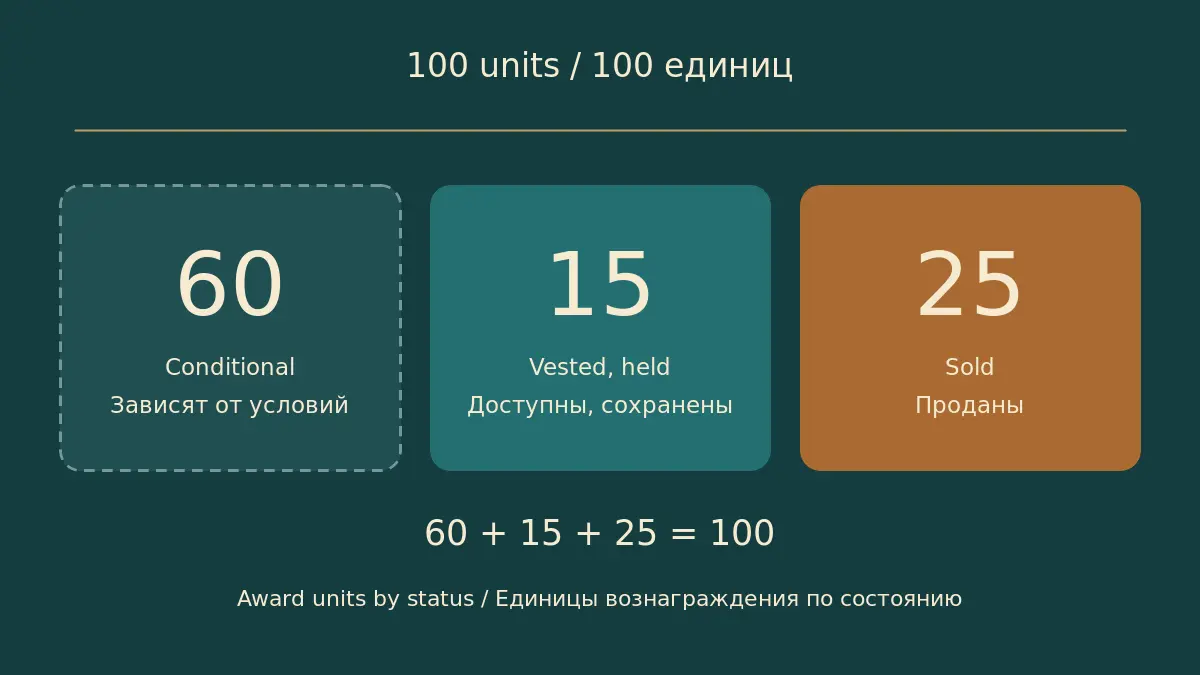
Next, the employee sells 25 of the 40 vested shares at a price of 14. We assume that this sale actually executes at that price, and we omit taxes, transaction expenses and other adjustments throughout. Gross sale proceeds are therefore 350. The remaining vested holding is 15 shares. At the same price of 14, its quoted value is 210. That last multiplication is a holding measurement, not another payment into the employee's cash balance.
- 60 units remain conditional and unsold.
- 15 vested shares remain in the employee's holding.
- 25 vested shares have been sold, producing 350 in gross proceeds.
- The quantities reconcile: 60 + 15 + 25 = 100 original units.
Why adding 480 and 350 counts the same shares twice
The vesting-date amount of 480 covered all 40 vested shares. The later sale proceeds of 350 concern 25 of those same shares. Adding the two amounts and calling the resulting 830 money received from the employer would mix a valuation of holdings with proceeds from disposing of part of those holdings. It would also count the sold units at two stages. The arithmetic addition is possible; the proposed interpretation of the sum is the mistake.
The overlap becomes clear if the vested block is divided using the quantities eventually sold and retained. At the vesting reference price of 12, the 25 later sold shares account for 300 of the 480. The other 15 account for 180. Thus 300 plus 180 equals 480. At the sale price of 14, the first group produces 350, while the second has a quoted value of 210. The two groups have not multiplied in number; each has simply been observed again at another price.
For the original vested block, 350 in cash proceeds plus 210 in remaining quoted share value equals 560 at the later observation. Compared with 480, that is an increase of 80. It is also 40 shares multiplied by the price change of 2. This reconciliation assumes the sale proceeds have neither been spent nor changed in value before the comparison. It combines cash and a quoted holding for a stated purpose; it does not turn all 560 into cash or classify the increase as another employer payment.
A second comparison isolates only the shares actually sold. Their reference value at vesting was 300, and the sale produces 350. The difference is 50. The retained shares account for the other 30 of the 80 increase, because 15 multiplied by 2 equals 30. This division answers where the change sits in the example. It deliberately says nothing about taxable gains, compensation expense or any required reporting category. Those questions would need rules and facts that this exercise does not supply.

A higher price does not fulfil an unrelated condition
Price and award status are separate variables in this model. The rise from 10 to 12 does not itself explain why 40 units vested: their conditions were assumed fulfilled as a distinct event. Likewise, the rise from 12 to 14 does not cause the other 60 to vest. Repricing those conditional units can produce a different multiplication, but it cannot replace missing evidence about their conditions. A register that automatically converts every price increase into newly available shares would be recording an event that never occurred in the example.
The converse is equally important. Suppose the same 40 units vested while the reference price stayed at 10. The employee would still move from zero vested shares to 40 vested shares under the stipulated terms. Their quoted value would be 400 rather than 480. A status change can therefore matter even when the price is unchanged. Quantity, status and price answer three different questions: how many units are involved, what stage they have reached, and which multiplication is being used to describe them.
What a failure scenario removes
Now consider a separate continuation in which the conditions for the remaining 60 units are not met and those units are forfeited. Assume this affects only the still-conditional part of the award. The employee's 15 retained vested shares and the earlier sale of 25 shares remain as stated. The original award can then be reconciled as 60 forfeited units, 15 retained shares and 25 sold shares. Forfeiture closes the conditional category; it does not require us to invent a reversal of events already completed.
This boundary is not a claim that every real plan protects vested shares or sale proceeds in every circumstance. It simply states the limits of the example. Introducing a recovery provision, a service requirement after vesting or an obligation to return money would create a different case. Such terms would have to be described explicitly before their effects were calculated. Without them, subtracting the reference value of 60 units from actual cash proceeds would confuse an opportunity that disappeared with money paid back.
The original reference amount of 1,000 remains a record of the starting multiplication, not a cash balance to be depleted as events unfold. It does not follow that selling 25 shares for 350 leaves 650 still payable. That subtraction uses money amounts drawn from different prices and applies them to an award defined in units. The remaining question must be answered with the register: how many units are conditional, vested and retained, sold, or forfeited? Only then can a chosen price be applied to an appropriate category.
The date is part of the number
A monetary description becomes ambiguous if its date is removed. The values 1,000, 480 and 350 are not three competing estimates of the same transaction. The first combines 100 conditional units with a reference price of 10. The second combines 40 vested shares with a later price of 12. The third records an actual assumed sale of 25 shares at 14. Each number has its own quantity, stage and time. Reducing them to a list of currency amounts conceals precisely the distinctions a reader needs.
Even a comparison made on one date needs consistent categories. Immediately after the sale, there are 15 retained vested shares, not 40. Applying the current price to all 40 and also listing the cash proceeds would again include the sold shares twice. Historical information about the 40-share block can still be useful, but it belongs in a movement record or an explicitly labelled earlier snapshot. It should not masquerade as a current holding alongside cash generated by reducing that holding.
Conversely, a movement record should not be read as a list of simultaneous assets. It can legitimately show 40 shares vesting and 25 being sold during the same period. Both events happened, and recording both is necessary to explain the final holding of 15. The error arises only when events are summed as though they were distinct remaining resources. A table can contain correct entries while a total assembled from the wrong kinds of entries tells an incorrect story.
Separate this year's movement from an older award
Suppose the original award remains in the register across two reporting periods. Carrying its unresolved 60 units into the next period does not create another grant of 60. The opening balance is inherited from the previous closing balance. If the employee receives a genuinely new award, that award needs a separate entry and its own conditions. Otherwise a reader cannot distinguish a continuing opportunity from additional compensation opportunities introduced later. The distinction concerns identification of units, not an assumption about how frequently an employer should make awards.
A simple way to maintain that distinction is to assign the original award a stable identifier. Its movement record begins with 100 units and traces their destinations. A later award starts a separate record, even if it concerns the same kind of share. The records may be brought together for a defined summary, but their histories should remain recoverable. In particular, a share sold from an earlier vested award should not silently reduce the conditional balance of a new award merely because both involve the same employee.
The same discipline helps when no sale takes place during a reporting period. A statement of zero sale proceeds does not prove that no award vested, that no shares remain held, or that no conditional opportunity exists. In our example, the period immediately after vesting but before sale contains 40 vested shares and no sale proceeds. A cash-only description would miss the holding. A share-value-only description would miss the absence of a cash transaction. Neither is wrong if accurately labelled; neither is a complete substitute for the other.
Questions that make a remuneration figure readable
Before comparing two amounts, identify their unit of observation. Are they totals for one award, movements during one period, or holdings at a particular date? Then identify whether the figure is a stated maximum, a multiplication at a reference price, or proceeds from an executed transaction. Finally, check whether the same shares appear in both amounts. These questions do not require a verdict on whether compensation is generous, deserved or effective. They establish whether the proposed comparison has a coherent meaning in the first place.
The information needed for this exercise is modest but specific: an award identifier, the number of units, their current category, the event date and the price used for each monetary calculation. Missing one field can change what can be concluded. A price without a quantity cannot establish a total. A quantity without a status cannot establish availability. An available holding without a sale record cannot establish proceeds. Collecting more decimal places for the reference price cannot repair any of those missing links.
Several potentially important questions remain outside the example. We have not modelled dividends, changes in share count, transaction restrictions, taxes, fees, borrowing against shares, recovery provisions or the probability of satisfying conditions. Nor have we calculated a present value or an accounting expense. Omitting these matters keeps the numerical explanation narrow; it is not evidence that they are unimportant. A real compensation assessment would have to address its own documents and purpose rather than importing the example's convenient assumptions.
A clear account does not need one grand total
The endpoint can be described accurately without forcing unlike measurements into a single headline. In the base case, 60 units remain conditional, 15 vested shares remain held, and 25 have been sold for gross proceeds of 350. At a price of 14 the retained holding has a quoted value of 210. The earlier amount of 480 describes the entire vested block at a different date. All these statements can be true together because they answer different questions.
The central safeguard is to keep the identity of the units visible as they move between stages. A proposal is not a sale; vesting is not the receipt of cash; and revisiting the same shares at another price is not another award. Once those distinctions are explicit, a reader can discuss the scale and structure of compensation without mistaking a reference multiplication for money paid or counting the same shares twice.