
A workshop can have a worthwhile machine repair and still lack the cash to commission it. It can also obtain a comfortable payment schedule for a repair that produces too little value. Separating those two problems is the starting point for understanding equipment renewal financed through an existing asset.
On 12 February 2024, Kommersant reported that DeltaLeasing offered equipment renewal in Russia through a structure in which it bought a customer's machine and leased it back, incorporating the renewal expense. This article examines the arithmetic of that arrangement, not the company's actual contract terms or customer results.
The distinction is important because money received for an existing machine can appear alongside the money needed for its repair. Looking only at the immediate bank balance can make an expensive transaction seem cheap. Looking only at the sum of later instalments can make a useful financing arrangement seem inexplicable. Neither view includes the complete exchange. The existing asset, repair expenditure, production benefit and future payments all need a place in the comparison.
Start with the same machine and the same work
Consider a fictional workshop that already owns a machine. It is choosing whether to renew that machine and, separately, how to pay for the renewal. The repair specification is identical under the two funding routes discussed below. So are the contractor, commissioning date, expected output and operating costs. These assumptions deliberately prevent differences in engineering or service from being mistaken for differences in finance.
All figures are invented, expressed in millions of rubles, and are not quotations, market averages or estimates for DeltaLeasing. Taxes, inflation, discounting and accounting classifications are excluded. The exercise compares cash amounts and their timing over twenty-four months. It does not calculate a market interest rate or establish the appropriate legal form of a transaction. Real offers would require those additional, contract-specific assessments.
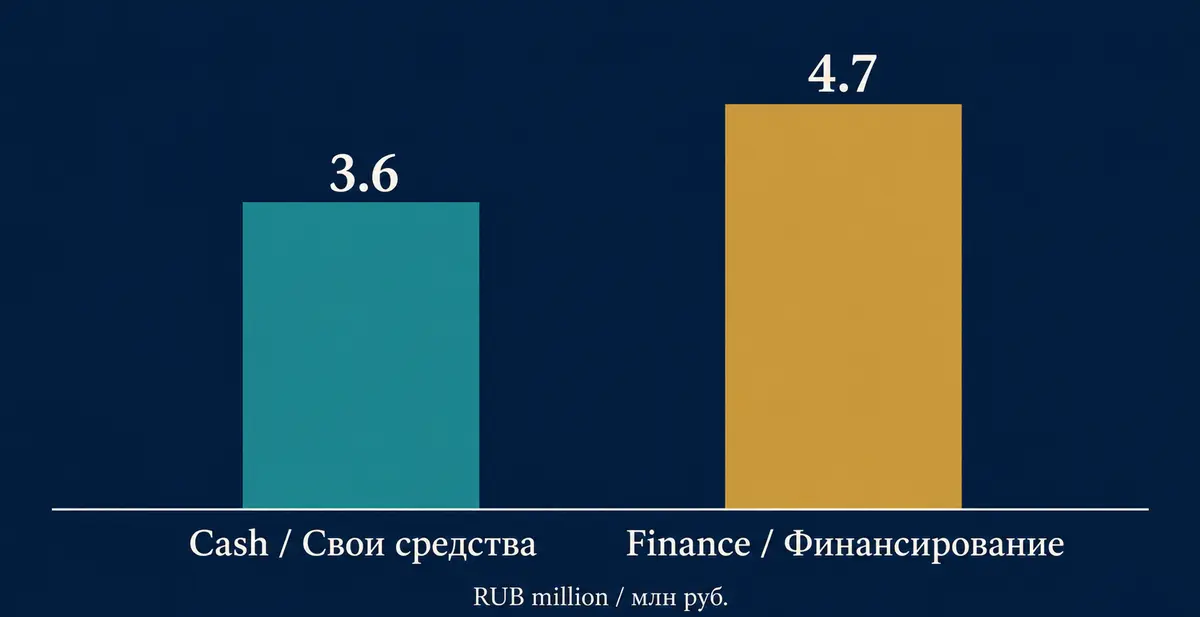
The workshop's machine is assumed to have a current sale value of 2.0. Repair costs 3.6. Work occupies the first two months, during which the workshop loses 0.4 of contribution compared with continuing the existing operation. From month three, the completed repair provides an additional 0.3 each month after the associated operating expenses. This additional contribution is assumed collectible in the month earned; delayed customer payment is examined separately later.
The repair has an economic question before a funding question
There are twenty-two productive months between commissioning and the end of the comparison. At 0.3 per month, their additional contribution totals 6.6. Deducting the 0.4 contribution lost during installation leaves 6.2 before the repair bill. Paying 3.6 for the work leaves a nominal improvement of 2.6 over the twenty-four months relative to the unchanged operation. That result depends entirely on the stated assumptions.
This is not a full investment valuation. It ignores the time value of money and any difference in the machine's remaining value compared with leaving it unrepaired. For the narrower comparison between two funding routes, however, the repaired machine's end value can be held equal. Both routes will deliver the same repaired machine and, under the assumed final purchase, the same ownership at the end. No residual value advantage is assigned to either funding route.
The old machine's original purchase price does not enter the repair arithmetic. It has already been paid and is unchanged by the choice being compared. Its current sale value is different: that becomes relevant when ownership changes to obtain finance. Mixing an old acquisition expense with a current sale receipt would confuse the workshop's history with the cash flows generated by the decision now on the table.
Now introduce a complete financing offer
In the fictional alternative, a financier pays the workshop 2.0 for the existing machine and pays the repair contractor 3.6. The workshop pays an advance of 0.4 and a separate fee of 0.1 at the outset. It then pays twenty-four monthly instalments of 0.25, beginning in month one, and a final purchase amount of 0.2 after the last instalment. These are assumptions for an example, not a description of a provider's product.
The transaction changes the initial cash position by positive 1.5: the 2.0 sale receipt less the 0.4 advance and 0.1 fee. There is no additional 3.6 receipt in the workshop's bank account because the financier pays that amount directly to the contractor. Recording the contractor payment as both cash received and an expense avoided would double-count the same financing service. The equipment still undergoes precisely the work in the cash-funded case.
Later instalments total 6.0. Adding the advance, fee and final purchase amount gives total payments of 6.7. Subtracting the 2.0 received for the existing machine leaves a net nominal outflow of 4.7. The cash-funded repair required 3.6. On these deliberately fixed assumptions, financing therefore adds 1.1 to the nominal cash cost over the full period while substantially improving cash availability at the beginning.
Reconcile the two results without changing the production story
The financed route produces the same operating improvement of 6.2. Against a net funding outflow of 4.7, it leaves 1.5. The cash-funded route left 2.6. Their difference is the same 1.1 found from the financing flows alone. The reconciliation is a useful check: a funding comparison should not quietly acquire extra production benefits merely because an initial receipt makes the proposal look more attractive.
- Operating improvement from repair over the period: 6.2 under either route.
- Cash-funded repair outflow: 3.6, leaving 2.6.
- Financed route's payments less asset-sale receipt: 4.7, leaving 1.5.
- Nominal difference between the two funding routes: 1.1.
That difference is not an annual interest rate. The financier supplies money at different times and receives it through an advance, instalments and a final payment. A rate calculation would need the dated cash flows and a specified convention. Calling 1.1 divided by 3.6 the financing rate would ignore both the existing-asset purchase and the pattern of repayments. A simple total is useful only if its limits remain explicit.
Liquidity can decide which route is feasible
Suppose the workshop has only 0.8 available for this project after protecting the cash needed for its other commitments. Paying 3.6 immediately would create a shortfall of 2.8 even before the installation loss. Including the assumed 0.4 loss brings the gap to 3.2. A positive twenty-four-month result does not close that opening gap. Without another funding source, the cash-funded option is not executable on the assumed timetable.
The financed route starts with the same 0.8 plus its net initial receipt of 1.5, giving 2.3. The two installation months consume the 0.4 operating loss and two instalments totalling 0.5. The project cash reserve therefore stands at 1.4 immediately before the productive phase, assuming no other movements. The example illustrates a genuine service supplied by financing: it moves purchasing power across time. That service need not be free to be useful.
It would still be incorrect to describe the initial 1.5 as profit from the repair. It arises before the machine has produced an additional saleable unit and is linked to the transfer of an existing asset and future obligations. The workshop has more cash available, but the financial exchange has not vanished. A project can become feasible without becoming more profitable. Those two conclusions should be presented together rather than treated as contradictory.
Test whether the uplift can carry the instalment
During each productive month, the assumed improvement of 0.3 exceeds the instalment of 0.25 by 0.05. This is a narrow project cash comparison, not a claim that the workshop's whole business has a particular debt-service ratio. Existing production, unrelated finance and other obligations are deliberately outside the example. The question is whether the improvement attributed to this repair can meet the payment assigned to its funding package.
If the improvement reaches only 0.2 per month, that comparison turns negative by 0.05 each month. Across twenty-two productive months, the gap totals 1.1. The sale receipt may temporarily cover the gap, but it cannot be received again every month. A payment schedule supported mainly by consuming the initial reserve is different from one supported by the repaired machine's continuing contribution, even if both meet their first few instalments.
The monthly break-even uplift for this limited payment test is 0.25. Relative to the planned 0.3, it is five-sixths, or approximately 83.3 percent. That is not the break-even point for the entire investment, because the advance, fee, downtime and final purchase remain. It is simply the operating-phase point at which the additional monthly cash equals the monthly instalment. Defining the question prevents one threshold from pretending to answer several others.
A delayed collection is different from weak production
The baseline assumed that contribution becomes cash immediately. Change that assumption so the first productive month's incremental receipts arrive one month later. The machine can perform exactly as planned while the reserve finances another instalment before those receipts arrive. The eventual nominal contribution need not fall, but the cash trough deepens. This is why a production acceptance test and a customer-payment forecast cannot substitute for one another.
Conversely, weak output reduces the amount eventually available even when every customer pays on time. Combining both problems into a single vague contingency hides their different remedies. A collection delay calls for temporary liquidity if payment remains credible. A persistent contribution shortfall challenges the repair's operating assumptions. Extending payment dates may relieve the first problem; it does not manufacture the missing economic benefit in the second.
The final ownership assumption must stay visible
The example includes a 0.2 final purchase so both funding routes end with the workshop owning the same repaired machine. Removing that payment while still treating the workshop as the owner would improve the financed result only by changing the comparison. Equally, adding a disposal value to the financed route alone would manufacture an advantage. Terminal treatment belongs beside the payment schedule, not in an unexamined footnote.
If an actual proposal leaves ownership elsewhere, the end position needs a different calculation. The analyst must identify what use, purchase or return rights are actually offered and what payments attach to them. Nothing in this fictional schedule establishes those rights for a real contract. The important analytical discipline is simpler: compare equivalent end positions, or identify and value the difference rather than allowing it to disappear.
Ask what each commercial promise changes
A funding package might include services as well as money. If a proposal offers repair management, testing or maintenance, those services should be specified before any value is assigned to them. The example deliberately includes none. Introducing a service would change its assumptions and could change both costs and expected operating performance. It would not justify adding an undefined bonus to the financing result.
The workshop can separate its review into a technical scope, a payment schedule and an acceptance record. The technical scope defines the work and the expected capability. The schedule identifies each payer, recipient, amount and due date. Acceptance determines whether the promised work has been delivered. Keeping those records connected allows a disagreement about a machine's performance to be distinguished from a disagreement about what the financing actually costs.
Keep other uses of the released cash separate
The initial receipt may tempt the workshop to combine this repair with another spending decision. Suppose management wants to use part of the available money for an unrelated purchase. That purchase does not become a benefit of repairing the machine merely because both actions share a funding transaction. Its own costs, receipts and risks belong in a separate calculation. Otherwise the repair could be credited with returns from an entirely different activity while retaining only its own comparatively narrow cost base.
The same discipline applies to the reserve. A sum shown as available for installation losses cannot simultaneously be committed to another project and still protect the original payment schedule. This is an allocation constraint, not a criticism of using finance for several purposes. A combined plan can be coherent, but the cash must be assigned once. Showing opening cash, transaction receipts and committed uses on the same calendar makes that constraint visible before the money is spent.
Changing the project duration requires similar care. The twenty-four-month schedule cannot be evaluated as though obligations end whenever the workshop stops using the machine. An early-exit comparison would require actual settlement terms, the machine's condition and a defined destination for the equipment. None is supplied by this example. It would therefore be misleading to claim that a particular reserve guarantees an affordable exit. The calculation establishes the planned path only; it does not invent a second contract for an unplanned departure.
Two decisions, one consistent comparison
The fictional repair improves nominal project cash under both funding routes, but the financed route gives up 1.1 over the full period to avoid the much larger initial cash requirement. That is the result of this example, not a recommendation for a particular business. Different prices, timing, output, fees or terminal rights could reverse parts of the comparison. The useful outcome is a calculation that reveals where the difference comes from.
Equipment renewal becomes easier to discuss once the repair and its finance stop borrowing each other's benefits. Better production belongs to the technical project. The initial sale receipt and later instalments belong to the funding exchange. Available cash determines whether the sequence can be carried through. A complete comparison keeps all three visible, so that a machine's second working life is judged on more than the size of its first payment.