
Two licensing contracts can produce the same receipt for the owner of a technology while leaving the manufacturer with different reasons to produce another unit. The distinction is not simply whether one payment looks large or small. It is whether the payment changes when output changes. A charge attached to every additional sale enters the production decision differently from a fixed fee that has already been accepted.
On August 1, 2024, Interfax reported Arm's April–June results, including $467 million of royalty revenue and $472 million from licensing. The United Kingdom company's filing uses the more precise category “license and other revenue” for the latter figure. Those separate categories provide a starting point, not a reconstruction of any individual contract.
Arm's June 2024 quarterly filing distinguishes license and support fees from per-chip royalties, whose schedules can vary. The following contracts are independent fictional alternatives, not Arm offers or an explanation of its reported result.
Specify the decision before comparing the payments
Imagine one manufacturer that can license the same technology under either of two hypothetical contracts. The rights, support, quality and other non-price terms are identical. Both contracts cover one period. The manufacturer chooses how many units to produce and sell, and every unit produced is sold immediately. There is no inventory, delivery uncertainty or capacity constraint in this model.
The seller faces an invented demand schedule: the price at which it can sell Q units is twenty minus Q. Quantity is an integer between zero and twenty. If it sells six units, the price is fourteen money units for each; if it sells eight, the price is twelve for each. The lower price applies to the entire quantity, not merely the last unit.
Physical production costs four money units per unit. There are no other variable costs in the example. The technology owner has no incremental cost per unit produced under the licence. Existing research expenditure and the wider costs of both businesses are outside the comparison. Consequently, the calculated receipts and contributions are not either company's net profit.
These assumptions do important work. Quantity responds to the contract because the manufacturer chooses it against a specified demand curve. If sales were fixed regardless of price or production, comparing the contracts would be a different exercise. Here the purpose is to follow the change in the seller's decision, not merely to calculate two bills for an externally determined volume.
A royalty enters the calculation for every unit
Contract A has no fixed fee and charges a royalty of four money units for each unit sold. The manufacturer therefore faces physical production cost of four and a royalty of four on every unit. At quantity Q, its contribution is the selling price, twenty minus Q, less those eight units of charges, multiplied by Q. In compact form, that is (12 − Q) × Q.
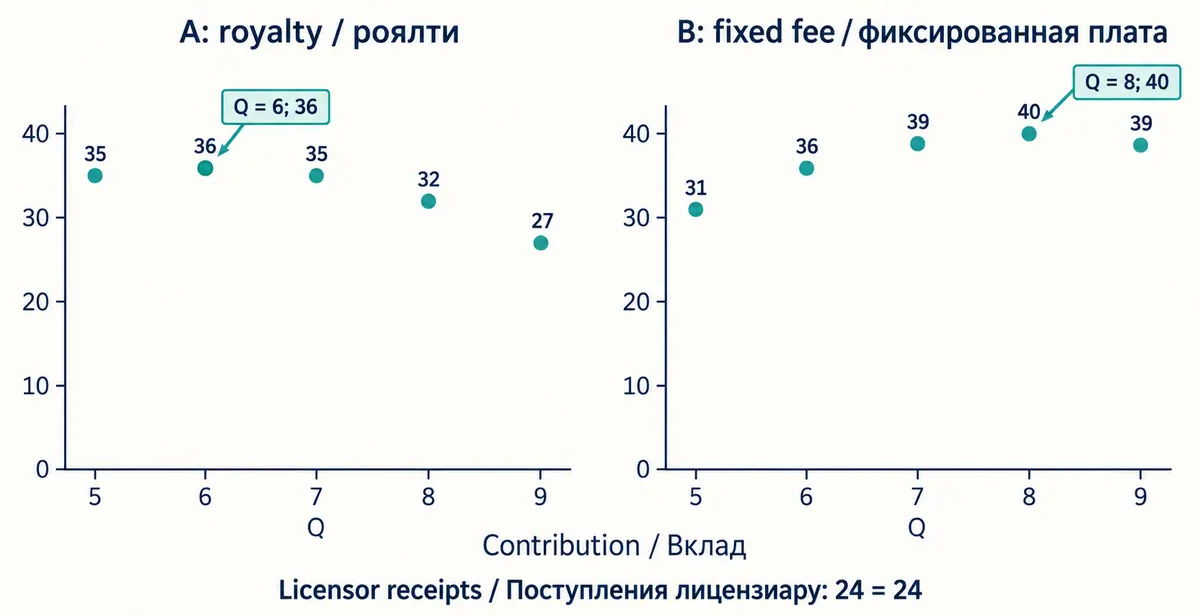
At five units the contribution is thirty-five. At six it is thirty-six, and at seven it returns to thirty-five. Producing eight gives thirty-two, while nine gives twenty-seven. The maximum occurs at six units. The same conclusion follows by writing the expression as 36 − (Q − 6)²: moving away from six reduces the result by a non-negative square.
At the chosen six units, the price is fourteen and revenue is eighty-four. Physical production cost is twenty-four, and the royalty payment is another twenty-four. The manufacturer retains thirty-six units of contribution. The technology owner receives twenty-four. Combined contribution, after physical production cost but before the wider costs excluded from the model, is sixty.
The royalty is not a physical resource consumed in producing a unit. It is a transfer between the two businesses. Nevertheless, it is a real additional payment from the manufacturer's perspective. The manufacturer has a reason to include it when deciding output, even though adding the two parties' contributions later cancels the transfer. Confusing those two perspectives would erase the mechanism being examined.
A fixed payment can leave a different output choice
Contract B instead charges a fixed, non-refundable fee of twenty-four and no per-unit royalty. Participation is accepted, and the fee does not change with the quantity subsequently chosen. The manufacturer still pays four per unit to produce. Its contribution is therefore (16 − Q) × Q − 24. The final subtraction affects the level of contribution but not which quantity maximises it.
At five units this contract leaves thirty-one. At six it leaves thirty-six, at seven thirty-nine, at eight forty and at nine thirty-nine. Eight is the best choice. Algebra gives the same result: the expression can be written as 40 − (Q − 8)². The fixed twenty-four remains payable at each of those quantities, so it does not favour one additional unit over another.
At eight units, the price is twelve and revenue is ninety-six. Physical production costs thirty-two. After the fixed fee of twenty-four, the manufacturer retains forty units of contribution. The technology owner again receives twenty-four. Combined contribution is sixty-four, four more than under Contract A, even though the owner's receipt is exactly the same.
The equality of the owner's receipts is deliberately constructed. It does not claim that actual negotiations naturally produce this pair of prices. It creates a clean comparison in which a changed total transfer cannot explain the difference. What changes is the payment attached to another unit, the manufacturer's chosen output and the resulting price under the stipulated demand schedule.
Check both contracts at the same quantities
Comparing only the chosen outcomes can conceal how the choice arises. At six units, both contracts leave the manufacturer thirty-six. At eight, Contract A leaves thirty-two while Contract B leaves forty. The contracts coincide at one quantity but differ away from it. Replacing a quantity-dependent charge with a fixed payment can therefore change behaviour even when a comparison at one starting volume appears neutral.
- At five units: Contract A contributes thirty-five; Contract B contributes thirty-one.
- At six units: both contribute thirty-six.
- At seven units: Contract A contributes thirty-five; Contract B contributes thirty-nine.
- At eight units: Contract A contributes thirty-two; Contract B contributes forty.
- At nine units: Contract A contributes twenty-seven; Contract B contributes thirty-nine.
This is not a recommendation to select a contract by a five-row table alone. The table is a check on the fully specified fictional expressions, whose maxima can also be verified across the allowed quantity range. Its purpose is to make the incentive visible without treating the result as a mysterious property of a formula or a claim about an actual chip market.

The extra unit changes revenue on earlier units too
Demand is the other essential part of the example. Moving from six units to seven does not add one sale at the old price of fourteen. It changes the common price from fourteen to thirteen. Total revenue moves from eighty-four to ninety-one, an increase of seven, not fourteen. Under Contract A the extra physical cost and royalty total eight, so contribution falls by one.
Under Contract B that same move adds seven of revenue and four of physical cost, with no change to the fixed fee. Contribution rises by three. Moving from seven to eight increases revenue from ninety-one to ninety-six, a gain of five. After four of physical cost, one additional unit of contribution remains. Moving from eight to nine adds only three of revenue against four of physical cost, so contribution falls again.
These steps explain why the chosen quantities differ without relying on an assumption that more production is always better. Even with no royalty, the manufacturer stops at eight. The declining price of the complete quantity eventually makes another unit unattractive. Removing a variable payment changes that stopping point; it does not abolish the demand constraint or create an unlimited reason to expand.
The model also does not establish that a royalty is always passed fully into the final price. Here prices follow the invented demand curve and the seller's quantity choice. A different competitive setting, demand relationship or pricing rule could produce a different response. The demonstrated result belongs to this stated environment, not to every technology licence.
Participation and production are separate decisions
The fixed fee is irrelevant to the output choice only after the commitment is accepted and cannot be changed by output. It can be very relevant to whether the manufacturer enters the arrangement at all. This example stipulates accepted participation under both contracts. It does not assume that every potential licensee can finance the fee or that every outside alternative is less attractive.
For instance, the forty-unit contribution under Contract B describes the result with the stipulated fee of twenty-four. Raising that fee would reduce the manufacturer's contribution at every quantity. Conditional on participation and the same production setting, the best quantity would remain eight. But at some point a different opportunity could make the whole agreement unacceptable. A constant does not change the location of a maximum, yet it can determine whether the maximum is worth pursuing.
That distinction is easy to lose when a business spreads a fixed licence fee over the units it expects to sell. An average cost per unit can be useful for reporting a complete project result. It is not automatically the additional cost of producing one more unit after the fee is committed. Recalculating the average allocation after every quantity change must not manufacture a contractual payment that does not exist.
Conversely, calling a fee fixed does not make it irrelevant to the technology owner. The owner needs receipts to support its business and may care about which customers can enter, the reliability of collection and the value of different rights. Our matched receipt of twenty-four sets those wider commercial questions aside. It does not answer them on the owner's behalf.
Reconcile the two parties without inventing new wealth
Under Contract A, the manufacturer has thirty-six and the technology owner twenty-four, giving sixty together. Under Contract B, the corresponding amounts are forty and twenty-four, giving sixty-four. The difference comes from the changed production and revenue outcome after physical costs, not from counting the same licence payment twice. A payment is a cost to one party and a receipt to the other.
This reconciliation does not value all social consequences. It omits research costs, broader competition, effects on other producers and any benefits not captured in the seller's revenue. It would therefore be inappropriate to label the four-unit increase a complete welfare calculation. The narrower statement is sufficient: the two fictional parties' combined contribution is higher under the specified second arrangement.
Nor is the result a criticism of Arm's actual royalty model. Real contracts can allocate risk, support different rights and reflect information unavailable to an outside observer. The public quarterly figures identify categories of revenue, not the marginal incentives of every customer. Using them to infer the fictional demand curve or declare a real contract inefficient would exceed the evidence.
Know which assumptions carry the conclusion
A reader can also check the direction of the transfer without changing the model. At eight units under Contract A, royalties would be thirty-two rather than twenty-four. But eight is not the manufacturer's chosen quantity under that contract. Substituting it merely to raise the owner's apparent receipt would combine one contract's payment rule with the other contract's behavioural result. A consistent comparison has to keep the choice and the rule together.
Several changes would require a new calculation. A per-unit cost borne by the technology owner would mean that its receipts were not its contribution. A fee refunded when output falls would no longer be a fixed non-refundable payment. Different rights or support would make the two contracts different products, while uncertain demand would raise questions about payment risk that this one-period model does not attempt to answer.
The example deliberately avoids ranking those possibilities. Its contribution is to isolate one reason why two equal payment totals need not be economically interchangeable. A sound comparison first identifies what varies with the decision, then traces the manufacturer's chosen quantity and only afterwards reconciles receipts between the parties. Treating quantity as unchanged from the outset would miss the very response that matters here.
The lesson is therefore precise rather than universal. With identical rights, accepted participation and the stated demand and cost conditions, a per-unit royalty and a fixed fee can deliver the same receipt to a licensor but different output choices. The relevant question is not only how much the licence costs at a selected volume. It is how the contract changes the incentive to move away from that volume.