

On 18 April 2024, Reuters reported Concord's agreed offer for Hipgnosis Songs Fund. Shareholder approval remained outstanding. The report also described a separate portfolio purchase option held by investment adviser HSM, linked to termination of its advisory agreement.
Those two descriptions concern different transaction boundaries. One refers to buying the company from its shareholders. The other refers to acquiring a portfolio owned by that company. Both may ultimately concern the same music, but that does not make the payments, recipients or remaining obligations interchangeable. A headline acquisition number cannot answer all three questions: what changes hands, who receives the money and what remains behind?
This distinction can be explained without estimating the fund's actual value or reconstructing its contracts. The following numerical example is entirely fictional. It is a funds-flow exercise, not a valuation, forecast, tax calculation or interpretation of the reported purchase option. Its purpose is to show why an analyst needs a consistent boundary before comparing two proposed routes to the same underlying assets.
Draw the company separately from its owners
Imagine a company that owns a music catalogue. Its shareholders own shares in the company; they do not each have a separate envelope containing a proportionate selection of songs. For this model, the catalogue remains inside the company until a distinct asset transfer occurs. Changing who owns the shares changes the owners of the company without, by assumption, separately transferring its individual assets.
Give the fictional catalogue a stipulated transaction value of 100 units. The company also holds five units of unrestricted cash and owes twenty units of debt. Assume there are no other assets, liabilities, taxes, restrictions or transaction expenses in the first comparison. These are deliberately strong simplifications. They let the residual economic interest be calculated as 100 plus five minus twenty, or eighty-five units.
The eighty-five is not a public quote or a claim that every buyer would agree to pay that amount. It follows from the values and exclusions just imposed. A real negotiation could attach different values to the catalogue, cash, obligations or other rights. Here, fixing those inputs allows the route of the payment to be examined without changing the valuation assumptions midway through the comparison.
A share purchase pays the selling shareholders
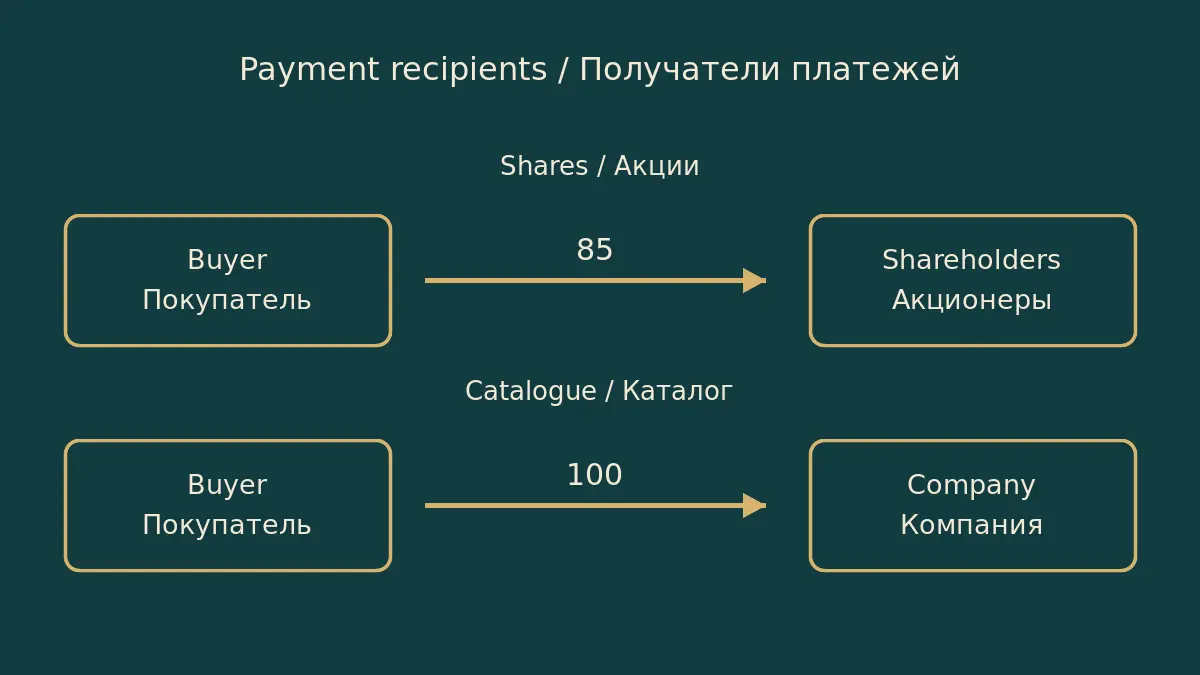
In the first route, a buyer pays eighty-five units to acquire all the shares from their existing owners. The selling shareholders receive the money. The company's own bank account does not receive those eighty-five units in this example. After the share transfer, the company still holds the catalogue and its five units of cash and still has its twenty-unit debt obligation.
The buyer now owns the equity interest in that company. It has paid for a residual position behind the stipulated obligation, not for an unencumbered asset with no other balance-sheet entries. Saying that the buyer acquired control of the catalogue through the company is compatible with this model. Saying that the catalogue-owning company's cash increased by the purchase price is not.
This is a secondary share transfer, not an issue of new shares to raise capital for the company. That distinction matters to any subsequent operating budget. Management cannot fund a new project with money that was paid to departing shareholders unless a further financing transaction brings resources into the company. The ownership announcement and the company's available cash therefore require separate records.
An asset purchase puts money inside the company
In the second route, a buyer pays 100 units directly to the company for the catalogue. The company exchanges its catalogue for cash. Immediately after the stipulated transfer, it has 105 units of cash: the original five plus the sale proceeds. It no longer holds the catalogue, and it still owes the twenty units of debt until repayment occurs.
Suppose the model then requires repayment of that debt at exactly twenty units, with no additional charge. Cash falls from 105 to eighty-five. That is the same residual amount calculated earlier, but it is now cash inside the selling company. It is not yet cash in the shareholders' personal accounts. A further assumed distribution would be needed to place it there.
The exercise deliberately stipulates that a full distribution is available and made. It does not claim that a real company may always distribute its entire cash balance immediately. Other obligations, documentation and restrictions could matter in practice. Keeping the distribution as an explicit additional step is precisely how the model avoids turning an asset-sale headline into an unsupported promise about shareholders' receipts.
Follow the same units through both routes
- Share route: the buyer pays eighty-five to the existing shareholders; company cash remains five.
- Asset route: the buyer pays 100 to the company; company cash rises to 105.
- After the stipulated twenty-unit debt repayment, the asset seller holds eighty-five in cash.
- Only after the separate assumed distribution do the shareholders receive that eighty-five.
The matching residual is a reconciliation, not an argument that the two transactions are equivalent in every respect. They place cash and obligations in different locations along the way. Timing, execution conditions and retained responsibilities have been excluded so far. The simple result is useful because it exposes the error in comparing 100 with eighty-five and declaring the larger number a better shareholder outcome.
Keep cash and debt on the correct side of the boundary
A common analytical mistake would be to compare the 100-unit asset payment with the eighty-five-unit share payment while ignoring the debt and original cash. Another would be to subtract the debt twice: once in calculating eighty-five and again from the shareholders' receipt in the share route. Both errors arise from moving an item across a transaction boundary without explaining why it moves.
The five units of existing cash deserve equal attention. In the asset route they remain inside the seller alongside the incoming proceeds. In the share route they remain in the company whose shares the buyer acquires. They are not an extra payment from the buyer to the former shareholders on top of the stipulated eighty-five. Counting them in both places would create value by bookkeeping.
A useful working sheet therefore gives each amount an owner, a payment direction and a point in the sequence. “Cash” alone is an insufficient label. Cash held by the buyer, cash held by the company and cash received by former shareholders are different balances. A reconciliation should be able to identify whose balance rises when another balance falls, rather than merely placing positive numbers in a column.
One extra expense changes the apparent comparison
Now change one assumption. Let the company incur three units of additional expense only if it follows the asset-sale route. Keep the catalogue price at 100, existing cash at five and debt repayment at twenty. The residual available under the stipulated distribution falls to eighty-two. The payment for the catalogue remains larger than the eighty-five-unit share offer, yet the residual is smaller.
For the asset route to leave eighty-five after that same expense, the stipulated catalogue price would have to rise to 103. Adding the original five, subtracting twenty and subtracting three then returns eighty-five. This is arithmetic under fixed assumptions, not a prediction of what a buyer will bid. It identifies the price that would match a particular residual, not the market's willingness to provide it.
There is no reason to assume in a real comparison that only an asset transaction has expenses. The model assigns the three units to one route solely to isolate the effect. If the share route also had expenses borne by the selling shareholders, their net receipt would need its own adjustment. Both alternatives must use the same convention: gross payments should not be ranked against net receipts.
Management is a separate relationship
Adding a service provider to our fictional company introduces another boundary to the conceptual map. Ownership of a company, ownership of its assets and responsibility for managing those assets are not identical labels. In a simplified organisational diagram they can be represented by different connections. A shareholding connection records an ownership interest; a management connection records a service relationship whose detailed content depends on its agreement.
The presence of an adviser does not, by itself, answer who receives an acquisition payment. Nor does a shareholder transfer alone tell an outside reader which management arrangements continue. Those questions need the relevant transaction and service documents. In particular, a reported option should not be expanded into invented terms about price, automatic exercise, transferable rights or the precise sequence of approvals.
For the fictional example, imagine first that the manager is unchanged in either route. Then imagine that one route instead requires a replacement manager. The balance-sheet bridge can remain arithmetically identical while the operating handover becomes different. That does not establish the cost of replacement or prove that replacement is necessary in the real case. It shows why a clean funds-flow calculation is not the complete execution plan.
A catalogue needs an operating handover, not just a label
Consider what the hypothetical buyer would need to know to operate the acquired business or assets. A list of songs would not, on its own, tell the buyer which records support the interests being purchased, which statements correspond to those interests or which receipts remain unresolved. In this exercise, those are questions for a handover inventory, not claims that particular records were missing from Hipgnosis.
The operating inventory should distinguish the asset description from the evidence used to administer it. A buyer can have an agreed purchase description while still needing to organise how people, records and reporting processes move into the chosen arrangement. Conversely, access to records does not itself establish ownership of the associated rights. Treating those two things as synonyms would make the boundary less clear again.
This observation does not require a claim about the performance of any named artist, platform or collection agency. It is an organisational consequence of separating the thing purchased from the processes used to manage it. A useful transaction analysis describes both, while leaving unresolved factual questions unresolved. It should not invent a catalogue-level revenue forecast merely because a headline price is available.
Compare proposals at one point in the sequence
A proposal to acquire shares and a possible route to purchase assets can be discussed at different stages of development. One may have an agreed price while another remains a conditional right or an unsubmitted alternative. Their existence does not justify presenting them as two completed, executable offers with identical certainty. A comparison needs a status column as well as an amount column.
A historical comparison must preserve the information available at its chosen starting point. An agreed offer, a completed payment and transferred ownership should have separate entries in the transaction record rather than being treated as interchangeable descriptions. Subsequent events cannot be inserted into that earlier account as though they were already known. An analytical example must also remain independent of the actual outcome it is not designed to reconstruct.
Even two fully specified fictional proposals would need a common comparison date. A receipt assumed to be available immediately and a receipt available after several unspecified steps are not the same cash event. This exercise has not assigned delays, probabilities or discount rates, so it cannot quantify a timing advantage. Its contribution is to identify the missing dimension before a numerical ranking claims more than it proves.
Ask what the proposed number actually measures
One final boundary concerns the labels on the calculation itself. The eighty-five-unit residual is not described here as profit from selling music. To calculate a gain on an asset disposal, a reader would need a relevant carrying amount and an appropriate accounting framework, neither of which this exercise supplies. Nor is the 100-unit receipt recurring catalogue revenue. It is the stipulated consideration for transferring the asset. Keeping receipts, residual distributions and operating revenue in separate categories prevents a transaction bridge from quietly becoming an unsupported earnings statement.
A careful reader can begin with a short set of questions. Is the quoted figure a payment for shares or for assets? Which entity receives it? Does the comparison include existing cash? Who retains or repays the obligations? Are the stated amounts before or after the assumed transaction expenses? What further step must occur before the owners receive spendable cash?
These questions are useful because they can change the meaning of the number without changing the number itself. A payment of 100 to a company with obligations is not a promise that its shareholders receive 100. A payment of eighty-five to shareholders does not put eighty-five into the company's operating account. The language surrounding the amount is part of the economic information, not a decorative qualification.
The music-fund example therefore offers a precise lesson. Follow ownership, obligations and money through the same transaction boundary before comparing headline prices. Under the stipulated clean assumptions, two different routes reconcile to the same residual. Once another expense is introduced, they no longer do. Neither result values a real catalogue; both show why the route from an asset to its owners' proceeds must remain visible.