

On 5 September 2024, Reuters reported discussion of a clearing mechanism amid a yuan shortage in Russia, attributing the proposal to VTB's Andrei Kostin. Discussion was not implementation. The report supplies a historical starting point, not the transactions in the example below.
The Basel Committee's 2013 glossary describes multilateral netting as offsetting obligations among several participants into each participant's net position.
Three obligations, one deliberately small experiment
Imagine three businesses, A, B and C. A owes B 100 units, B owes C 100, and C owes A 80. These invented amounts share one unit of account and one settlement session. They are already fixed and undisputed. No exchange rates, interest, fees or new borrowing enter the calculation. The businesses are anonymous domestic participants, not stand-ins for particular banks. The question is narrowly numerical: can two specified procedures finish with identical balances while needing different amounts available at the start?
For the first comparison, A starts with 100 units and the others with zero. Both procedures receive exactly this opening allocation. In the first, the original instructions must be paid individually and in full, without overdrafts. In the second, all three participants are assumed to have an effective agreed arrangement replacing those instructions with a single payment derived below.
Write the opening balances in the order A, B, C: (100, 0, 0). Keep that order throughout. Adding the three entries gives 100, the entire amount of money inside this closed example. A transfer changes the distribution of that total, not its size. No amount arrives from outside during either procedure. This restriction will be important when testing whether 100 is merely a convenient starting amount or the minimum for completing the original whole instructions.
Follow the original instructions one at a time
A can pay B immediately. After the 100-unit transfer, the balances become (0, 100, 0). A has discharged its instruction to B but has not yet received the 80 owed by C. B now holds the original 100 units. Nothing about this first step requires another 100 to appear in the system. The same money is simply in a different participant's possession, ready for the second instruction.
B pays its 100 to C, moving the balances to (0, 0, 100). B's receipt and payment are equal. C can now pay the final 80 to A, leaving (80, 0, 20). All three original instructions have been completed. A finishes 20 below its opening balance, B finishes where it started, and C finishes 20 above its opening balance. The three changes are therefore minus 20, zero and plus 20.
- Opening balances: A 100, B 0, C 0.
- After A pays B 100: A 0, B 100, C 0.
- After B pays C 100: A 0, B 0, C 100.
- After C pays A 80: A 80, B 0, C 20.
The payment amounts add to 280, but the largest total balance in the system is still only 100. In fact, that total is 100 at every listed step. Treating 280 as the cash required at the beginning would count the first 100 again when B passes it to C, and count 80 of it once more when C returns that portion to A. The list records movements, not three independent piles waiting outside the process.
The last transfer is smaller than the first two. That is why 20 remains with C rather than returning to A. The resulting distribution can be read directly from the original obligations: A must send 100 and receive 80; B must receive and send 100; C must receive 100 and send 80. These differences describe the completed example even before the intermediate states are written down. The states show how this particular procedure reaches them.
With the chosen opening allocation, the order shown is forced rather than selected for speed. Initially only A has money. After its payment, only B has money. After B's payment, only C has money. At each of these states there is exactly one funded original instruction. Trying to put C first would require a different opening allocation, not merely moving its name to the top of a list. This explains why no comparison of alternative processing times is needed to verify the displayed sequence.
Reach the same finish with a different instruction
Now return to the same opening balances, (100, 0, 0), and apply the assumed agreed alternative. A transfers 20 directly to C. The resulting balances are (80, 0, 20), exactly the same as before. There is no payment involving B in this alternative. That absence matches B's zero overall cash change; it does not imply that B had no original obligations. The original list contains both its 100-unit receipt and its 100-unit payment.
A's 20-unit payment to C is not an extra purchase inserted into the story. It is the replacement settlement instruction specified by the assumed arrangement. Nor has the example discovered that A originally bought something from C: the original direction between those two participants was C owing A 80. Keeping the original obligation list beside the replacement instruction prevents those two different descriptions from becoming confused.
The distinction is particularly visible if the original claims are examined pair by pair. Between A and B there is only A's 100-unit obligation. Between B and C there is only B's 100-unit obligation. Between C and A there is only C's 80-unit obligation. No pair contains two opposite amounts to subtract. Cancelling only opposite entries within each pair would therefore leave this particular list untouched. The 20-unit replacement uses the relationship among all three participants.
B's disappearance from the replacement payment must come after the calculation, not before it. Delete B and both entries involving it from the original list, and only C's obligation to A remains. That truncated list would call for eighty units to move from C to A, the opposite direction from the replacement payment in the complete example. B's zero overall change therefore does not make its original entries irrelevant. Its receipt and payment connect the two other participants' calculations. Removing those entries is different from including them and finding that their effects on B cancel. The zero result belongs to a completed calculation using the full list; it is not a reason to start with an incomplete list.
For A, both procedures deliver an ending balance of 80. For C, both deliver 20. For B, both deliver zero. This is a participant-by-participant comparison, stronger than observing that the group total remains 100. An alternative ending such as (70, 0, 30) would preserve that total too, but it would not reproduce the agreed cash changes of this example. Matching the group sum alone would miss the ten-unit difference for A and C.
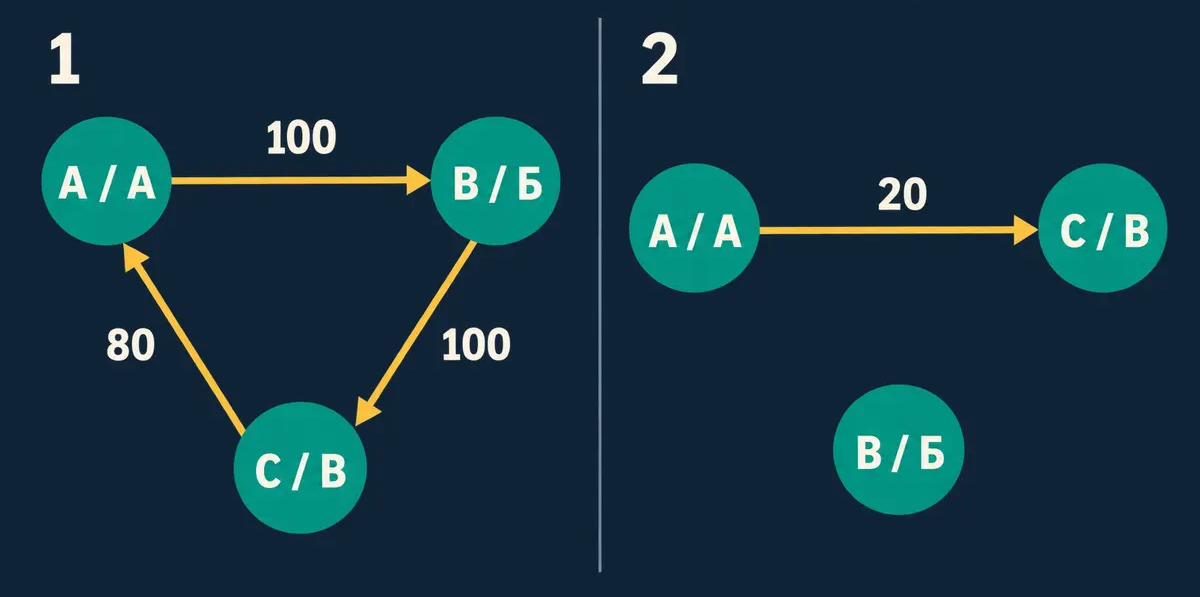
Why 100 and 20 are the two starting requirements
So far, both procedures began with 100 at A. That makes their final balances directly comparable, but it does not show that both need all 100. Under the replacement instruction, A uses only 20. Its other 80 never moves. Start that procedure instead with (20, 0, 0), and A can still complete the specified payment to C, finishing at (0, 0, 20). The absolute ending balance at A is now different because its opening balance was smaller.
That second opening allocation cannot start the original instructions. A has 20 but needs 100 to pay B in full. B has nothing and owes 100. C has nothing and owes 80. Every instruction fails the available-balance test. The failure is not a claim that A ultimately loses 100: the earlier calculation already established its completed cash change as minus 20. The obstacle is having enough for an original whole instruction before the offsetting receipt arrives.
A lower bound, followed by a working construction
Could some clever allocation of less than 100 make the original whole-payment procedure work? Not under the stated closed-system rules. At least one 100-unit instruction must eventually be executed. At that moment its sender must hold 100. If the total money across all three participants is less than 100, no individual can hold 100 without another having a negative balance. Negative balances are excluded. Thus the total starting amount cannot be less than 100.
The earlier sequence supplies the other half of the proof: 100 at A really does work. A lower bound of 100 plus a successful construction using 100 establishes the minimum for this example. Merely noticing that the biggest payment is 100 would not have supplied the successful sequence. Here the sequence has been explicitly checked, including the final 80-unit payment, rather than presumed from the size of the largest instruction.
For the replacement procedure, the corresponding proof is shorter. Its only instruction is 20 from A to C. Fewer than 20 units in the closed system cannot fund that whole instruction without a negative balance; 20 at A can. Its minimum is therefore 20. Comparing these two proved minima gives a difference of 80. Comparing their payment totals, 280 and 20, gives a different difference of 260. The two subtractions answer different questions.
Allocation still matters when the total is sufficient
The 100-unit minimum does not mean every opening allocation totalling 100 starts the original sequence. Put 40 at A, 40 at B and 20 at C. A cannot pay 100, B cannot pay 100, and C cannot pay 80. No first instruction is possible, although the system contains 100 in total. This allocation contrasts with the successful (100, 0, 0) opening. Amount and placement are separate features even within this tiny example.
This observation does not require a search for the best payment order. With (40, 40, 20), there is no eligible first payment to reorder. With (100, 0, 0), the displayed sequence already works. Moving balances between participants before starting would introduce additional instructions or arrangements, outside the two procedures being compared. The minimum claim is that a successful allocation exists at 100 and none exists below 100, not that every distribution at that total succeeds.
The replacement procedure also has a placement condition. Twenty units at C and zero at A would not fund A's instruction. Twenty at A would. The example therefore identifies both the minimum total and a sufficient location for it. Saying only “the group needs 20” would omit the identity of the sender in the sole remaining instruction. The successful starting allocation is part of the result, not a dispensable footnote.
What the smaller payment total does not measure
The 260-unit fall in recorded movements cannot be assigned to any participant as extra earnings. Under the common opening allocation, A ends with 80 in both procedures, B with zero in both, and C with 20 in both. There is no additional 260 in those balances, and there is no fourth participant receiving it. The number comes from deleting offsetting movements in this constructed comparison, not from adding money to an ending account.
Similarly, the 80-unit difference between minimum starting amounts is not an 80-unit increase in A's ending wealth. With 100 initially available, A retains 80 after either procedure. With only 20 initially available under the alternative, A finishes at zero. The smaller opening balance has not been conjured into a larger ending balance. What changes is whether 80 must be present during the specified process, not the completed cash change assigned to A.
No fee schedule has been introduced, so multiplying the reduction in transfers by a supposed charge would add a new assumption. No financing rate or duration has been introduced either. The arithmetic can establish 100 versus 20 without putting a price on making those balances available. Keeping the result in units of starting funds avoids pretending that this experiment has also calculated a cost saving, a profit margin or a return on investment.
A balanced variation checks the distinction
Change just the final original obligation from 80 to 100. A now owes and receives 100, as do B and C. Each completed cash change is zero. Under the assumed agreed offset, there is no remaining transfer. Under the original whole-instruction rule, however, zero money everywhere cannot start any of the three 100-unit payments. With 100 at A, the money can travel around the three instructions and return to A.
This variation removes the 20-unit imbalance but preserves the contrast between the two procedures. It is not a second claim about the news event. It checks a precise feature of the invented ledger: zero eventual change for every participant does not supply the opening 100 required to start the original whole payments. Conversely, the original 100, 100, 80 list shows that a group-wide sum of zero changes can coexist with nonzero changes for particular participants.
The useful conclusion is the separation of three records in this experiment: original obligations, executed payment instructions and balances available at each step. The original list totals 280; the displayed gross sequence needs 100 placed at A; the agreed replacement needs 20 placed at A. Both produce the same individual cash changes. Those exact statements explain the contrast without turning the historical proposal into an accomplished system or the fictional reduction in movements into an economic windfall.