

A project can have lost money and still be worth finishing. It can also have consumed a large investment and still be better stopped. Neither conclusion follows from how much has already been spent. The next decision depends on the alternatives still available: what completion would require, what it would produce, and what could be recovered or would have to be paid on exit.
On 7 February 2026, Reuters reported that Automotive Cells Company said the prerequisites for restarting its projects in Italy and Germany were not expected to be met. The company described dialogue with employee representatives about possible discontinuation.
The report does not provide the project cash flows needed to evaluate those choices. The analysis below therefore makes no judgment about whether the company should proceed or stop. Instead, an independent numerical example separates the history of a project from the cash consequences of the decision now facing its owner. That separation matters precisely when an earlier commitment makes every available outcome uncomfortable.
Draw the boundary at the current decision
Imagine a business that has already paid 60 monetary units for work on a project. This amount cannot be recovered, transferred or refunded under the initial assumptions. Completing the project requires another 40 units and will produce a future benefit worth 50 units. Alternatively, the business can stop, recover assets worth eight and pay three to close the project.
All amounts are invented, not estimates for any battery manufacturer or other real company. They are measured at one common evaluation date so the exercise does not require a discount-rate assumption. Taxes, financing, uncertain outcomes and legal restrictions are excluded. The future benefit is a net amount after operating expenses other than the specifically listed completion cost; those expenses must not be subtracted a second time.
The available choices are deliberately limited to completion and exit. Both are assumed feasible. A real business might have additional alternatives, but adding them would require their own proceeds, costs and conditions. The purpose of this small comparison is to understand which amounts change between the two choices already defined.
Completion brings ten, exit brings five
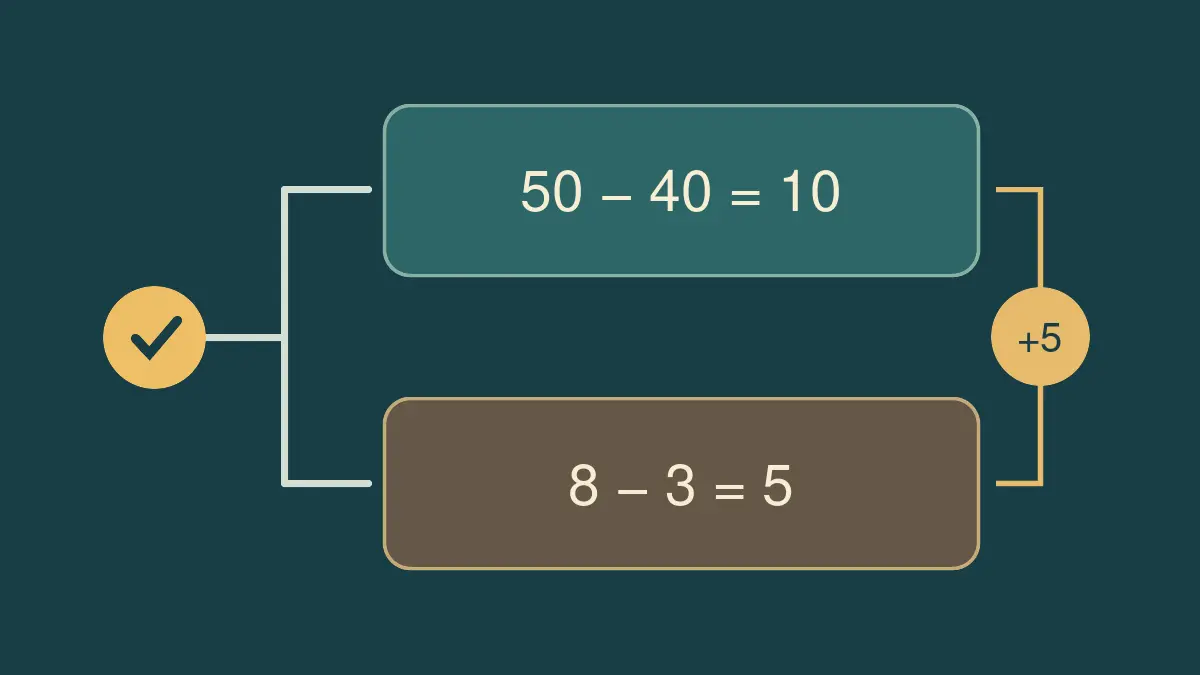
From the present decision point, completing the project produces 50 and requires 40, leaving ten. Stopping produces eight of recoverable value and costs three to close, leaving five. Completion therefore produces five more units than exit. Under these assumptions, finishing is the better of the two available choices even though the project has already absorbed 60.
| From today | Finish | Exit |
|---|---|---|
| Proceeds | 50 | 8 |
| Further costs | 40 | 3 |
| Net result | 10 | 5 |
Now restore the earlier spending to describe the whole history. Completion gives ten minus 60, or a total loss of 50. Exit gives five minus 60, or a total loss of 55. Both totals are negative, yet completion still leaves the owner five better off. A decision can limit a loss without turning the original project into a successful investment.
The comparison does not erase the earlier expenditure. It places that expenditure in both histories rather than pretending it belongs to only one. That is why the ranking remains unchanged.
Past spending does not become a benefit of continuing
A common temptation is to describe the 60 already paid as something that finishing will save. But the example gives no way to recover that payment merely by completing the project. Completion delivers the specified future benefit of 50; it does not deliver 50 plus the old 60. Adding the earlier payment to future proceeds would invent a receipt that neither alternative provides.
The opposite mistake is to charge the old 60 only against completion while treating exit as a fresh start with no history. That would compare a whole-project outcome on one side with a forward-looking outcome on the other. The two columns would answer different questions, so their apparent difference would not describe the choice available today.
Increase the irrecoverable historical expenditure from 60 to 600 while leaving every future amount unchanged. Both whole-project outcomes deteriorate by 540, but completion still beats exit by five. The history becomes worse; the incremental ranking does not.
A smaller remaining bill is not automatically attractive
Someone might argue that the project should continue because most of the money has already been spent. That argument substitutes a proportion for a comparison. What matters in the example is whether the remaining 40 buys an outcome better than the net five available on exit. The fact that 40 is smaller than the old 60 does not establish that result.
Raise the remaining completion cost to 48 while keeping the future benefit at 50. Completion now leaves two, while exit still leaves five. Stopping is better by three, even though the remaining bill is still smaller than the historical expenditure. Conversely, a project with little spent so far could justify a substantial new commitment if the specified future alternatives supported it.
Percentage complete is therefore not a decision rule. It may describe progress against a budget or a work plan, but neither percentage supplies the missing comparison with the alternative use or recovery of resources.
The threshold comes from the alternatives
In the baseline, exit yields five and completion produces a benefit of 50 before the remaining bill. The largest remaining bill that leaves completion equally attractive is therefore 45. Below 45, completion is better; above 45, exit is better. At exactly 45, both produce five, and this model alone gives no reason to prefer one.
That threshold is not a market quotation, an approved budget or a recommendation for an actual investment. It is the result of the assumed benefit and exit recovery. Change either input and the threshold changes. The old expenditure of 60 does not appear in it because that amount is common to both histories.
A past payment may still contain recoverable value
The word spent does not settle whether an amount is irrecoverable. Suppose a separate ten-unit payment made earlier will be refunded if the owner exits, but not if it completes. Exit now produces the original five plus the refund of ten, giving 15. Completion still produces ten. The refund reverses the baseline ranking.
This is not a contradiction of the earlier result. The refund creates a future receipt that differs between alternatives. The initial assumption that the historical payment was unavailable under either choice no longer describes that part of the transaction. Calling every past payment a sunk cost would conceal the receipt the decision-maker can still obtain.
For clarity, the ten-unit refundable payment in this variant is separate from the original irrecoverable 60. If it were part of a single reported historical total, the analyst would need to separate its refundable and non-refundable components. Either presentation can work, provided the refund is counted once and the history is reconciled consistently.
An unpaid amount can be common to both choices
The reverse distinction also matters. Assume the owner must pay a further six units under either alternative, with no way to avoid or change that obligation in this exercise. Completion now leaves four rather than ten. Exit leaves minus one rather than five. Completion still beats exit by five because both alternatives have fallen by the same six.
The payment remains relevant to cash planning. A business cannot ignore a bill merely because it cancels out of one comparison. The narrower conclusion is that this particular obligation does not explain a preference between the two defined choices. A payment can matter greatly to affordability while contributing nothing to their incremental difference.
Whether a real obligation is unavoidable depends on evidence not supplied here. An invoice date, an internal budget label or an unpaid status cannot establish its legal treatment. The example stipulates identical payment under both paths and draws only the arithmetic conclusion that follows from that stipulation.
Stopping is not necessarily a zero-cost alternative
Exit in the baseline already includes a closure cost of three. Now add a further termination payment of nine that arises only if the project stops. Net exit recovery becomes eight minus three minus nine, or minus four. Completion remains ten, so its advantage rises to 14. The additional payment matters because the current choice changes whether it occurs.
This does not suggest that organisations should create exit penalties to make weak projects appear attractive. It shows that an existing decision cannot be evaluated by assuming away costs attached to an available alternative. A comparison that labels exit as zero while omitting specified exit payments can rank the options incorrectly.
The baseline closure cost and the new termination payment must also remain distinct. If an actual estimate already includes termination, adding it again would double-count the same outflow. The useful classification follows which choice causes a payment, not how many different documents mention it.
Ownership does not make an asset free to use
The eight units recoverable on exit represent another important boundary. The owner already possesses the relevant assets, but using them to complete the project gives up the recovery assumed under exit. Their historical acquisition price is not the right substitute for that current alternative. Neither is zero merely because no new purchase is required.
There are two equivalent ways to display the baseline. One compares completion's ten with exit's five. Another asks whether completion's ten exceeds the five forgone by not exiting. Both give an advantage of five. The second presentation must not then subtract the same exit recovery again, or it would charge the alternative twice.
This is why a clear pair of complete alternatives is often easier to audit than a long list of loosely labelled relevant costs. Each receipt or payment has an explicit place, and the difference can be calculated after the two paths are internally consistent.
Keep the earlier decision open to review
Excluding an irrecoverable amount from the current ranking does not excuse poor original decisions. The decision to begin the project and the decision to finish it occur at different times with different alternatives. The first may have committed the owner to a disappointing position. The second must address the position that now exists rather than pretend the first can be undone.
An organisation can therefore investigate how the 60 was authorised while also choosing the path that limits further loss. Those activities are compatible. Refusing to continue solely to demonstrate toughness could sacrifice the five-unit advantage in the baseline; continuing solely to defend the original decision could sacrifice three in the higher-completion-cost variant.
A useful review preserves both questions. What information supported the initial commitment, and what did later evidence change? Separately, which currently feasible alternative produces the better specified outcome? Combining the questions into a verdict on whether the project is good or bad makes both harder to answer.
The calculation is only as complete as its boundaries
The numerical example counts financial amounts available to one project owner. It does not measure every consequence for employees, customers, neighbouring businesses or public authorities. Nor does it resolve the timing of payments, financing availability or uncertain future receipts. A five-unit advantage within the model is not proof that all affected parties benefit or that the owner can execute the chosen path.
Additional consequences should be identified explicitly rather than hidden inside the old spending total. If completion requires another future payment, add it to completion. If exit produces an additional recovery or obligation, add it to exit. If an effect cannot reasonably be expressed as one monetary figure, disclose that limit instead of manufacturing precision.
The discipline is to compare the same scope, horizon and decision-maker across alternatives. A narrow calculation can be informative when its limits are visible. It becomes misleading when its result is presented as a complete corporate strategy or a reconstruction of facts that were never observed.
Judge the next payment on what it changes
A compact decision record can preserve the main distinctions:
- Record irrecoverable historical spending separately from future choices.
- Describe completion and exit as complete, feasible alternatives.
- Include refunds, recoveries and closure payments where they actually arise.
- Keep common future obligations in cash budgets even when they cancel in the comparison.
- Reconcile the forward-looking result with the whole-project history.
- Review the original commitment without letting its size decide the next one.
In the baseline, finishing loses 50 across the project's full history, while stopping loses 55. The reason to finish is the five-unit difference still available, not the 60 already gone. With a larger remaining bill or a conditional refund, the ranking changes. The transferable lesson is not always continue or always cut losses. It is to identify what the next decision can still change, then keep that comparison separate from the money it cannot bring back.