

A sawmill can have a profitable order book and still lack the cash for its next machine. Timber already bought, unfinished batches and invoices awaiting payment all compete with an investment that promises benefits later. When expansion relies on internal funds, the relevant question is not simply whether the business earns a profit. It is whether money becomes available before each project payment falls due, without leaving the existing operation unable to meet its commitments.
That distinction offers a useful way to read a late-2024 report about the forest industry in Russia. Kommersant reported on 5 December on a B1 and ASBO survey conducted in October and November among about thirty companies. According to the report, 81% of respondents regarded their own funds as the principal source for expanding their activities. That is a statement about the surveyed businesses, not a measurement of the proportion of investment financed internally across the entire industry.
The following analysis examines the operating choices behind that answer. It does not estimate the finances of the respondents or forecast the sector's investment. Its numerical example is fictional. The purpose is to show why a decision to use retained cash creates a scheduling problem as well as a profitability test, and why the same account balance cannot safely be assigned to several purposes at once.
Own funds are not a separate pot waiting to be spent
The expression can suggest money that is free of obligations. In a working factory, cash may already have several claims against it. Materials arrive before finished goods leave. Employees and service providers expect payment while customers may settle invoices later. Equipment maintenance has its own timetable. An expansion proposal enters this calendar rather than an empty balance sheet. Money need not be borrowed to have an opportunity cost: using it for a deposit can remove the ability to buy an essential input next week.
There is also a difference between accumulated accounting earnings and liquid resources. A sale on credit can contribute to reported profit before the customer pays. Inventory may embody expenditure without being ready for sale. The practical starting point for an internally financed project is therefore a dated schedule of receipts and payments, not a percentage of last year's earnings. This does not make profit irrelevant. It means that profit and liquidity answer different questions about the same proposed expansion.
Follow the material through the yard
For an illustrative wood-processing business, the cash commitment begins before a finished bundle reaches a customer. Purchased material occupies space and requires handling. Different batches may wait for different operations. Some output may be available for sale while other material remains unfinished. A single inventory total hides those stages. A useful internal view separates material that can support a confirmed order from material awaiting a specification, a buyer or a processing slot. Their accounting value does not reveal when each will generate cash.
Reducing stock is not automatically the answer. An indiscriminate cut can interrupt work or force small, expensive replenishment orders. Conversely, buying a large quantity because the unit price looks attractive can consume funds needed for the project. The relevant comparison includes timing: how long the material is expected to remain in the operation, which order it supports and what would happen if that order moved. These are questions for the enterprise's own records, not assumptions that can be supplied by an industry headline.
A working inventory classification
- Material linked to confirmed orders with an agreed delivery window.
- Routine operating stock needed to keep existing work moving.
- Material awaiting processing capacity or customer clarification.
- Slow-moving stock without a clear near-term route to cash.
The categories need not imply that one batch is good and another bad. They expose different timing risks. A management team considering expansion can then ask whether the proposed equipment would actually shorten a waiting stage or merely add capacity elsewhere. If the cash remains trapped in a different operation, a faster new machine may not solve the financing problem that justified its purchase.
Separate the investment from its supporting expenditure
An equipment quote is an important document, but it is not necessarily the complete cash requirement. A project can also involve preparation of the installation area, transport, commissioning, training or a temporary interruption of existing work. Which items apply depends on the actual project. Listing them as questions avoids the opposite errors of assuming that they are all included or inventing a universal allowance. Each commitment needs an owner, a payment date and a clear indication of whether it remains optional.
The distinction between reversible preparation and binding expenditure is particularly useful. A feasibility review may be stopped with a limited loss. A non-refundable deposit or a site alteration may be harder to reverse. Internal funding does not remove this difference. It makes it more important to know the point at which a change of plan would no longer preserve the money. A project schedule should show that point explicitly, alongside the anticipated date when the equipment can support paid deliveries.
A fictional budget exposes the timing problem
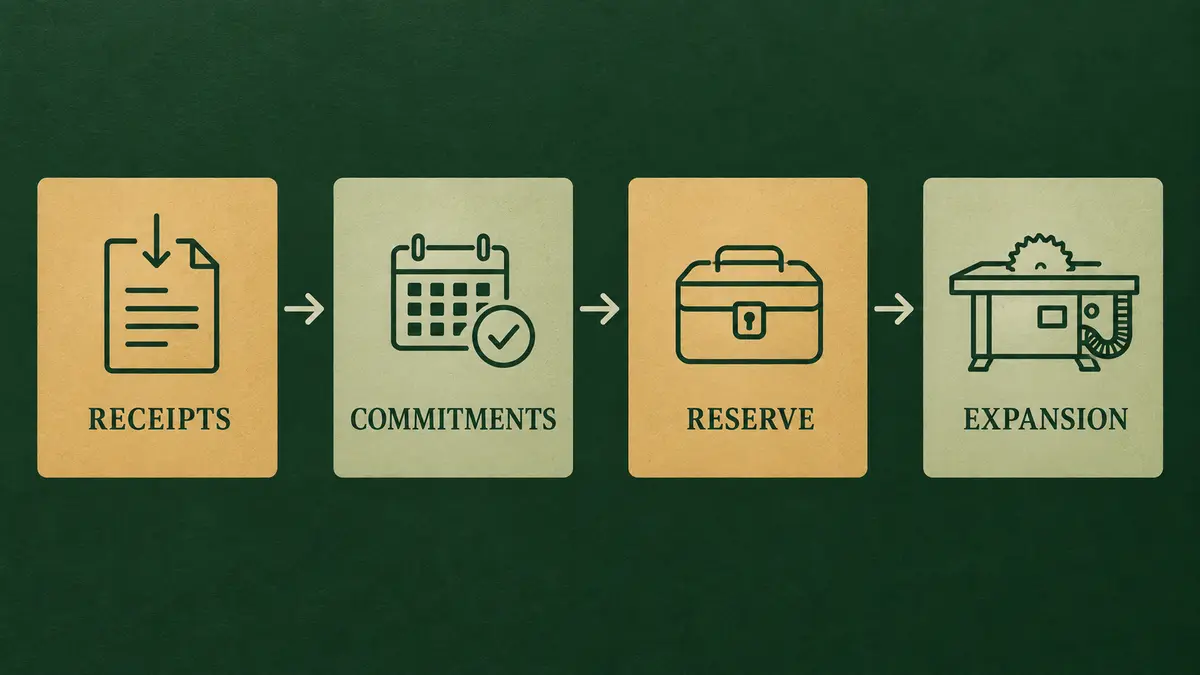
Consider an invented processor using millions of currency units, without reference to a real company. It begins a planning period with 12 in available cash and expects 8 from customer receipts. Existing commitments require 9, planned maintenance requires 2, and management wishes to retain a minimum operating buffer of 3. Subtracting those uses from the combined 20 leaves 6 for a potential expansion. This arithmetic describes a scenario, not a recommended buffer or an estimate of typical industry costs.
Now suppose that 3 of the expected customer receipts arrive in the following period instead. Resources available during the current period fall from 20 to 17. The existing commitments, maintenance and buffer still total 14, leaving only 3 for expansion. The customer has not necessarily defaulted, and the underlying order may remain profitable. Nevertheless, the amount available for an immediate project payment has halved. A plan requiring a deposit of 5 no longer fits the assumed cash calendar.
This example also shows why the buffer cannot be counted twice. If management pays the 5 deposit and then describes the remaining 1 as enough because another 3 is supposedly reserved, it has treated an allocation as additional money. In the delayed-receipt scenario, paying 9, 2 and 5 from 17 leaves 1 in total. There is no separate reserve unless it is actually held outside those resources. The purpose of the calculation is to make the competing uses visible before a commitment is signed.
The immediate shortfall against the proposed deposit is therefore 2, not the entire delayed receipt of 3: the remaining expansion allowance is 3 against a payment of 5. If that receipt arrives before the deposit falls due, with every other assumption unchanged, the allowance returns to 6. Timing changes feasibility within this example without changing the machine's price.
Maintenance and expansion require different arguments
A maintenance payment can preserve an existing capability, while expansion seeks an additional one. Treating both as interchangeable investment spending can distort the decision. Deferring maintenance may temporarily improve the apparent project budget but increase exposure to interruption. Equally, describing every proposed improvement as indispensable maintenance can hide discretionary expansion. The business needs a practical explanation of what each item preserves or adds, rather than relying on the label attached to the purchase request.
A useful discussion asks what happens without the expenditure. Does an existing commitment become harder to fulfil? Does the business lose an optional growth opportunity? Is there a temporary workaround, and does it create another cost or constraint? These questions do not produce an automatic ranking. They establish the consequences that must be compared. A smaller expansion with a credible operating plan can differ materially from a larger one made affordable only by postponing necessary work elsewhere.
Customer commitments can change the sequence
A request for additional output is not the same as a confirmed, payable order. Before allocating internal funds, the processor needs to understand what the customer has actually committed to: specification, quantity, acceptance conditions and payment timing. The analysis here does not prescribe contract terms. It highlights why a sales forecast and a cash forecast may diverge. A promising conversation can justify further investigation without yet providing the basis for an irreversible equipment payment.
Customer concentration adds another dimension. Several orders may depend on the same buyer, distributor or construction programme. Counting them as independent sources of cash can make the expansion look more diversified than it is. The relevant question is whether their timing could change together. That assessment should come from the company's commercial evidence. It cannot be inferred from the number of invoices alone, and it should not be replaced by a general assumption that a growing market guarantees timely receipts.
A staged project must have useful stopping points
Dividing an investment into stages can preserve flexibility, but only if each stage has a practical role. Purchasing half of an inseparable system may tie up money without producing any benefit. A genuinely separable improvement might support existing production before the next phase begins. The difference is technical and commercial, not merely financial. A smaller initial payment is not inherently safer if it commits the business to unavoidable later spending that the cash plan leaves out.
For every stage, the proposal can identify what becomes operational, what remains dependent on another purchase and what happens if the next phase is postponed. It can also distinguish money already spent from money still avoidable. That prevents past expenditure from becoming the sole reason to continue. The decision should concern the remaining cost and achievable benefit, while acknowledging the consequences of stopping. This is a way to organise the discussion, not a claim that staged investment suits every production line.
Compare alternatives using the same boundary
Keeping an existing process, purchasing equipment and using an outside processing service may have different payment patterns. A comparison is useful only if it includes the same task and quality requirement. One option may quote a machine price, another a charge per accepted unit, and another only the immediate repair bill. Placing those numbers side by side without their surrounding obligations creates a false ranking. The scope, time horizon and remaining uncertainties need to be stated before totals become meaningful.
There is no need to invent a universal winner. Internal records can reveal where flexibility is worth paying for and where a recurring external charge becomes significant. They can also show whether a proposed change creates extra handling or transport. The point is to compare complete operating choices rather than attractive headline prices. In a self-financed business, an option's payment timing can matter alongside its eventual total cost, particularly when several commitments cluster in the same period.
Keep the survey in its proper role
An approved budget should also be distinguished from an actual payment. Permission to spend an amount sets a decision limit, but the cash may remain in the account until the contractual date. Conversely, a deposit has already reduced available resources even if the equipment has not arrived. Showing the authorised amount, signed commitment and completed payment separately reveals both the remaining project budget and the remaining freedom to change it. This distinction is especially useful when several small purchases are discussed: each may appear affordable alone, while together they consume money needed for another decision already taken.
A short review after each material change can keep the plan usable. If a customer moves a payment, the finance schedule changes; if installation moves, the production schedule changes as well. Recording both effects prevents a delayed project from appearing to save money simply because its costs have shifted into another month. The revised plan should show which commitments have already become binding and which decisions are still open.
Responsibility matters as much as frequency. Sales can explain the confidence attached to receipts, operations can identify necessary work, and the project lead can confirm payment milestones. Combining those views gives management one reconciled schedule rather than several optimistic versions of the same cash. The resulting document need not promise certainty. Its value is that assumptions can be located, challenged and updated without losing track of the obligations already accepted.
The late-2024 survey supplies a reason to examine internal financing, not a complete model of a typical mill. A sample of about thirty businesses cannot be treated as a detailed census, and a reported preference does not reveal each respondent's cash position. Nor does it show that every planned expansion went ahead. The most defensible use of the finding is as a historical prompt for a specific question: what must a business protect when growth is funded from the same resources that sustain daily production?
The answer lies in making commitments and dates visible. Material should have an identifiable purpose, expected receipts should retain their uncertainty, and project payments should include supporting work rather than the equipment alone. Maintenance, operating reserves and expansion should not compete invisibly inside one undifferentiated balance. A firm may still choose an ambitious project. The discipline is to make that choice with a coherent account of when money becomes available and what must remain funded while the new capability is being built.