
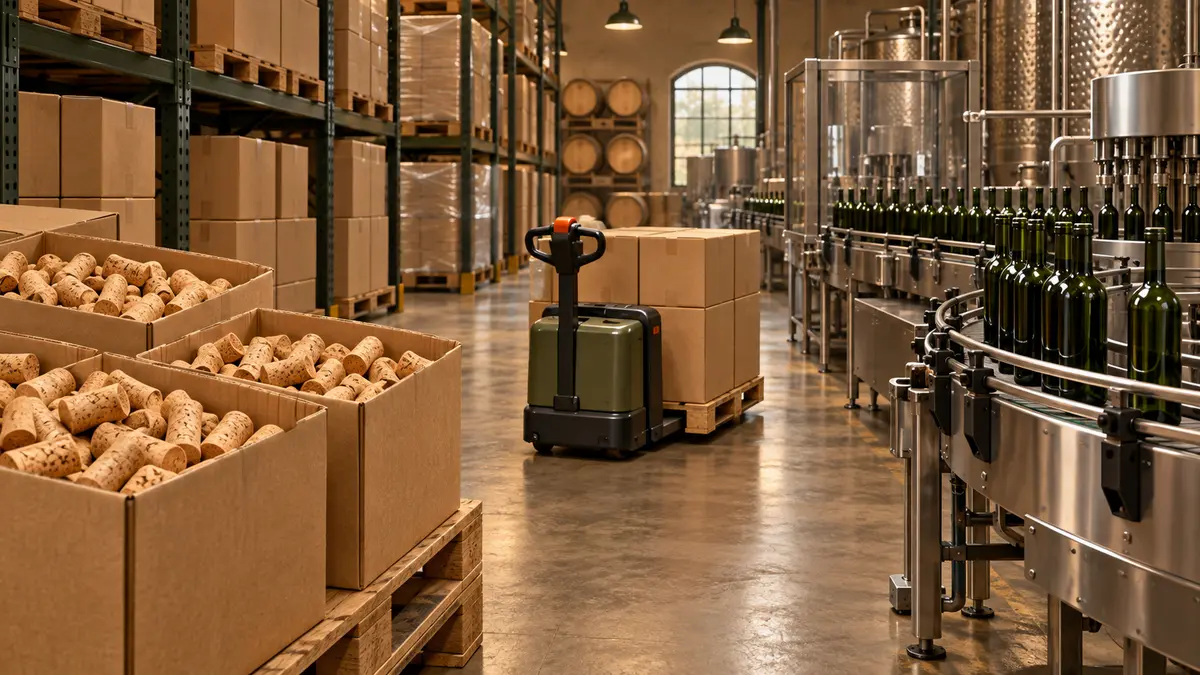
Corticeira Amorim, based in Portugal, reported weaker first-quarter results in May 2024. Reuters reported on 9 May that group sales fell 9.7% to about €235 million, while net profit declined roughly 32% to €16 million. The company attributed pressure on cork-stopper volumes mainly to customers reducing inventories. These are historical quarterly figures, not a description of current trading.

Orders and consumption follow different clocks
The inventory explanation matters because a supplier's deliveries and a consumer's purchases are not the same transaction. A winery can use closures already held in storage while ordering fewer replacements. Its supplier then records weaker shipments even if the customer's bottling activity has not fallen by the same proportion. That is a general explanation of the mechanism, not a measurement of what happened at each Amorim customer.
Three quantities to keep separate
- Deliveries from the closure producer to its customers.
- Closures taken from customer inventories for bottling.
- Finished bottles sold further along the distribution chain.
Those quantities can diverge during a stock adjustment. A lower order book alone cannot establish how much wine people drank, how many bottles remained in shops or how long a customer's stocks would last. Answering those questions requires information from different stages of the chain. Treating a supplier's revenue decline as an identical decline in final consumption would skip those distinctions.
One explanation is not a complete profit bridge
Revenue and net profit also measure different things. Revenue reflects sales, whereas the final profit figure includes expenses and other financial effects. The two percentage changes therefore should not be subtracted to produce an estimate of the cost of destocking. Such a calculation would mix different bases and would not isolate a cause.
For a reader of this quarterly announcement, the useful question is narrower: what evidence would show that the inventory adjustment was ending? Customer replenishment orders, stock levels and bottling schedules would address that question more directly than a single group profit number. This is an editorial reading framework, not a prediction that orders would recover in a particular month.
The report records a difficult opening quarter for the company. It does not, on its own, establish a permanent switch away from cork or the disappearance of demand for wine closures. Those are longer-term claims that would need evidence beyond one reporting period.